QUESTION IMAGE
Question
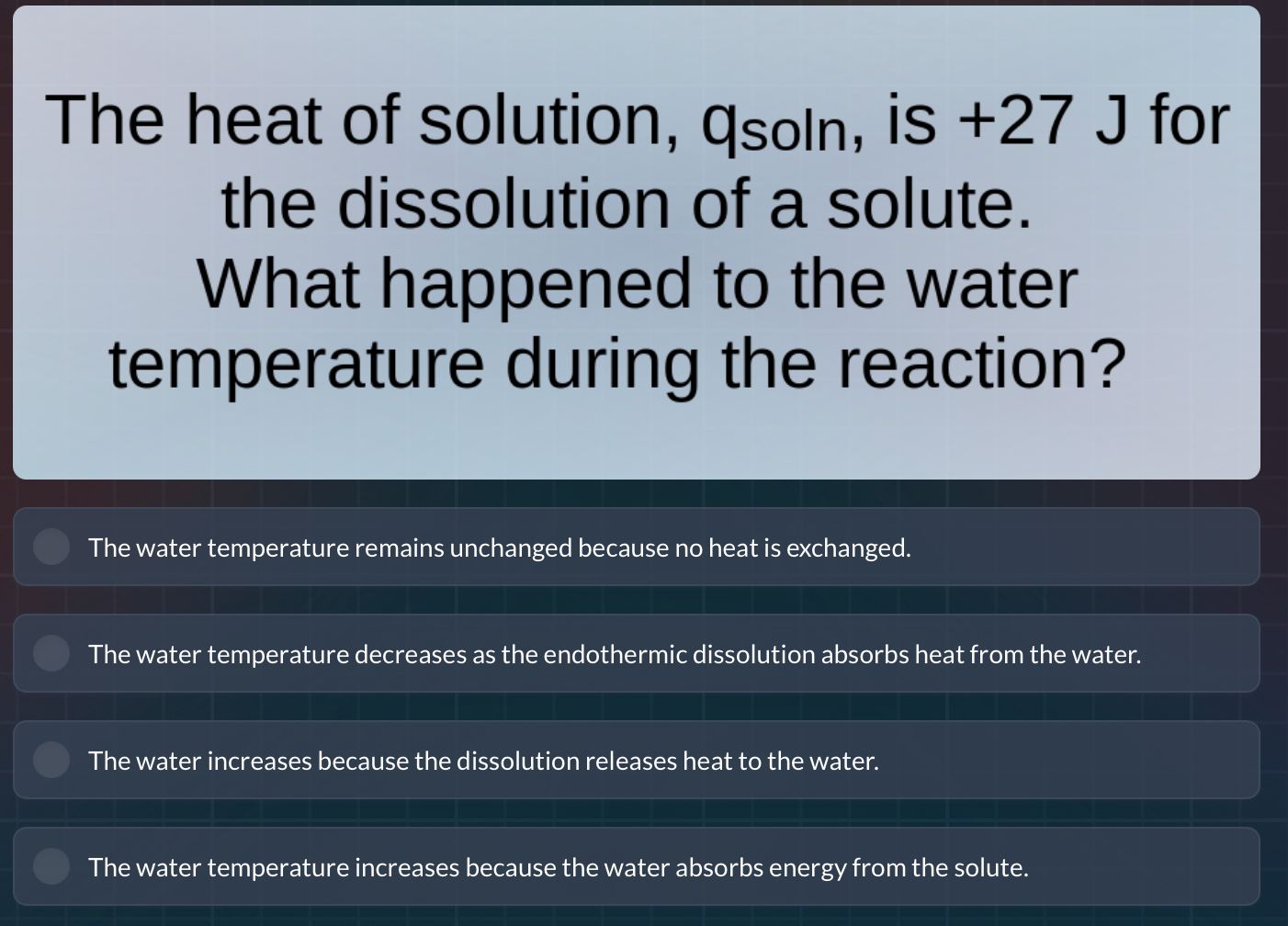
the heat of solution, $q_{soln}$, is +27 j for the dissolution of a solute. what happened to the water temperature during the reaction? the water temperature remains unchanged because no heat is exchanged. the water temperature decreases as the endothermic dissolution absorbs heat from the water. the water increases because the dissolution releases heat to the water. the water temperature increases because the water absorbs energy from the solute.
The heat of solution (\(q_{\text{soln}}\)) is positive (\(+27\) J), indicating an endothermic process (the dissolution absorbs heat). In an endothermic dissolution, the system (solute dissolving) absorbs heat from the surroundings (water). When water loses heat, its temperature decreases.
- The first option is wrong because heat is exchanged (positive \(q_{\text{soln}}\) shows heat absorption by the solution).
- The third option is wrong as a positive \(q_{\text{soln}}\) is endothermic, not exothermic (which would release heat).
- The fourth option is wrong because the solute absorbs heat from water, not the other way around.

Snap & solve any problem in the app
Get step-by-step solutions on Sovi AI
Photo-based solutions with guided steps
Explore more problems and detailed explanations
The water temperature decreases as the endothermic dissolution absorbs heat from the water.