QUESTION IMAGE
Question
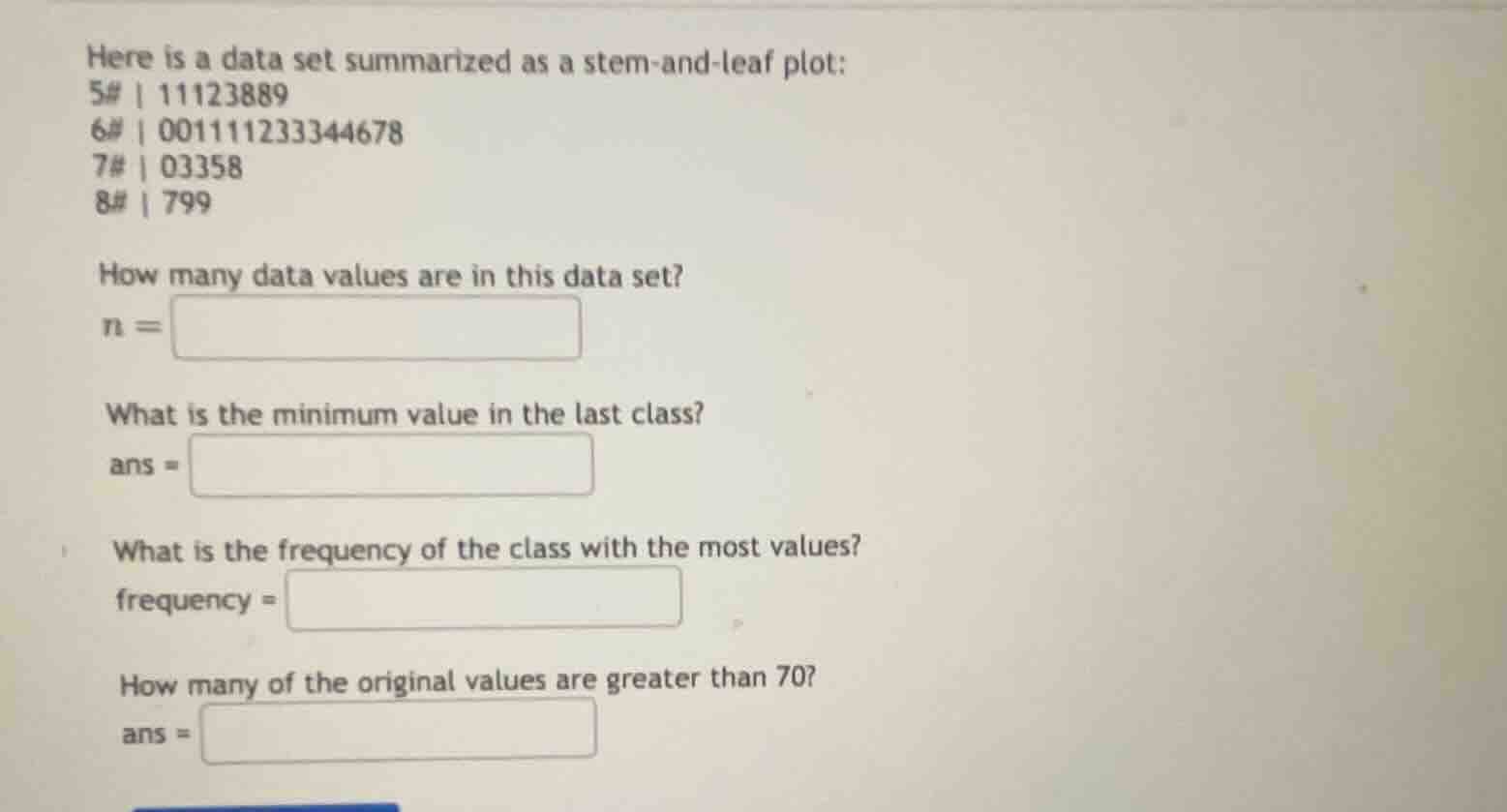
here is a data set summarized as a stem-and-leaf plot:
5# | 11123889
6# | 001111233344678
7# | 03358
8# | 799
how many data values are in this data set?
n =
what is the minimum value in the last class?
ans =
what is the frequency of the class with the most values?
frequency =
how many of the original values are greater than 70?
ans =
Sub - Question 1: How many data values are in this data set?
Step 1: Count values in 5# row
The stem 5# has leaves 1,1,1,2,3,8,8,9. So the number of values is 8.
Step 2: Count values in 6# row
The stem 6# has leaves 0,0,1,1,1,1,2,3,3,3,4,4,6,7,8. The number of values is 15.
Step 3: Count values in 7# row
The stem 7# has leaves 0,3,3,5,8. The number of values is 5.
Step 4: Count values in 8# row
The stem 8# has leaves 7,9,9. The number of values is 3.
Step 5: Sum the counts
To find the total number of data values \( n \), we sum the number of values in each row: \( n=8 + 15+5 + 3\)
\(n = 31\)
Sub - Question 2: What is the minimum value in the last class?
The last class (stem) is 8#. The leaves for 8# are 7,9,9. The values in this class are formed by the stem (8) and the leaves. So the values are 87, 89, 89. The minimum value among them is 87.
Sub - Question 3: What is the frequency of the class with the most values?
We already calculated the number of values in each class: 5# has 8, 6# has 15, 7# has 5, 8# has 3. The class with the most values is 6# with 15 values. So the frequency is 15.
Sub - Question 4: How many of the original values are greater than 70?

Snap & solve any problem in the app
Get step-by-step solutions on Sovi AI
Photo-based solutions with guided steps
Explore more problems and detailed explanations
s:
- For "How many data values are in this data set?": \(n = 31\)
- For "What is the minimum value in the last class?": \(87\)
- For "What is the frequency of the class with the most values?": \(15\)
- For "How many of the original values are greater than 70?": \(8\)