QUESTION IMAGE
Question
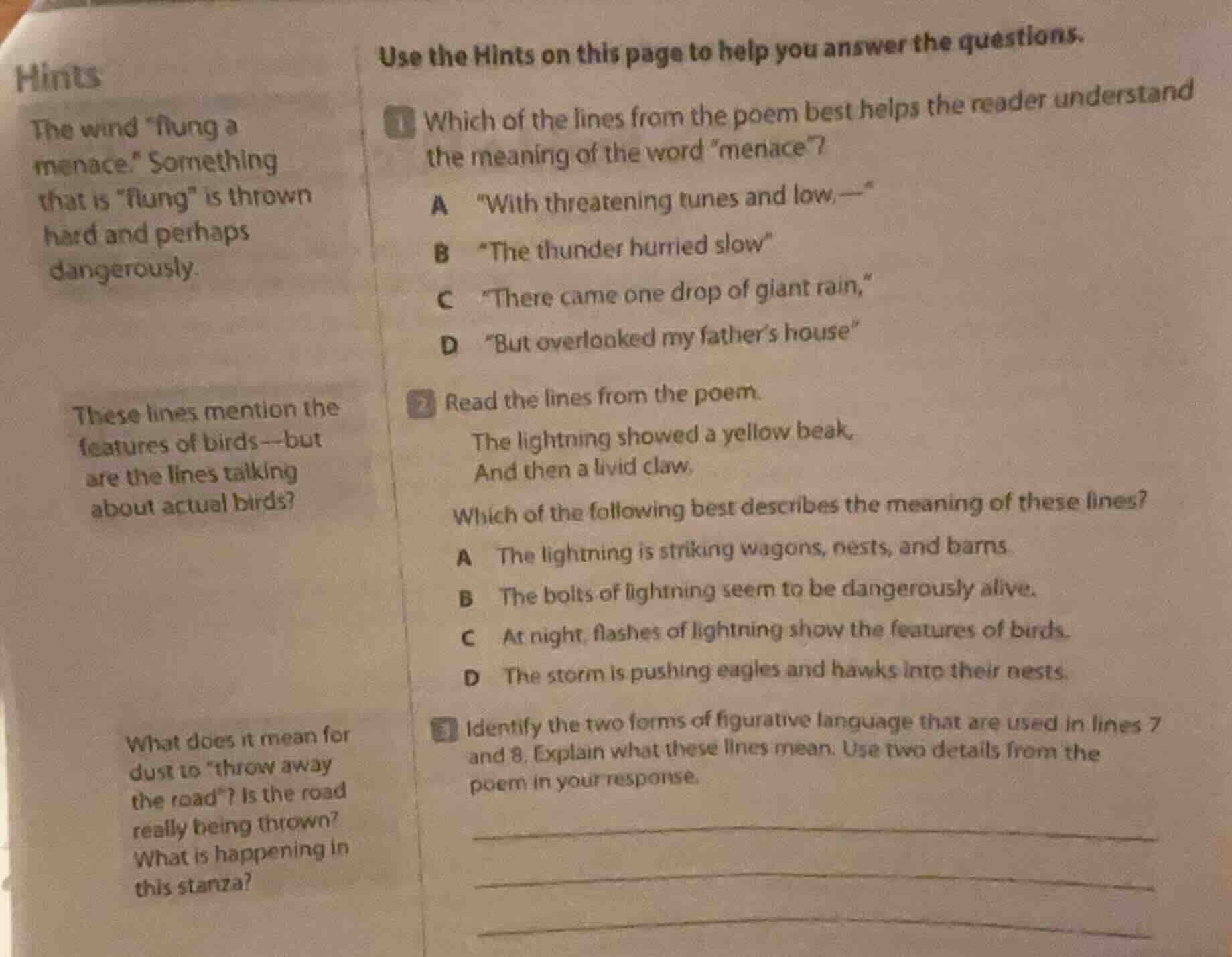
hints
the wind \flung a menace.\ something that is \flung\ is thrown hard and perhaps dangerously.
these lines mention the features of birds—but are the lines talking about actual birds?
what does it mean for dust to \throw away the road\? is the road really being thrown? what is happening in this stanza?
use the hints on this page to help you answer the questions.
1 which of the lines from the poem best helps the reader understand the meaning of the word \menace\?
a \with threatening tunes and low,—\
b \the thunder hurried slow\
c \there came one drop of giant rain,\
d \but overlooked my father’s house\
2 read the lines from the poem.
the lightning showed a yellow beak,
and then a livid claw.
which of the following best describes the meaning of these lines?
a the lightning is striking wagons, nests, and barns.
b the bolts of lightning seem to be dangerously alive.
c at night, flashes of lightning show the features of birds.
d the storm is pushing eagles and hawks into their nests.
3 identify the two forms of figurative language that are used in lines 7 and 8. explain what these lines mean. use two details from the poem in your response.
_____________________________________
_____________________________________
_____________________________________
Question 1
To understand "menace", we look for a line with a threatening connotation. The hint says "flung" implies danger. Option A has "threatening tunes", which relates to menace (a threat). Option B is about thunder's speed, C about a rain drop, D about overlooking a house—none relate to threat like A.
The lines compare lightning to a bird with a beak and claw, personifying it (making it seem alive). Option A is about striking structures (not in the lines), C says lightning shows actual bird features (it's a metaphor, not literal), D is about storm pushing birds (not in lines). B says lightning seems dangerously alive, matching the personification.
(General, assuming common storm - poem lines):
- Personification: A form where non - human things are given human actions. For example, if a line has dust "throwing away the road", dust (non - human) is given the human action of throwing.
- Metaphor (or Simile): If the dust is compared to a living, threatening thing (like a beast), it’s a metaphor. These devices create a vivid image of the storm’s power, showing how the elements (dust, wind) act aggressively, emphasizing the storm’s menacing nature.
To explain the lines’ meaning: The personification shows the storm’s elements (dust, wind) acting with human - like aggression, and the metaphor (if present) compares them to dangerous creatures, highlighting the storm’s destructive and threatening presence.

Snap & solve any problem in the app
Get step-by-step solutions on Sovi AI
Photo-based solutions with guided steps
Explore more problems and detailed explanations
A. "With threatening tunes and low,—"