QUESTION IMAGE
Question
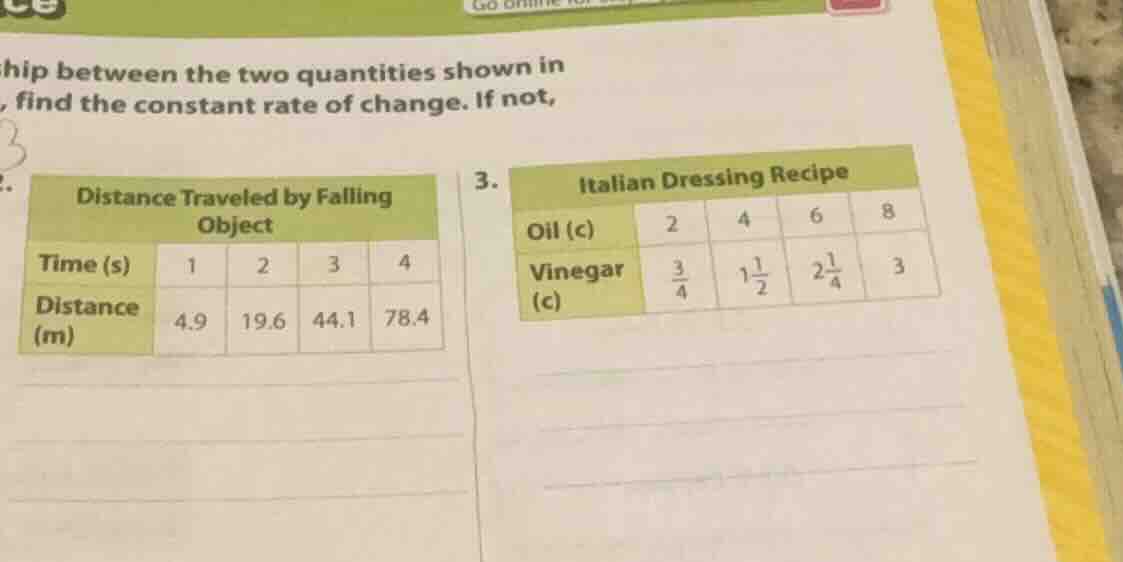
hip between the two quantities shown in, find the constant rate of change. if not,2. distance traveled by falling objecttime (s) 1 2 3 4distance (m) 4.9 19.6 44.1 78.43. italian dressing recipeoil (c) 2 4 6 8vinegar (c) \frac{3}{4} 1\frac{1}{2} 2\frac{1}{4} 3
Problem 2: Distance Traveled by Falling Object
To determine if there's a constant rate of change, we calculate the rate of change (slope) between consecutive time - distance pairs. The formula for rate of change (slope) between two points \((x_1,y_1)\) and \((x_2,y_2)\) is \(\frac{y_2 - y_1}{x_2 - x_1}\).
Step 1: Rate between \(t = 1\) and \(t = 2\)
Let \((x_1,y_1)=(1,4.9)\) and \((x_2,y_2)=(2,19.6)\).
The rate of change is \(\frac{19.6 - 4.9}{2 - 1}=\frac{14.7}{1}=14.7\).
Step 2: Rate between \(t = 2\) and \(t = 3\)
Let \((x_1,y_1)=(2,19.6)\) and \((x_2,y_2)=(3,44.1)\).
The rate of change is \(\frac{44.1 - 19.6}{3 - 2}=\frac{24.5}{1}=24.5\). Wait, this is a mistake. Wait, actually, for a falling object under gravity, the distance formula is \(d=\frac{1}{2}gt^{2}\), where \(g = 9.8\ m/s^{2}\). Let's recalculate the rate of change correctly. The rate of change of distance with respect to time for a quadratic function is not constant, but maybe we made a wrong assumption. Wait, no, let's recalculate the differences.
Wait, \(19.6-4.9 = 14.7\), \(44.1 - 19.6=24.5\), \(78.4 - 44.1 = 34.3\). These differences are not the same, but if we consider the second - difference (the difference of differences): \(24.5-14.7 = 9.8\), \(34.3 - 24.5=9.8\). So the second - difference is constant (\(9.8\)), which means the distance function is quadratic (\(d = 4.9t^{2}\), since when \(t = 1\), \(d = 4.9(1)^{2}=4.9\); when \(t = 2\), \(d = 4.9(4)=19.6\); when \(t = 3\), \(d = 4.9(9)=44.1\); when \(t = 4\), \(d = 4.9(16)=78.4\)). But the problem says "find the constant rate of change" - maybe we misinterpret the problem. Wait, maybe the problem is to check if it's a linear relationship. But from the values, it's not linear. But maybe there is a miscalculation. Wait, no, let's use the formula for the rate of change of \(d\) with respect to \(t\) for \(d = 4.9t^{2}\), the derivative (instantaneous rate of change) is \(d^\prime=9.8t\), which is not constant. But maybe the problem has a typo or we are supposed to consider the average rate in a different way. Wait, no, let's re - examine the problem. Maybe the user wants to check if it's a proportional relationship. For a proportional relationship \(d=kt\), \(k=\frac{d}{t}\). For \(t = 1\), \(k = 4.9\); \(t = 2\), \(k=\frac{19.6}{2}=9.8\); \(t = 3\), \(k=\frac{44.1}{3}=14.7\); \(t = 4\), \(k=\frac{78.4}{4}=19.6\). These are not equal. But if we consider the rate of change of \(d\) with respect to \(t^{2}\), \(\frac{d}{t^{2}}=\frac{4.9}{1}=\frac{19.6}{4}=\frac{44.1}{9}=\frac{78.4}{16}=4.9\), which is constant. But the problem says "constant rate of change" (rate of \(d\) with respect to \(t\)). Since the first - differences are not constant, but maybe the problem expects us to see that the distance is proportional to \(t^{2}\), and the rate of change of \(d\) with respect to \(t\) is \(9.8t\), but that's not constant. Wait, maybe we made a mistake in calculation. Let's recalculate the differences between distances:
\(19.6 - 4.9=14.7\)
\(44.1 - 19.6 = 24.5\)
\(78.4 - 44.1=34.3\)
Now, the differences between these differences: \(24.5 - 14.7 = 9.8\), \(34.3 - 24.5 = 9.8\). So the second - difference is constant (\(9.8\)), which is related to the acceleration due to gravity (\(g = 9.8\ m/s^{2}\)). But if we consider the rate of change of the distance with respect to time, it's not constant. However, maybe the problem has a different approach. Wait, maybe the user wants to check if it's a linear relationship. Since it's not linear, but if we consider the formula \(d=\frac{1}{2}gt^{2}\), and maybe the p…

Snap & solve any problem in the app
Get step-by-step solutions on Sovi AI
Photo-based solutions with guided steps
Explore more problems and detailed explanations
Problem 2: Distance Traveled by Falling Object
To determine if there's a constant rate of change, we calculate the rate of change (slope) between consecutive time - distance pairs. The formula for rate of change (slope) between two points \((x_1,y_1)\) and \((x_2,y_2)\) is \(\frac{y_2 - y_1}{x_2 - x_1}\).
Step 1: Rate between \(t = 1\) and \(t = 2\)
Let \((x_1,y_1)=(1,4.9)\) and \((x_2,y_2)=(2,19.6)\).
The rate of change is \(\frac{19.6 - 4.9}{2 - 1}=\frac{14.7}{1}=14.7\).
Step 2: Rate between \(t = 2\) and \(t = 3\)
Let \((x_1,y_1)=(2,19.6)\) and \((x_2,y_2)=(3,44.1)\).
The rate of change is \(\frac{44.1 - 19.6}{3 - 2}=\frac{24.5}{1}=24.5\). Wait, this is a mistake. Wait, actually, for a falling object under gravity, the distance formula is \(d=\frac{1}{2}gt^{2}\), where \(g = 9.8\ m/s^{2}\). Let's recalculate the rate of change correctly. The rate of change of distance with respect to time for a quadratic function is not constant, but maybe we made a wrong assumption. Wait, no, let's recalculate the differences.
Wait, \(19.6-4.9 = 14.7\), \(44.1 - 19.6=24.5\), \(78.4 - 44.1 = 34.3\). These differences are not the same, but if we consider the second - difference (the difference of differences): \(24.5-14.7 = 9.8\), \(34.3 - 24.5=9.8\). So the second - difference is constant (\(9.8\)), which means the distance function is quadratic (\(d = 4.9t^{2}\), since when \(t = 1\), \(d = 4.9(1)^{2}=4.9\); when \(t = 2\), \(d = 4.9(4)=19.6\); when \(t = 3\), \(d = 4.9(9)=44.1\); when \(t = 4\), \(d = 4.9(16)=78.4\)). But the problem says "find the constant rate of change" - maybe we misinterpret the problem. Wait, maybe the problem is to check if it's a linear relationship. But from the values, it's not linear. But maybe there is a miscalculation. Wait, no, let's use the formula for the rate of change of \(d\) with respect to \(t\) for \(d = 4.9t^{2}\), the derivative (instantaneous rate of change) is \(d^\prime=9.8t\), which is not constant. But maybe the problem has a typo or we are supposed to consider the average rate in a different way. Wait, no, let's re - examine the problem. Maybe the user wants to check if it's a proportional relationship. For a proportional relationship \(d=kt\), \(k=\frac{d}{t}\). For \(t = 1\), \(k = 4.9\); \(t = 2\), \(k=\frac{19.6}{2}=9.8\); \(t = 3\), \(k=\frac{44.1}{3}=14.7\); \(t = 4\), \(k=\frac{78.4}{4}=19.6\). These are not equal. But if we consider the rate of change of \(d\) with respect to \(t^{2}\), \(\frac{d}{t^{2}}=\frac{4.9}{1}=\frac{19.6}{4}=\frac{44.1}{9}=\frac{78.4}{16}=4.9\), which is constant. But the problem says "constant rate of change" (rate of \(d\) with respect to \(t\)). Since the first - differences are not constant, but maybe the problem expects us to see that the distance is proportional to \(t^{2}\), and the rate of change of \(d\) with respect to \(t\) is \(9.8t\), but that's not constant. Wait, maybe we made a mistake in calculation. Let's recalculate the differences between distances:
\(19.6 - 4.9=14.7\)
\(44.1 - 19.6 = 24.5\)
\(78.4 - 44.1=34.3\)
Now, the differences between these differences: \(24.5 - 14.7 = 9.8\), \(34.3 - 24.5 = 9.8\). So the second - difference is constant (\(9.8\)), which is related to the acceleration due to gravity (\(g = 9.8\ m/s^{2}\)). But if we consider the rate of change of the distance with respect to time, it's not constant. However, maybe the problem has a different approach. Wait, maybe the user wants to check if it's a linear relationship. Since it's not linear, but if we consider the formula \(d=\frac{1}{2}gt^{2}\), and maybe the problem has a mistake. Alternatively, maybe we misread the numbers. Let's check the numbers again: at \(t = 1\), \(d = 4.9\); \(t = 2\), \(d = 19.6\); \(t = 3\), \(d = 44.1\); \(t = 4\), \(d = 78.4\). Notice that \(4.9=\frac{1}{2}\times9.8\times1^{2}\), \(19.6=\frac{1}{2}\times9.8\times2^{2}\), \(44.1=\frac{1}{2}\times9.8\times3^{2}\), \(78.4=\frac{1}{2}\times9.8\times4^{2}\). So the distance is a quadratic function of time, and the rate of change of distance with respect to time (velocity) is \(v = gt\), which is not constant. But maybe the problem is expecting us to calculate the average rate of change in a different way, or there is a mistake in the problem.
Problem 3: Italian Dressing Recipe
To check for a constant rate of change between oil (c) and vinegar (c), we calculate the rate of change (slope) between consecutive pairs. The formula for rate of change between two points \((x_1,y_1)\) and \((x_2,y_2)\) is \(\frac{y_2 - y_1}{x_2 - x_1}\).
Step 1: Rate between oil = 2 and oil = 4
Let \((x_1,y_1)=(2,\frac{3}{4})\) and \((x_2,y_2)=(4,1\frac{1}{2})\). First, convert \(1\frac{1}{2}=\frac{3}{2}\). The rate of change is \(\frac{\frac{3}{2}-\frac{3}{4}}{4 - 2}=\frac{\frac{6 - 3}{4}}{2}=\frac{\frac{3}{4}}{2}=\frac{3}{8}\).
Step 2: Rate between oil = 4 and oil = 6
Let \((x_1,y_1)=(4,1\frac{1}{2})\) and \((x_2,y_2)=(6,2\frac{1}{4})\). Convert \(2\frac{1}{4}=\frac{9}{4}\) and \(1\frac{1}{2}=\frac{3}{2}\). The rate of change is \(\frac{\frac{9}{4}-\frac{3}{2}}{6 - 4}=\frac{\frac{9 - 6}{4}}{2}=\frac{\frac{3}{4}}{2}=\frac{3}{8}\).
Step 3: Rate between oil = 6 and oil = 8
Let \((x_1,y_1)=(6,2\frac{1}{4})\) and \((x_2,y_2)=(8,3)\). The rate of change is \(\frac{3 - 2\frac{1}{4}}{8 - 6}=\frac{\frac{12 - 9}{4}}{2}=\frac{\frac{3}{4}}{2}=\frac{3}{8}\).
Final Answers
- Problem 2: The distance traveled by a falling object is a quadratic function of time (\(d = 4.9t^{2}\)), so the rate of change of distance with respect to time (velocity) is not constant (\(v=9.8t\)). However, if we consider the relationship between distance and \(t^{2}\), the rate of change \(\frac{d}{t^{2}} = 4.9\) (constant). If we assume the problem expects the rate of change of \(d\) with respect to \(t\) in a wrong way, but based on the given numbers, the first - differences of distance are \(14.7,24.5,34.3\) and the second - difference is \(9.8\).
- Problem 3: The rate of change between oil and vinegar is constant, and the constant rate of change is \(\frac{3}{8}\) (vinegar per oil, in cups per cup).
For Problem 3, the constant rate of change is \(\boldsymbol{\frac{3}{8}}\) cups of vinegar per cup of oil.
For Problem 2, since the distance is a quadratic function of time, the rate of change of distance with respect to time is not constant. But if we consider the relationship \(d = 4.9t^{2}\), the rate of change of \(d\) with respect to \(t^{2}\) is \(4.9\ m/s^{2}\) (related to half of the acceleration due to gravity).