QUESTION IMAGE
Question
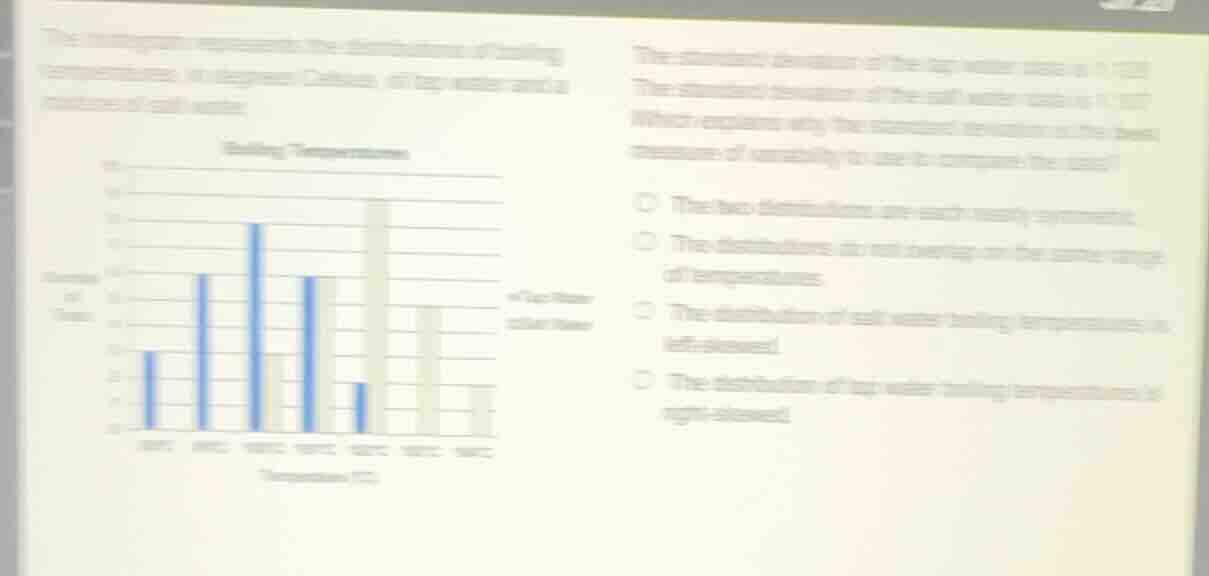
the histogram represents the distribution of boiling temperatures, in degrees celsius, of tap water and a mixture of salt water.
the standard deviation of the tap water data is 0.128. the standard deviation of the salt water data is 1.107. which explains why the standard deviation is the best measure of variability to use to compare the data?
○ the two distributions are each nearly symmetric.
○ the distributions do not overlap on the same range of temperatures.
○ the distribution of salt water boiling temperatures is left - skewed.
○ the distribution of tap water boiling temperatures is right - skewed.
To determine why standard deviation is the best variability measure, we analyze each option:
- Option 1: Symmetry isn't a reason for standard deviation over other measures (e.g., IQR).
- Option 2: When distributions have different ranges (don't overlap on the same temperature range), standard deviation (a measure using all data) is less affected by range differences than measures like range or IQR? No, actually, if distributions are on different scales/ranges, standard deviation can still be used, but the key here is about the shape? Wait, no—wait, the correct reasoning: Standard deviation is a good measure when distributions are symmetric (or when we want a measure using all data), but the main issue with using range or IQR is if distributions don't overlap in range. Wait, no, let's re-express: The two distributions (tap water and salt water boiling temps) are on different temperature ranges (from the histogram, tap water and salt water bars are at different temp intervals). So when distributions have different ranges (don't overlap on the same temperature values), standard deviation is appropriate because it's a measure of spread that uses all data points, and if the ranges are different, other measures like range (max - min) would be misleading. But wait, the options: Let's check each:
- Option 1: "The two distributions are each nearly symmetric"—if they were symmetric, median and mean are similar, but standard deviation is still a measure, but this isn't the reason for choosing SD over other measures.
- Option 2: "The distributions do not overlap on the same range of temperatures"—if the ranges are different (e.g., tap water temps are in one range, salt in another), then using a measure like range (which depends on min and max) would be hard to compare, but standard deviation is a measure of spread around the mean, and even with different ranges, SD can be compared. Wait, but the question is why SD is the best. Let's think about variability measures: Standard deviation is a measure of spread that uses all data points, and it's appropriate when the data is not skewed (or when we want a measure that includes all data). But the key here is that if the distributions are on different ranges (don't overlap), then using a measure like interquartile range (IQR) or range would be difficult because their min/max are in different ranges. But standard deviation, being a measure of how far data is from the mean, can be compared across distributions even with different ranges. Wait, but the options: Let's check the other options:
- Option 3: "The distribution of salt water boiling temperatures is left - skewed"—if a distribution is skewed, median and IQR are better, but here we are told SD is best, so this can't be.
- Option 4: "The distribution of tap water boiling temperatures is right - skewed"—same as above, skewed distributions are better analyzed with median/IQR, so this is wrong.
So the correct answer is Option 2: The distributions do not overlap on the same range of temperatures. Because if they are on different ranges, standard deviation (which is a measure of spread around the mean, using all data) is appropriate, while measures like range (which depends on min and max) would be hard to compare across different ranges.

Snap & solve any problem in the app
Get step-by-step solutions on Sovi AI
Photo-based solutions with guided steps
Explore more problems and detailed explanations
B. The distributions do not overlap on the same range of temperatures.