QUESTION IMAGE
Question
homework
show all work.
write your # in the top right corner of the
paper. (-5 points if missing)
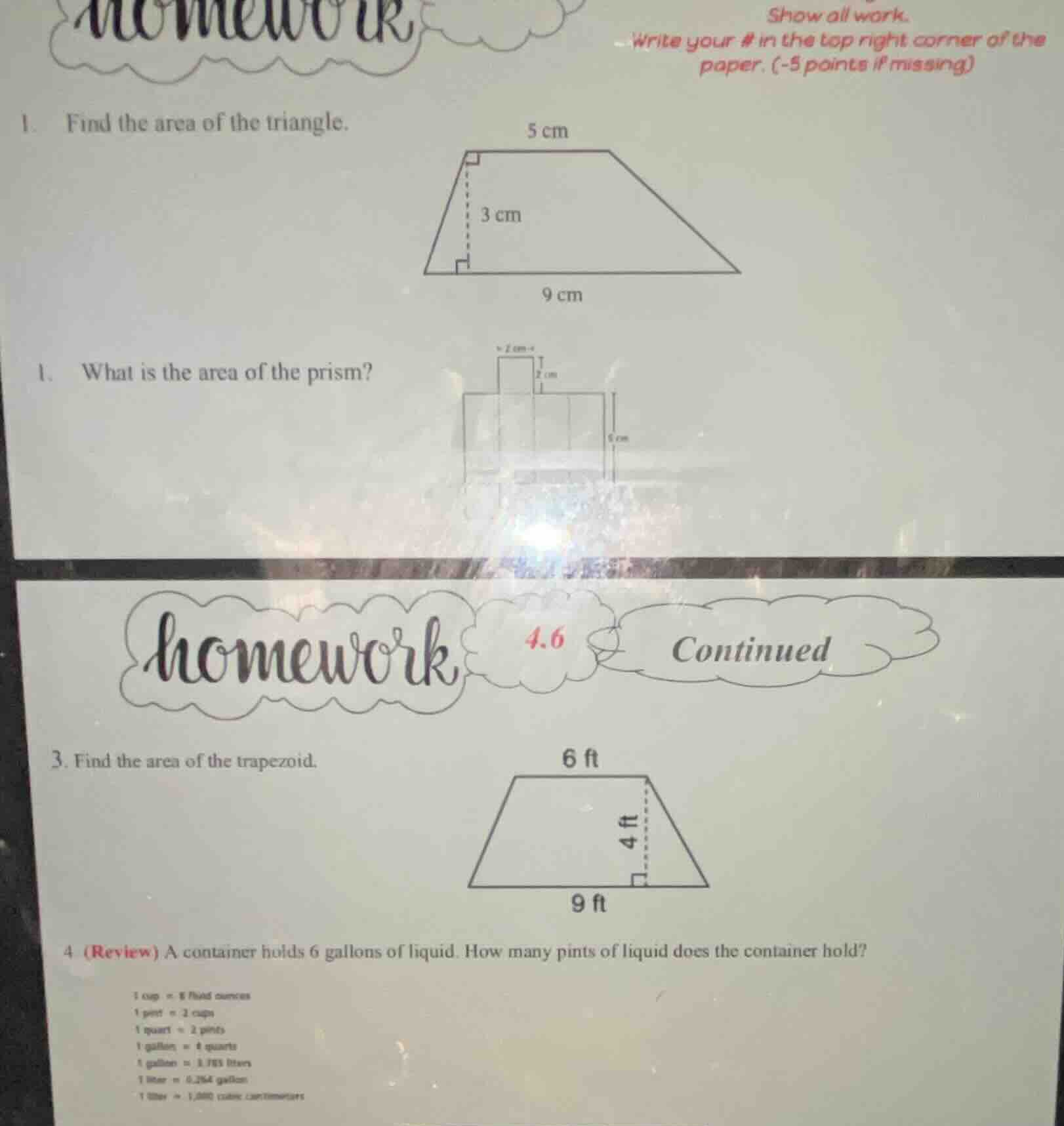
- find the area of the triangle.
(figure: trapezoid with top base 5 cm, height 3 cm, bottom base 9 cm)
- what is the area of the prism?
(figure: composite prism with small square 2 cm x 2 cm and larger rectangle)
homework 4.6 continued
- find the area of the trapezoid.
(figure: trapezoid with top base 6 ft, height 4 ft, bottom base 9 ft)
4 (review) a container holds 6 gallons of liquid. how many pints of liquid does the container hold?
1 cup = 8 fluid ounces
1 pint = 2 cups
1 quart = 2 pints
1 gallon = 4 quarts
1 gallon = 3.785 liters
1 liter = 0.264 gallon
1 liter = 1,000 cubic centimeters
Problem 1: Area of the Trapezoid (Assuming the first figure is a trapezoid, maybe a typo for triangle? But let's solve trapezoid first as per the third problem's label)
Step 1: Recall Trapezoid Area Formula
The formula for the area of a trapezoid is \( A=\frac{(a + b)}{2}\times h \), where \( a \) and \( b \) are the lengths of the two parallel sides (bases), and \( h \) is the height (the perpendicular distance between the bases).
Step 2: Identify Values
From the trapezoid figure (top one, or the third problem? Wait, the third problem is trapezoid with \( a = 6\) ft, \( b = 9\) ft, \( h = 4\) ft. Wait, the first problem's figure: top base \( 5\) cm, bottom base \( 9\) cm, height \( 3\) cm. Let's solve the first problem (maybe it's a trapezoid, maybe the "triangle" is a typo). Let's take the first figure: \( a = 5\) cm, \( b = 9\) cm, \( h = 3\) cm.
Step 3: Substitute into Formula
\( A=\frac{(5 + 9)}{2}\times3=\frac{14}{2}\times3 = 7\times3=21\) square centimeters. Wait, but if it's a triangle, maybe the figure is a triangle? Wait, the first problem says "Find the area of the triangle", but the figure is a trapezoid. Maybe the triangle is part of the trapezoid? Wait, the trapezoid can be split into a rectangle and a triangle. The rectangle is \( 5\times3 \), and the triangle has base \( 9 - 5=4\) cm, height \( 3\) cm. Then area of triangle is \( \frac{1}{2}\times4\times3 = 6\) cm², and rectangle is \( 5\times3 = 15\) cm², total trapezoid area \( 21\) cm². But if the problem is triangle, maybe the figure is mislabeled. Alternatively, let's solve the third problem: trapezoid with \( a = 6\) ft, \( b = 9\) ft, \( h = 4\) ft.
Step 3 (Third Problem): Substitute Values
\( A=\frac{(6 + 9)}{2}\times4=\frac{15}{2}\times4 = 15\times2 = 30\) square feet.
Problem 4: Convert Gallons to Pints
Step 1: Recall Conversion Factors
We know that \( 1\) gallon \( = 4\) quarts, and \( 1\) quart \( = 2\) pints. So first, convert gallons to quarts, then quarts to pints.
Step 2: Convert Gallons to Quarts
For \( 6\) gallons, number of quarts \( = 6\times4 = 24\) quarts.
Step 3: Convert Quarts to Pints
Since \( 1\) quart \( = 2\) pints, number of pints \( = 24\times2 = 48\) pints.
Problem 2: Area of the Prism (Surface Area)
The prism's net: Let's assume the base is a square of \( 2\) cm (top square) and a rectangle of \( 6\) cm height. Wait, the net has a top square (side \( 2\) cm) and a larger rectangle? Wait, the figure is a bit unclear, but assuming it's a composite prism. Let's say the base is a square with side \( 2\) cm, and the height of the prism is, or the net has rectangles. Wait, maybe the net has: two squares of \( 2\times2\) (top and bottom), and four rectangles? No, maybe it's a rectangular prism with a smaller cube on top. Wait, the figure: a small square (2x2) on top of a larger rectangle (let's say length \( L \), width \( W \), height \( H \)). Wait, the given dimensions: 2 cm (side of small square), 6 cm (height of larger part). Maybe the surface area: calculate the surface area of the larger rectangular prism and the smaller cube, then subtract the overlapping area (where they are joined).
Assume the larger prism: length \( 2\) cm (same as small square), width \( 2\) cm, height \( 6\) cm. Surface area of larger prism: \( 2(lw + lh + wh)=2(2\times2 + 2\times6 + 2\times6)=2(4 + 12 + 12)=2(28)=56\) cm². The small cube (2x2x2) has surface area \( 6\times2\times2 = 24\) cm². But where they are joined, we have two faces (2x2) that are internal, so we subtract \( 2\times(2\times2)=8\) cm². So total surface area \( 56 + 24 - 8 = 72\) cm². But this is an assumption. Alternatively, maybe the net is as follows: the larger rectangle is \( 2\times6\) (length 2, height 6) and there are four such rectangles? No, the figure is a bit unclear. Maybe the problem is to find the surface area of a rectangular prism with length \( 2\) cm, width \( 2\) cm, and height \( 6 + 2 = 8\) cm? No, that might not be right.
Problem 4 (Review):
Step 1: Convert Gallons to Quarts
Given \( 1\) gallon \( = 4\) quarts, so \( 6\) gallons \( = 6\times4 = 24\) quarts.
Step 2: Convert Quarts to Pints
Given \( 1\) quart \( = 2\) pints, so \( 24\) quarts \( = 24\times2 = 48\) pints.

Snap & solve any problem in the app
Get step-by-step solutions on Sovi AI
Photo-based solutions with guided steps
Explore more problems and detailed explanations
s:
- (Assuming trapezoid, area) \( 21\) cm² (if it's the first figure) or for the third problem (trapezoid) \( 30\) ft².
- (Prism area, assuming the above calculation) \( 72\) cm² (approximate, depending on figure).
- (Trapezoid area) \( 30\) ft².
- (Gallons to pints) \( 48\) pints.
Wait, let's focus on the fourth problem (Review) as it's clear: