QUESTION IMAGE
Question
hopping
elcome to math challenge #9. this challenge invites you into the world of shopping, where you
ll use coins and dollars to solve real - life math problems. building on what you practiced in math
hallenge 8, you will add prices, calculate the correct amount of change, compare costs, and
ecide which deals are better. these challenges will ask you to organize information, choose
mart strategies, and clearly explain your thinking - just like a careful shopper using math every
y.
kinder & first grade: solve at least 3 problems.
second & third grade: solve at least 7 problems.
fourth grade and above: solve at least 12 problems.
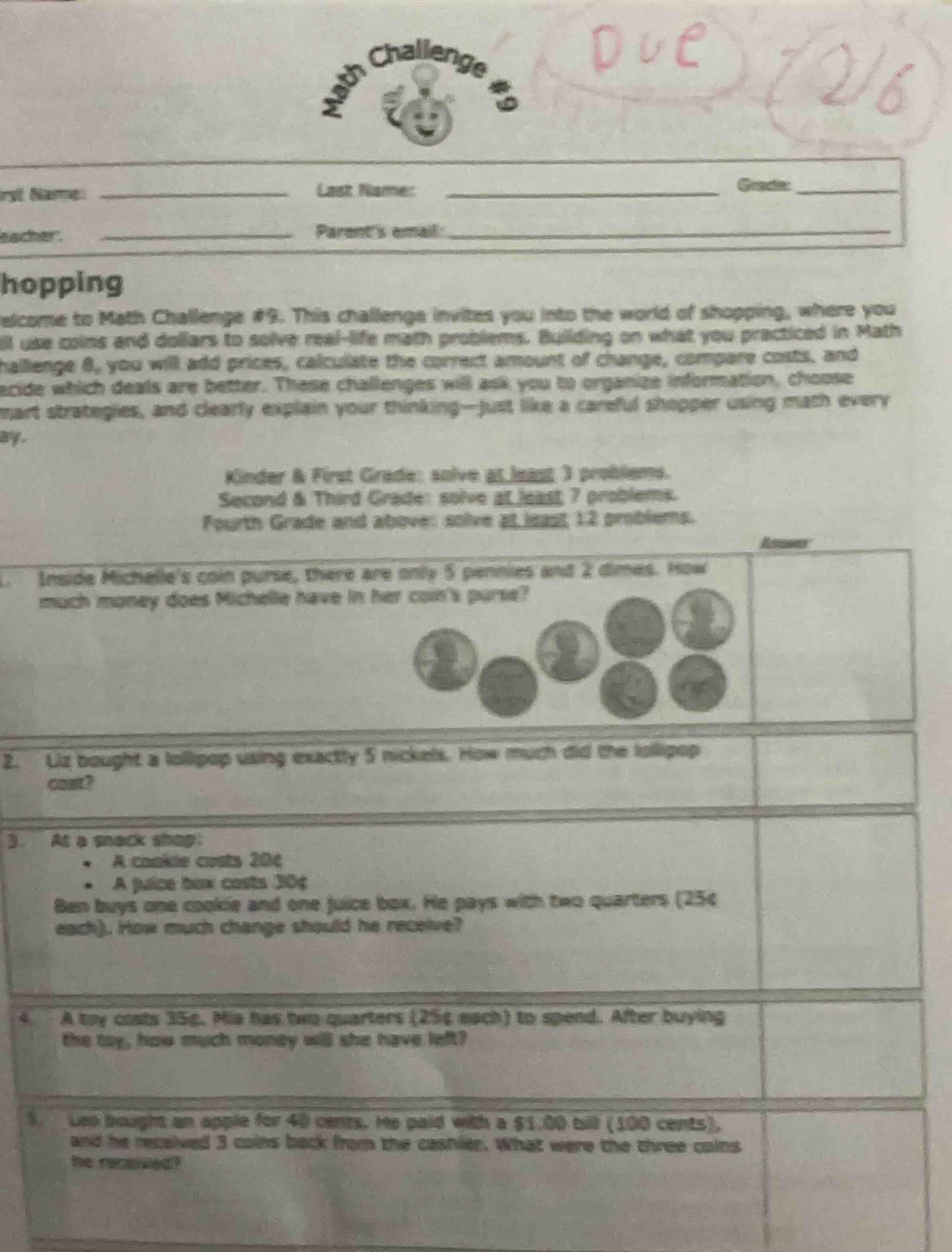
- inside michelles coin purse, there are only 5 pennies and 2 dimes. how
much money does michelle have in her coin purse?
- liz bought a lollipop using exactly 5 nickels. how much did the lollipop
cost?
- at a snack shop:
- a cookie costs 20¢
- a juice box costs 30¢
ben buys one cookie and one juice box. he pays with two quarters (25¢
each). how much change should he receive?
- a toy costs 35¢. mia has two quarters (25¢ each) to spend. after buying
the toy, how much money will she have left?
- leo bought an apple for 49 cents. he paid with a $1.00 bill (100 cents),
and he received 3 coins back from the cashier. what were the three coins
he received?
Problem 1:
Step1: Calculate value of pennies
Each penny is 1 cent, 5 pennies: \(5\times1 = 5\) cents.
Step2: Calculate value of dimes
Each dime is 10 cents, 2 dimes: \(2\times10 = 20\) cents.
Step3: Total money
Add penny and dime values: \(5 + 20 = 25\) cents.
Step1: Value of one nickel
One nickel is 5 cents.
Step2: Total cost for 5 nickels
\(5\times5 = 25\) cents.
Step1: Total cost of items
Cookie (20¢) + Juice box (30¢): \(20 + 30 = 50\) cents.
Step2: Money paid
Two quarters: \(2\times25 = 50\) cents.
Step3: Change
Paid - Cost: \(50 - 50 = 0\) cents? Wait, no—wait, two quarters is 50¢, cost is 50¢? Wait, maybe miscalculation. Wait, cookie 20¢, juice 30¢: total 50¢. Two quarters: 25×2=50¢. So change is 50 - 50 = 0? Wait, maybe the problem is correct. Alternatively, maybe I misread. Wait, the problem says "he pays with two quarters (25¢ each)". So 25×2=50¢. Cost is 20+30=50¢. So change is 0. But maybe I made a mistake. Wait, no—20+30=50, 25×2=50. So change is 0.

Snap & solve any problem in the app
Get step-by-step solutions on Sovi AI
Photo-based solutions with guided steps
Explore more problems and detailed explanations
25 cents