QUESTION IMAGE
Question
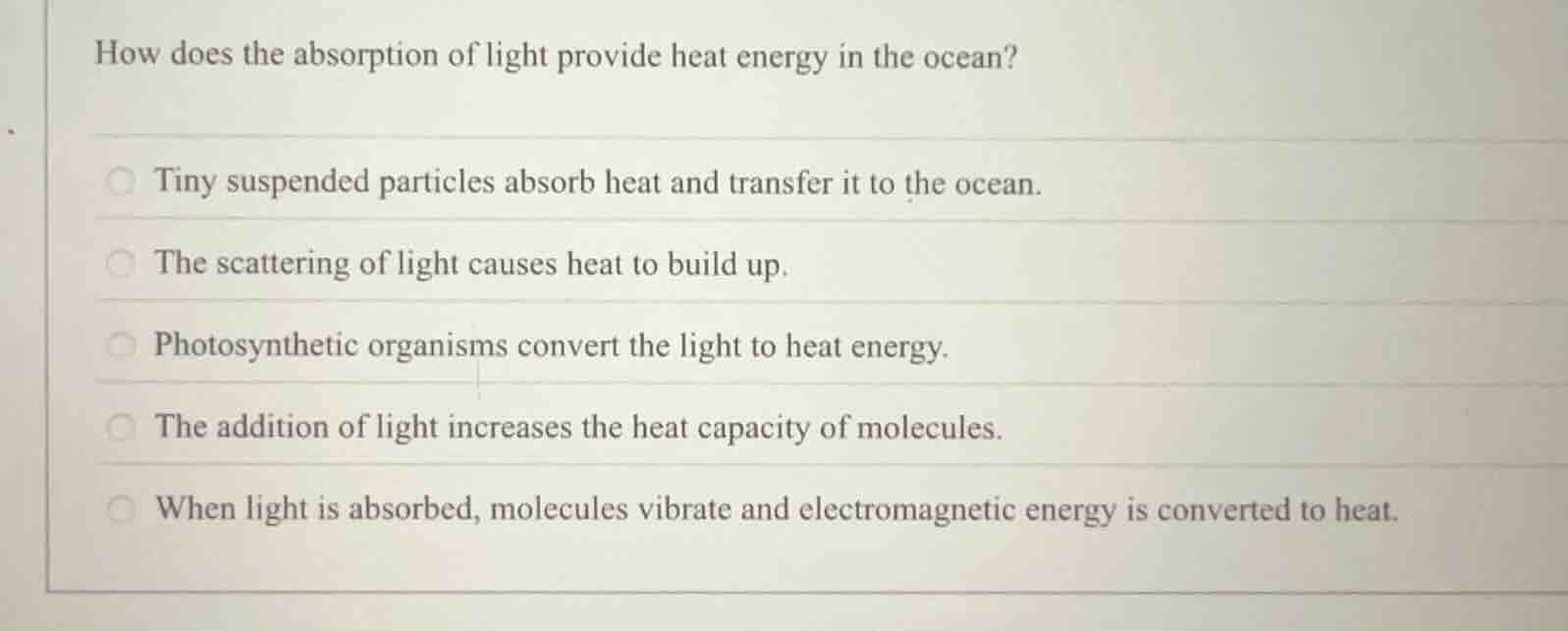
how does the absorption of light provide heat energy in the ocean?
tiny suspended particles absorb heat and transfer it to the ocean.
the scattering of light causes heat to build up.
photosynthetic organisms convert the light to heat energy.
the addition of light increases the heat capacity of molecules.
when light is absorbed, molecules vibrate and electromagnetic energy is converted to heat.
Brief Explanations
- For the option "Tiny suspended particles absorb heat and transfer it to the ocean": Light is electromagnetic energy, and particles absorbing heat (thermal energy) is different from absorbing light to produce heat. So this is incorrect.
- For the option "The scattering of light causes heat to build up": Scattering of light is about the redirection of light waves, not a direct conversion to heat. So this is incorrect.
- For the option "Photosynthetic organisms convert the light to heat energy": Photosynthetic organisms convert light energy to chemical energy (glucose), not heat energy. So this is incorrect.
- For the option "The addition of light increases the heat capacity of molecules": Heat capacity is a property of a substance and is not increased by the addition of light. So this is incorrect.
- For the option "When light is absorbed, molecules vibrate and electromagnetic energy is converted to heat": When light (electromagnetic energy) is absorbed by molecules in the ocean, the molecules gain energy and vibrate. This vibrational energy is then converted into thermal (heat) energy. This is the correct mechanism.

Snap & solve any problem in the app
Get step-by-step solutions on Sovi AI
Photo-based solutions with guided steps
Explore more problems and detailed explanations
When light is absorbed, molecules vibrate and electromagnetic energy is converted to heat.