QUESTION IMAGE
Question
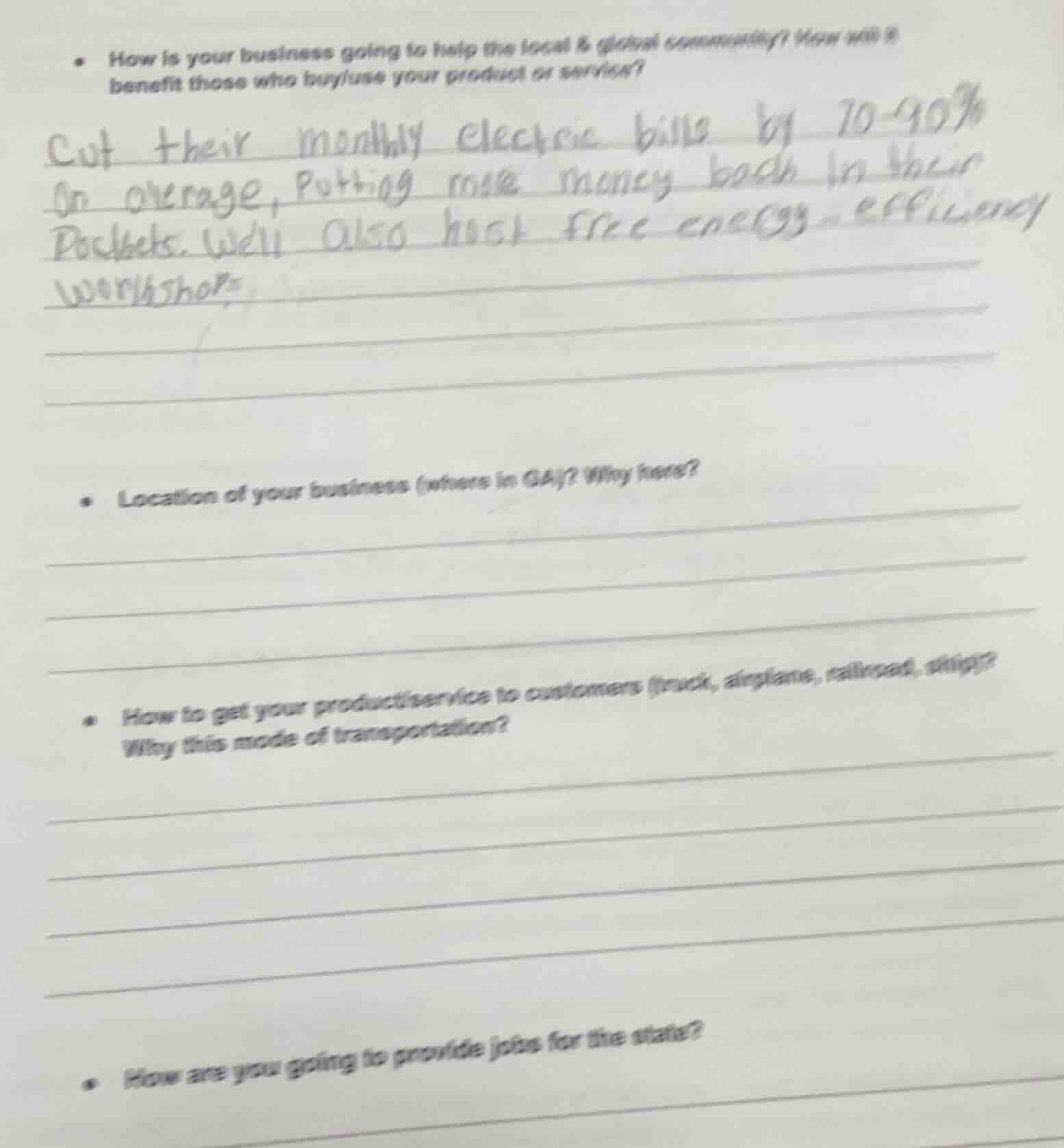
- how is your business going to help the local & global community? how will it benefit those who buy/use your product or service?
cut their monthly electric bills by 70 - 90% on average, putting more money back in their pockets. well also host free energy - efficiency workshops.
- location of your business (where in ga)? why here?
- how to get your product/service to customers (truck, airplanes, railroad, ships)? why this mode of transportation?
- how are you going to provide jobs for the state?
Brief Explanations
- For the location question: Atlanta, GA is chosen because it has a large, dense population, high demand for energy-efficient solutions, strong local business infrastructure, and access to a skilled workforce for an energy-focused business.
- For the transportation question: Local delivery uses light-duty trucks, as they are flexible for navigating urban/suburban areas in GA, cost-effective for small to medium shipments, and can reach customers quickly. For regional/global distribution, partner with freight trucks and small cargo planes; trucks handle bulk regional orders affordably, while planes enable timely global shipping of compact energy components.
- For the job creation question: Hire local staff for installation, customer service, and workshop coordination. Train entry-level workers in energy efficiency skills, and create roles in sales, logistics, and administrative support as the business scales.

Snap & solve any problem in the app
Get step-by-step solutions on Sovi AI
Photo-based solutions with guided steps
Explore more problems and detailed explanations
- Location: Atlanta, GA. Reason: Dense population, high demand for energy efficiency, strong local business infrastructure, and access to skilled labor.
- Transportation: Local: Light-duty trucks (flexible for GA's urban/suburban areas, cost-effective for small shipments). Regional/Global: Freight trucks (affordable bulk regional delivery) + small cargo planes (timely global shipping of compact components).
- Job Creation: Hire local workers for installation, customer service, and workshop roles; train entry-level staff in energy efficiency skills; add sales, logistics, and admin roles as the business expands.