QUESTION IMAGE
Question
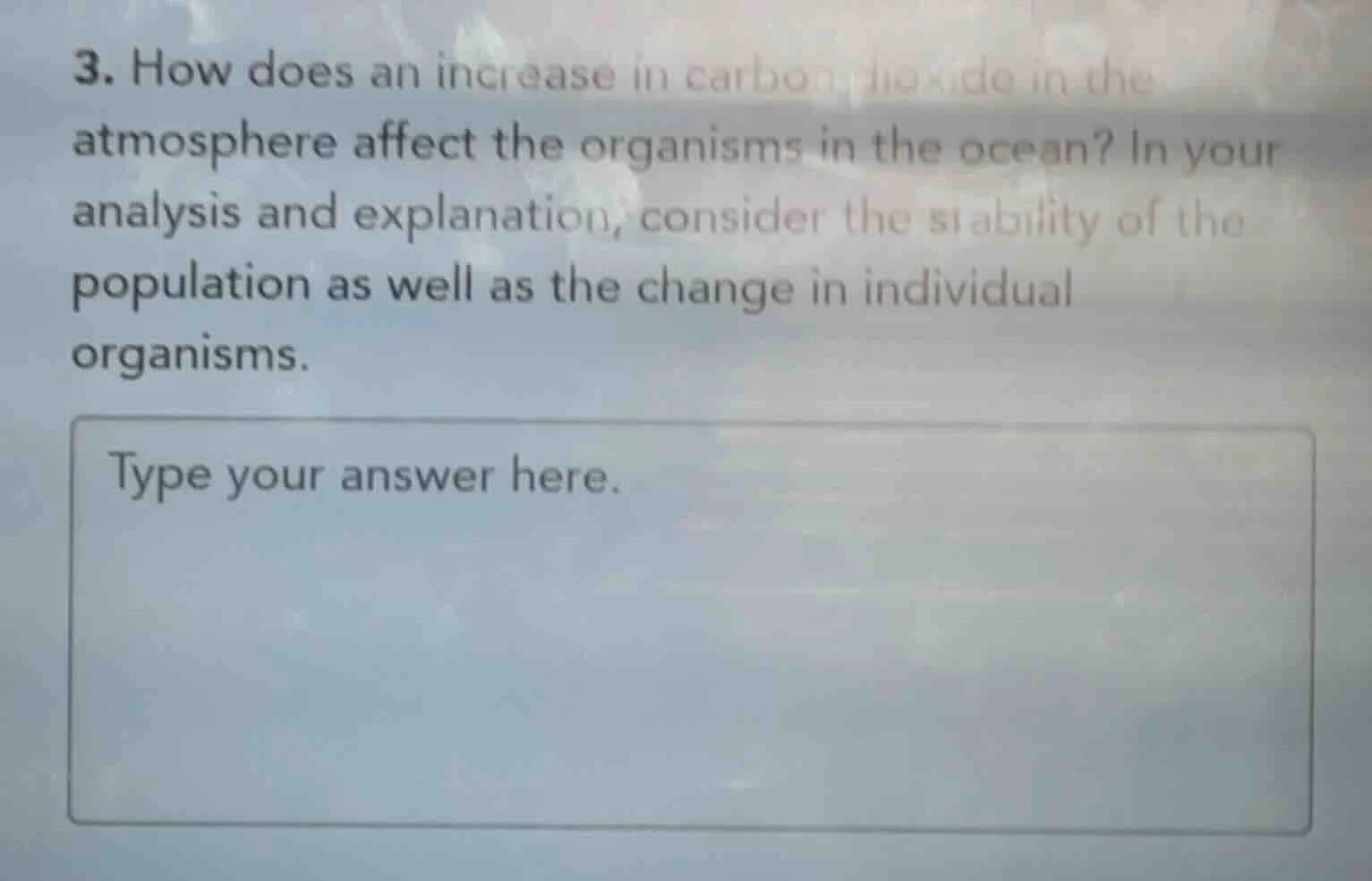
- how does an increase in carbon dioxide in the atmosphere affect the organisms in the ocean? in your analysis and explanation, consider the stability of the population as well as the change in individual organisms.
type your answer here.
- Ocean Acidification Mechanism: Excess atmospheric $\text{CO}_2$ dissolves in seawater, reacting to form carbonic acid ($\text{H}_2\text{CO}_3$), which dissociates to lower ocean pH (ocean acidification):
This reduces the concentration of carbonate ions ($\text{CO}_3^{2-}$) needed for calcification.
- Effects on Individual Organisms:
- Calcifying organisms (coral, shellfish, plankton like coccolithophores) struggle to build/ maintain calcium carbonate ($\text{CaCO}_3$) shells/skeletons; existing structures may dissolve.
- Fish and other marine vertebrates experience disrupted sensory systems (e.g., impaired ability to detect predators/ food) and altered physiological functions (e.g., reduced oxygen transport in blood) due to acidosis.
- Effects on Population Stability:
- Calcifying species face reduced survival, growth, and reproduction rates, leading to declining populations. This disrupts food webs (e.g., plankton declines reduce food for fish).
- Coral reef degradation destroys critical habitat, reducing biodiversity and destabilizing reef-dependent populations.
- Some tolerant species may experience population increases, shifting community structure and reducing ecosystem resilience.

Snap & solve any problem in the app
Get step-by-step solutions on Sovi AI
Photo-based solutions with guided steps
Explore more problems and detailed explanations
Increased atmospheric carbon dioxide harms ocean organisms through two key linked pathways, impacting both individuals and population stability:
- Ocean Acidification & Individual Organisms:
Excess $\text{CO}_2$ dissolves in seawater, lowering pH and reducing carbonate ion availability. Calcifying organisms (coral, shellfish, plankton) cannot build or maintain calcium carbonate shells/skeletons, and existing structures may dissolve. Fish face disrupted sensory systems (impaired predator/food detection) and physiological stress like blood acidosis.
- Population & Ecosystem Instability:
Calcifying species suffer reduced survival, growth, and reproduction, causing population declines that disrupt food webs (e.g., plankton losses reduce fish food sources). Coral reef degradation eliminates critical habitat, reducing biodiversity and destabilizing reef-dependent populations. Tolerant species may overpopulate, shifting community structure and reducing overall ecosystem resilience.