QUESTION IMAGE
Question
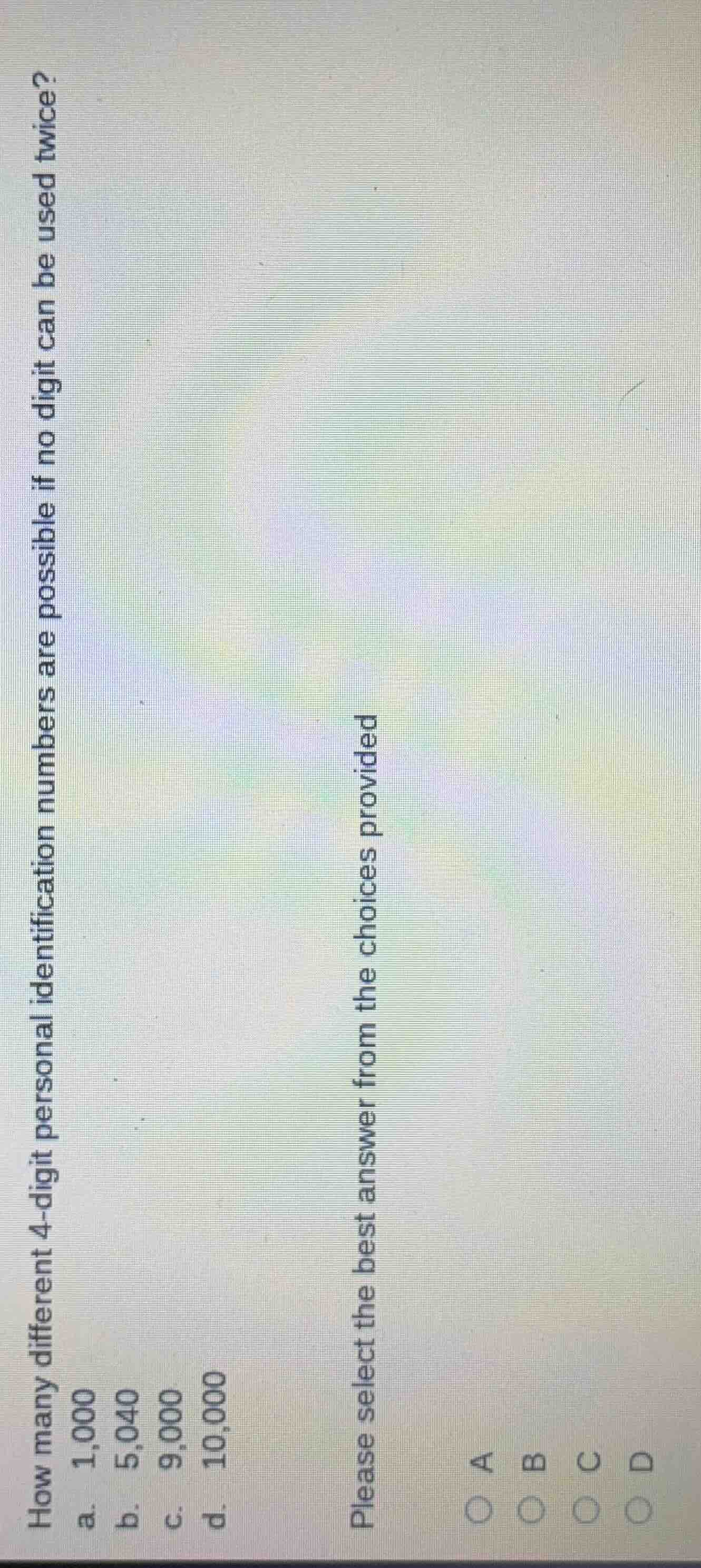
how many different 4 - digit personal identification numbers are possible if no digit can be used twice?
a. 1,000
b. 5,040
c. 9,000
d. 10,000
please select the best answer from the choices provided
a
b
c
d
Step1: Analyze the first digit
The first digit (thousands place) of a 4 - digit number can't be 0. So, we have 9 choices (1 - 9) for the first digit.
Step2: Analyze the second digit
After choosing the first digit, for the second digit (hundreds place), we can use 0 (since we already used a non - zero digit for the first place) and we have 9 remaining digits (because we can't use the digit we used for the first place, but now 0 is available). So, there are 9 choices.
Step3: Analyze the third digit
For the third digit (tens place), we have already used 2 digits, so we have 8 remaining digits to choose from.
Step4: Analyze the fourth digit
For the fourth digit (units place), we have already used 3 digits, so we have 7 remaining digits to choose from.
Step5: Calculate the total number of 4 - digit numbers
To find the total number of 4 - digit numbers with no digit repeated, we use the multiplication principle. The total number of such numbers is \(9\times9\times8\times7\)
First, \(9\times9 = 81\), then \(81\times8=648\), then \(648\times7 = 4536\). Wait, this seems wrong. Wait, maybe the problem is "no digit is used twice" but maybe I misread. Wait, maybe the problem is about 4 - digit numbers where no digit is repeated. Wait, another approach: The first digit (thousands place): 9 options (1 - 9). The second digit: 9 options (0 and the 8 non - used digits from 1 - 9). The third digit: 8 options (remaining 8 digits). The fourth digit: 7 options (remaining 7 digits). So \(9\times9\times8\times7=4536\). But the options given are 1000, 5040, 9000, 10000. Wait, maybe the problem is "no digit is repeated" but maybe I made a mistake. Wait, another way: The number of 4 - digit numbers with distinct digits: The first digit: 9 (1 - 9). The second digit: 9 (0 - 9 except the first digit). The third digit: 8 (except the first two). The fourth digit: 7 (except the first three). So \(9\times9\times8\times7 = 4536\). But this is not in the options. Wait, maybe the problem is "no digit is used twice" but maybe the question is about 4 - digit numbers where digits can be repeated? No, the question says "no digit can be used twice". Wait, maybe I misread the question. Wait, the options include 5040. Let's recalculate: The number of permutations of 10 digits (0 - 9) taken 4 at a time, minus the permutations where the first digit is 0. The number of permutations of 10 digits taken 4 at a time is \(P(10,4)=\frac{10!}{(10 - 4)!}=\frac{10!}{6!}=10\times9\times8\times7 = 5040\). And the number of permutations where the first digit is 0 (which are not 4 - digit numbers) is \(P(9,3)=\frac{9!}{(9 - 3)!}=\frac{9!}{6!}=9\times8\times7 = 504\). Wait, no, if we want 4 - digit numbers with distinct digits, it's \(9\times9\times8\times7\)? No, wait, the correct formula for the number of 4 - digit numbers with all distinct digits is: For the first digit (thousands place), we have 9 choices (1 - 9). For the second digit (hundreds place), we can choose any of the remaining 9 digits (including 0, excluding the first digit). For the third digit (tens place), we choose from the remaining 8 digits. For the fourth digit (units place), we choose from the remaining 7 digits. So \(9\times9\times8\times7=4536\). But this is not in the options. Wait, maybe the problem is "no digit is used twice" but the question is about 4 - digit numbers where digits can be repeated? No, the question says "no digit can be used twice". Wait, the option 5040 is \(P(10,4)=10\times9\times8\times7 = 5040\). Ah! Maybe the problem is considering 4 - digit numbers where the first digit can be…

Snap & solve any problem in the app
Get step-by-step solutions on Sovi AI
Photo-based solutions with guided steps
Explore more problems and detailed explanations
b. 5,040