QUESTION IMAGE
Question
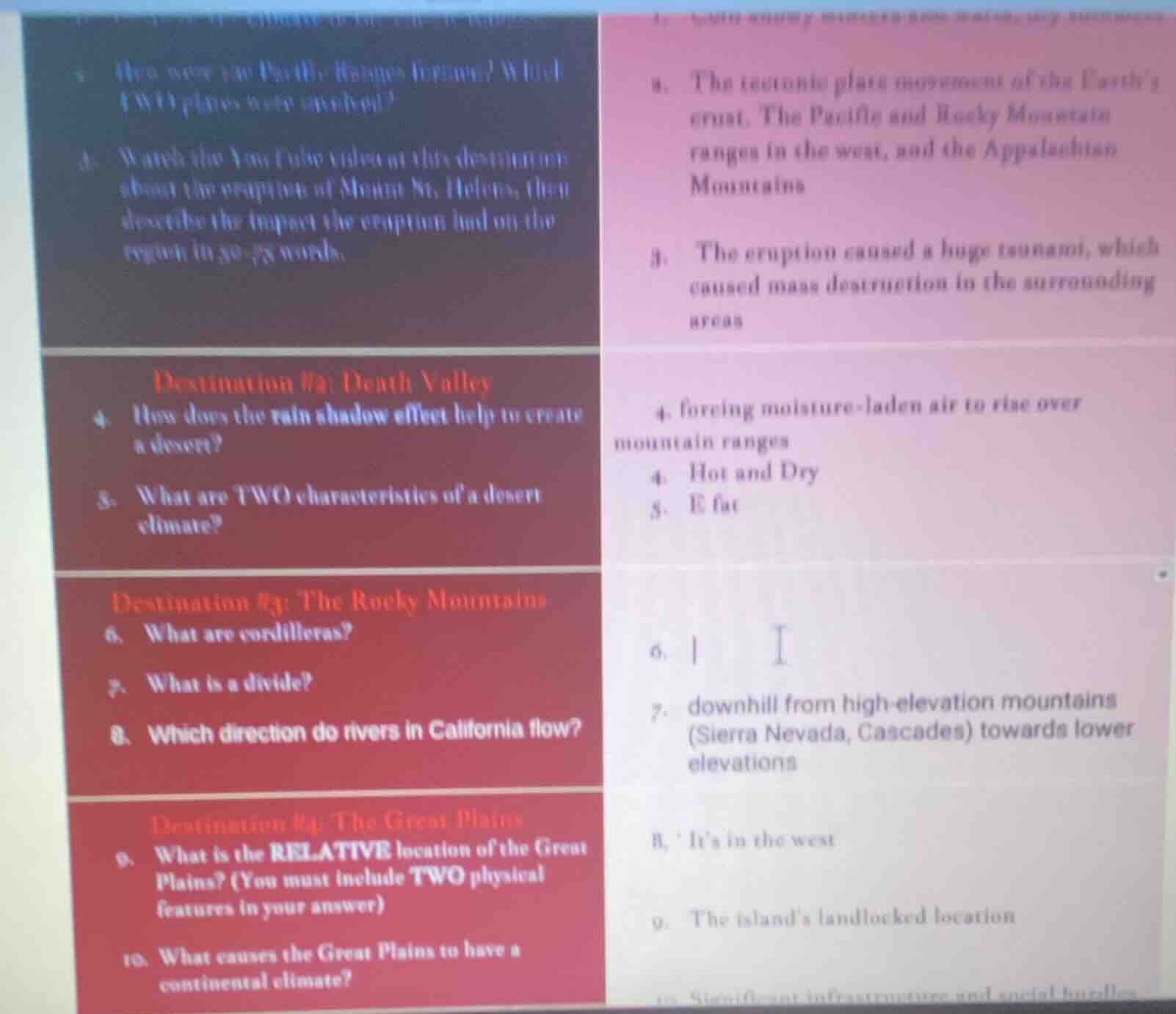
- how were the pacific ranges formed? which tectonic plates were involved?
- watch the youtube video at this destination about the eruption of mount st. helens, then describe the impact the eruption had on the region in 30 - 35 words.
destination #8: death valley
- how does the rain shadow effect help to create a desert?
- what are two characteristics of a desert climate?
destination #9: the rocky mountains
- what are cordilleras?
- what is a divide?
- which direction do rivers in california flow?
destination #10: the great plains
- what is the relative location of the great plains? (you must include two physical features in your answer)
- what causes the great plains to have a continental climate?
Question 4: How does the rain shadow effect help to create a desert?
The rain shadow effect occurs when moist air from an ocean is forced to rise over a mountain range. As the air rises, it cools and condenses, causing precipitation on the windward (ocean - facing) side of the mountains. By the time the air crosses over the mountain range and descends on the leeward (opposite) side, it has lost most of its moisture. This dry, descending air warms adiabatically, which further reduces its ability to hold moisture. The lack of precipitation on the leeward side, combined with the warm and dry conditions, leads to the formation of a desert.
Desert climates are known for their low precipitation levels, usually receiving less than 250 millimeters of rain per year. Another characteristic is high temperature variability, with very hot days (often exceeding 30°C or 86°F) and relatively cool nights due to the lack of cloud cover and vegetation to retain heat. Also, desert climates have low humidity as there is little moisture in the air.
A cordillera is a major system of mountain ranges that are connected or related in origin. These mountain ranges are often formed by tectonic activity, such as the collision of tectonic plates. For example, the North American Cordillera includes the Rocky Mountains, the Sierra Nevada, and other associated mountain ranges.

Snap & solve any problem in the app
Get step-by-step solutions on Sovi AI
Photo-based solutions with guided steps
Explore more problems and detailed explanations
Moist air rises over mountains (windward side), loses moisture via precipitation. Dry air descends on leeward side, warms, holds little moisture, creating arid conditions that form a desert.