QUESTION IMAGE
Question
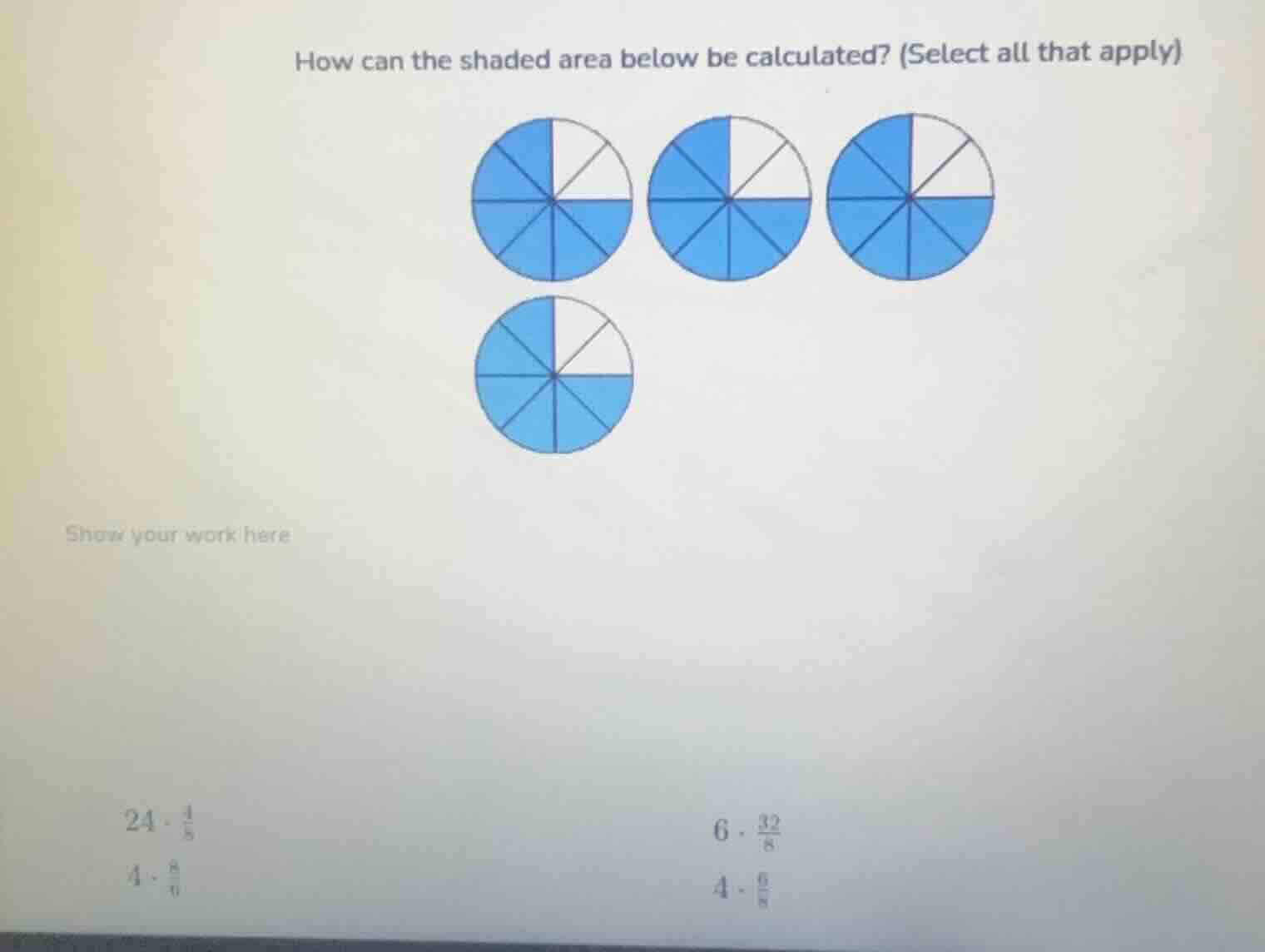
how can the shaded area below be calculated? (select all that apply)
show your work here
$24 \cdot \frac{4}{8}$
$6 \cdot \frac{32}{8}$
$4 \cdot \frac{8}{0}$
$4 \cdot \frac{6}{8}$
Step1: Analyze each circle
Each circle is divided into 8 parts, and the shaded parts in each circle are 6. So the fraction of shaded area per circle is $\frac{6}{8}$.
Step2: Count the number of circles
There are 4 circles. To find the total shaded area, we multiply the number of circles (4) by the fraction of shaded area per circle ($\frac{6}{8}$), so the formula is $4 \cdot \frac{6}{8}$.
Also, if we consider the total number of parts in all circles: each circle has 8 parts, 4 circles have $4\times8 = 32$ parts. The total shaded parts: each circle has 6 shaded parts, 4 circles have $4\times6 = 24$ parts. So the fraction of shaded area is $\frac{24}{32}=\frac{24}{8}\times\frac{1}{4}$? Wait, no, another way: if we think of each circle as 8 parts, 4 circles have 32 parts, and the shaded is 24, but also, $4 \cdot \frac{6}{8}=\frac{24}{8}$, and $24 \cdot \frac{1}{8}$? Wait, no, let's re - check.
Wait, the first option: $24\cdot\frac{1}{8}$: if there are 24 shaded parts (4 circles * 6 shaded parts per circle = 24), and each part is $\frac{1}{8}$ of a circle, then total shaded area is $24\times\frac{1}{8}$, which is equivalent to $4\times\frac{6}{8}$ (since $4\times\frac{6}{8}=\frac{24}{8}=24\times\frac{1}{8}$). And the fourth option is $4\cdot\frac{6}{8}$. Let's check the other options:
- Option $6\cdot\frac{32}{8}$: 6 times $\frac{32}{8}$ is 6 * 4 = 24, but the logic is wrong. Because we have 4 circles, not 6.
- Option $4\cdot\frac{8}{6}$: This is incorrect as the shaded parts per circle are 6, not 8.
So the correct formulas are $4\cdot\frac{6}{8}$ and $24\cdot\frac{1}{8}$ (since $4\times6 = 24$ and each part is $\frac{1}{8}$ of a circle). But from the given options, $4\cdot\frac{6}{8}$ and $24\cdot\frac{1}{8}$ (the first option is $24\cdot\frac{1}{8}$? Wait, the first option is $24\cdot\frac{1}{8}$? Wait, the user wrote the first option as $24\cdot\frac{1}{8}$? Wait, the original problem's options: let's re - examine. The user's options:
- $24\cdot\frac{1}{8}$
- $6\cdot\frac{32}{8}$
- $4\cdot\frac{8}{6}$
- $4\cdot\frac{6}{8}$
Wait, each circle has 8 parts, 4 circles have 32 parts. Shaded parts: 4 circles * 6 shaded parts per circle = 24. So the shaded area can be calculated as the number of shaded parts (24) times the area of each part ($\frac{1}{8}$ of a circle), so $24\times\frac{1}{8}$. Also, as there are 4 circles, each with $\frac{6}{8}$ shaded, so $4\times\frac{6}{8}$.
Let's calculate the values:
- $4\times\frac{6}{8}=\frac{24}{8}=3$
- $24\times\frac{1}{8}=\frac{24}{8}=3$
- $6\times\frac{32}{8}=6\times4 = 24$ (wrong, too big)
- $4\times\frac{8}{6}=\frac{32}{6}=\frac{16}{3}\approx5.33$ (wrong)
So the correct options are $24\cdot\frac{1}{8}$ (first option) and $4\cdot\frac{6}{8}$ (fourth option). But let's check the first option again: if each part is $\frac{1}{8}$ of a circle, and there are 24 shaded parts, then total shaded area is $24\times\frac{1}{8}$. And $4\times\frac{6}{8}=\frac{24}{8}=24\times\frac{1}{8}$. So both $4\cdot\frac{6}{8}$ and $24\cdot\frac{1}{8}$ are correct. But looking at the options, the first option is $24\cdot\frac{1}{8}$ (assuming that $\frac{1}{8}$ is the area of each part) and the fourth option is $4\cdot\frac{6}{8}$.

Snap & solve any problem in the app
Get step-by-step solutions on Sovi AI
Photo-based solutions with guided steps
Explore more problems and detailed explanations
The correct options are:
- $24\cdot\frac{1}{8}$
- $4\cdot\frac{6}{8}$