QUESTION IMAGE
Question
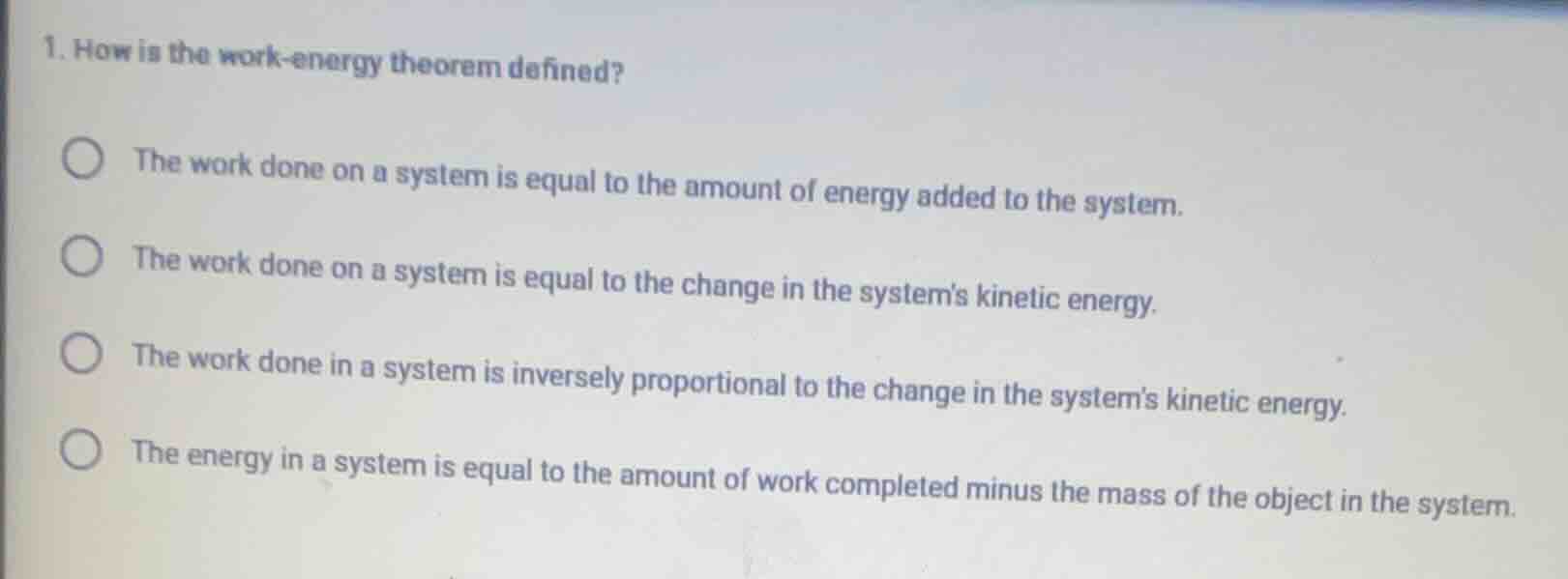
- how is the work - energy theorem defined?
the work done on a system is equal to the amount of energy added to the system.
the work done on a system is equal to the change in the systems kinetic energy.
the work done in a system is inversely proportional to the change in the systems kinetic energy.
the energy in a system is equal to the amount of work completed minus the mass of the object in the system.
The work-energy theorem specifically states that the net work done on an object or system is exactly equal to the change in its kinetic energy. Mathematically, this is expressed as $W_{net} = \Delta KE = KE_f - KE_i$, where $W_{net}$ is net work, $KE_f$ is final kinetic energy, and $KE_i$ is initial kinetic energy. The other options either overgeneralize the energy type or contain incorrect proportionality/relationships.

Snap & solve any problem in the app
Get step-by-step solutions on Sovi AI
Photo-based solutions with guided steps
Explore more problems and detailed explanations
The work done on a system is equal to the change in the system's kinetic energy.