QUESTION IMAGE
12,437 Learners found this answer helpful
Question
Question was provided via image upload.
Response
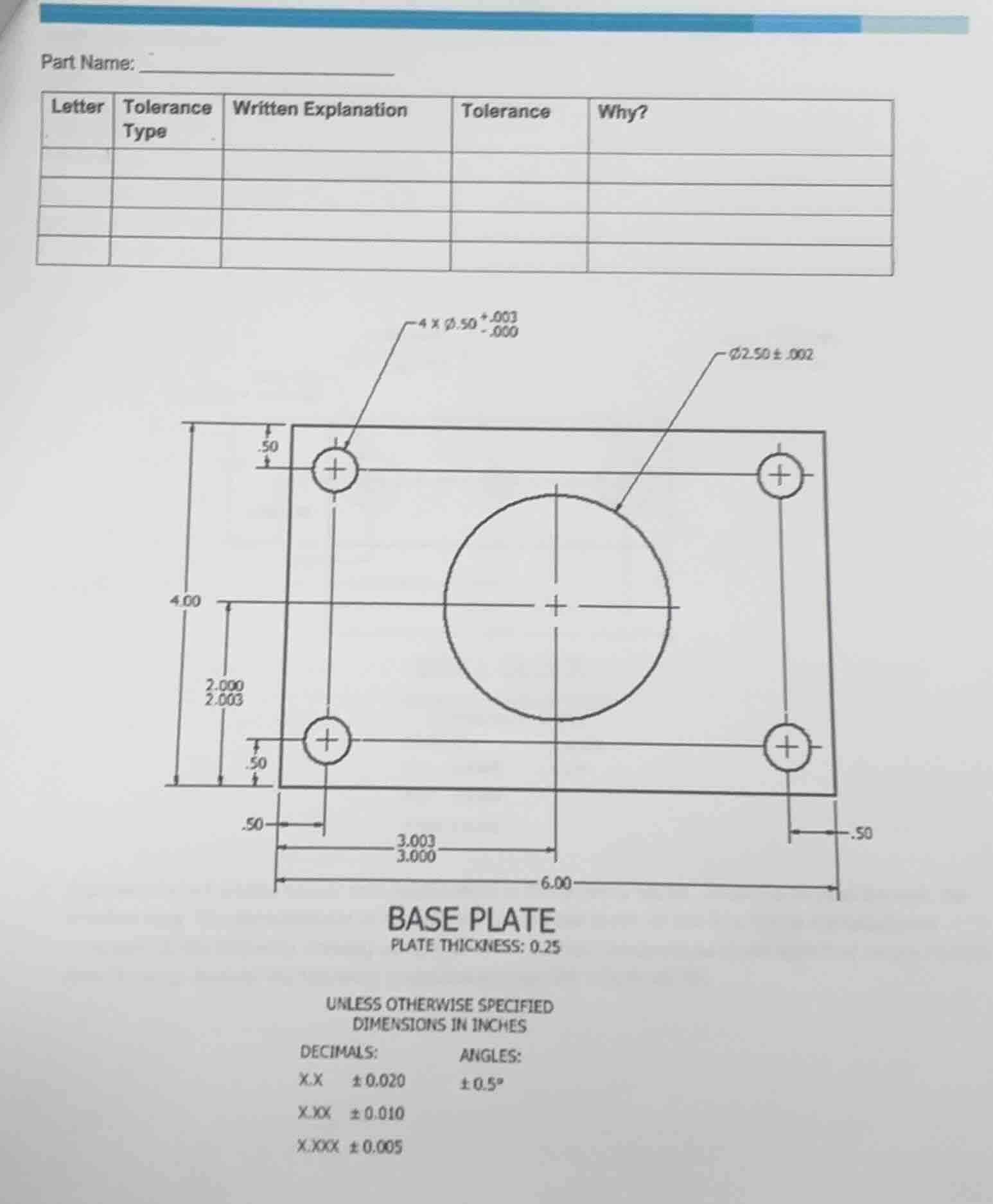
To fill the table, we analyze each dimension's tolerance:
1. Dimension: \( 4 \times \varnothing.50 \, ^{+0.003}_{-0.000} \)
- Tolerance Type: Limit (Unilateral, since only upper limit \( +0.003 \) and lower limit \( -0.000 \) (i.e., minimum size is \( 0.50 \), maximum is \( 0.503 \))).
- Written Explanation: The diameter of each of the 4 small holes must be at least \( 0.50 \) inches and at most \( 0.503 \) inches.
- Tolerance: \( 0.003 \) (max - min = \( 0.503 - 0.500 = 0.003 \)).
- Why?: Unilateral tolerance (only positive deviation) is used here, likely to ensure the holes are large enough for a fastener but not too loose (since lower limit is \( 0.50 \), no negative tolerance).
2. Dimension: \( \varnothing 2.50 \pm 0.002 \)
- Tolerance Type: Bilateral (equal positive and negative deviation from a nominal size).
- Written Explanation: The diameter of the large central hole must be between \( 2.498 \) inches (\( 2.50 - 0.002 \)) and \( 2.502 \) inches (\( 2.50 + 0.002 \)).
- Tolerance: \( 0.004 \) (total tolerance = \( 0.002 + 0.002 = 0.004 \)).
- Why?: Bilateral tolerance is used for symmetry around the nominal size, ensuring the hole is neither too small nor too large relative to \( 2.50 \) inches.
3. Dimension: \( 2.000 \, ^{+0.003}_{-0.000} \) (vertical dimension for small holes)
- Tolerance Type: Limit (Unilateral, lower limit \( 2.000 \), upper limit \( 2.003 \)).
- Written Explanation: The vertical distance between the centers of the small holes must be at least \( 2.000 \) inches and at most \( 2.003 \) inches.
- Tolerance: \( 0.003 \) (max - min = \( 2.003 - 2.000 = 0.003 \)).
- Why?: Unilateral tolerance to ensure the distance is sufficient (no negative tolerance, so minimum is \( 2.000 \), maximum \( 2.003 \)).
4. Dimension: \( 3.000 \, ^{+0.003}_{-0.000} \) (horizontal dimension for small holes)
- Tolerance Type: Limit (Unilateral, lower limit \( 3.000 \), upper limit \( 3.003 \)).
- Written Explanation: The horizontal distance between the centers of the small holes must be at least \( 3.000 \) inches and at most \( 3.003 \) inches.
- Tolerance: \( 0.003 \) (max - min = \( 3.003 - 3.000 = 0.003 \)).
- Why?: Unilateral tolerance to ensure the distance is sufficient (no negative tolerance, minimum \( 3.000 \), maximum \( 3.003 \)).
5. Dimension: \( 6.00 \) (overall length, decimal format \( X.X \))
- From the note: \( X.X \) dimensions have tolerance \( \pm 0.020 \).
- Tolerance Type: Bilateral (standard for \( X.X \) decimals).
- Written Explanation: The overall length of the base plate must be between \( 5.98 \) inches (\( 6.00 - 0.020 \)) and \( 6.02 \) inches (\( 6.00 + 0.020 \)).
- Tolerance: \( 0.040 \) (total tolerance = \( 0.020 + 0.020 = 0.040 \)).
- Why?: Standard tolerance for \( X.X \) decimal dimensions (per the note “\( X.X \pm 0.020 \)”).
Filled Table (Example Row for \( 4 \times \varnothing.50 \, ^{+0.003}_{-0.000} \)):
| Letter | Tolerance Type | Written Explanation | Tolerance | Why? |
|---|
Repeat for other dimensions using the above logic.

Snap & solve any problem in the app
Get step-by-step solutions on Sovi AI
Photo-based solutions with guided steps
Explore more problems and detailed explanations
To fill the table, we analyze each dimension's tolerance:
1. Dimension: \( 4 \times \varnothing.50 \, ^{+0.003}_{-0.000} \)
- Tolerance Type: Limit (Unilateral, since only upper limit \( +0.003 \) and lower limit \( -0.000 \) (i.e., minimum size is \( 0.50 \), maximum is \( 0.503 \))).
- Written Explanation: The diameter of each of the 4 small holes must be at least \( 0.50 \) inches and at most \( 0.503 \) inches.
- Tolerance: \( 0.003 \) (max - min = \( 0.503 - 0.500 = 0.003 \)).
- Why?: Unilateral tolerance (only positive deviation) is used here, likely to ensure the holes are large enough for a fastener but not too loose (since lower limit is \( 0.50 \), no negative tolerance).
2. Dimension: \( \varnothing 2.50 \pm 0.002 \)
- Tolerance Type: Bilateral (equal positive and negative deviation from a nominal size).
- Written Explanation: The diameter of the large central hole must be between \( 2.498 \) inches (\( 2.50 - 0.002 \)) and \( 2.502 \) inches (\( 2.50 + 0.002 \)).
- Tolerance: \( 0.004 \) (total tolerance = \( 0.002 + 0.002 = 0.004 \)).
- Why?: Bilateral tolerance is used for symmetry around the nominal size, ensuring the hole is neither too small nor too large relative to \( 2.50 \) inches.
3. Dimension: \( 2.000 \, ^{+0.003}_{-0.000} \) (vertical dimension for small holes)
- Tolerance Type: Limit (Unilateral, lower limit \( 2.000 \), upper limit \( 2.003 \)).
- Written Explanation: The vertical distance between the centers of the small holes must be at least \( 2.000 \) inches and at most \( 2.003 \) inches.
- Tolerance: \( 0.003 \) (max - min = \( 2.003 - 2.000 = 0.003 \)).
- Why?: Unilateral tolerance to ensure the distance is sufficient (no negative tolerance, so minimum is \( 2.000 \), maximum \( 2.003 \)).
4. Dimension: \( 3.000 \, ^{+0.003}_{-0.000} \) (horizontal dimension for small holes)
- Tolerance Type: Limit (Unilateral, lower limit \( 3.000 \), upper limit \( 3.003 \)).
- Written Explanation: The horizontal distance between the centers of the small holes must be at least \( 3.000 \) inches and at most \( 3.003 \) inches.
- Tolerance: \( 0.003 \) (max - min = \( 3.003 - 3.000 = 0.003 \)).
- Why?: Unilateral tolerance to ensure the distance is sufficient (no negative tolerance, minimum \( 3.000 \), maximum \( 3.003 \)).
5. Dimension: \( 6.00 \) (overall length, decimal format \( X.X \))
- From the note: \( X.X \) dimensions have tolerance \( \pm 0.020 \).
- Tolerance Type: Bilateral (standard for \( X.X \) decimals).
- Written Explanation: The overall length of the base plate must be between \( 5.98 \) inches (\( 6.00 - 0.020 \)) and \( 6.02 \) inches (\( 6.00 + 0.020 \)).
- Tolerance: \( 0.040 \) (total tolerance = \( 0.020 + 0.020 = 0.040 \)).
- Why?: Standard tolerance for \( X.X \) decimal dimensions (per the note “\( X.X \pm 0.020 \)”).
Filled Table (Example Row for \( 4 \times \varnothing.50 \, ^{+0.003}_{-0.000} \)):
| Letter | Tolerance Type | Written Explanation | Tolerance | Why? |
|---|
Repeat for other dimensions using the above logic.