QUESTION IMAGE
Question
Question was provided via image upload.
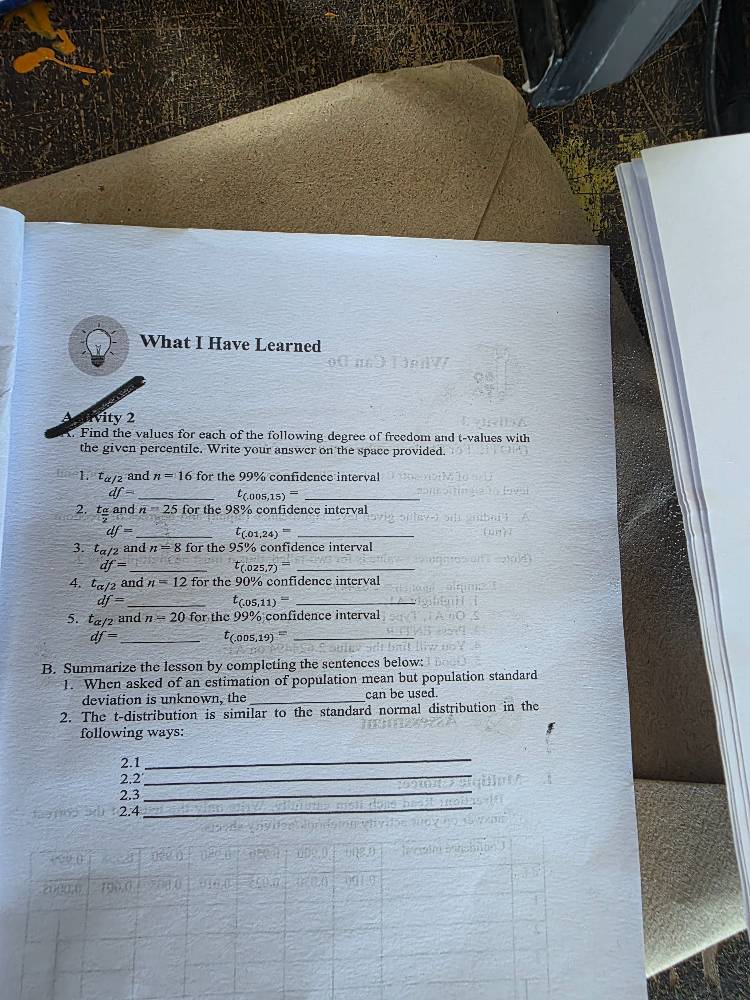
Part A: Finding \( t_{\alpha/2} \) or \( t_{\alpha} \) values
1. \( t_{\alpha/2} \) and \( n = 16 \) for 99% confidence interval
Step 1: Calculate degrees of freedom (\( df \))
Degrees of freedom for a t - distribution when dealing with sample size \( n \) is \( df=n - 1 \). Here, \( n = 16 \), so \( df=16 - 1=15 \).
Step 2: Determine the significance level (\( \alpha \))
For a 99% confidence interval, the confidence level \( CL = 0.99 \). The significance level \( \alpha=1 - CL=1 - 0.99 = 0.01 \). Since we are looking for \( t_{\alpha/2} \), we divide \( \alpha \) by 2, so \( \alpha/2=\frac{0.01}{2}=0.005 \).
Step 3: Find \( t_{0.005,15} \)
Using a t - table or statistical software, for \( df = 15 \) and \( \alpha/2=0.005 \), \( t_{0.005,15}\approx2.947 \).
2. \( t_{\alpha} \) and \( n = 25 \) for 98% confidence interval
Step 1: Calculate degrees of freedom (\( df \))
\( df=n - 1 \), with \( n = 25 \), so \( df=25 - 1 = 24 \).
Step 2: Determine the significance level (\( \alpha \))
For a 98% confidence interval, \( CL = 0.98 \), so \( \alpha=1 - 0.98 = 0.02 \).
Step 3: Find \( t_{0.02,24} \)
Using a t - table or statistical software, for \( df = 24 \) and \( \alpha = 0.02 \) (one - tailed test, since we are looking for \( t_{\alpha} \)), \( t_{0.02,24}\approx2.172 \).
3. \( t_{\alpha/2} \) and \( n = 8 \) for 95% confidence interval
Step 1: Calculate degrees of freedom (\( df \))
\( df=n - 1 \), with \( n = 8 \), so \( df=8 - 1 = 7 \).
Step 2: Determine the significance level (\( \alpha \))
For a 95% confidence interval, \( CL = 0.95 \), so \( \alpha=1 - 0.95 = 0.05 \). Then \( \alpha/2=\frac{0.05}{2}=0.025 \).
Step 3: Find \( t_{0.025,7} \)
Using a t - table or statistical software, for \( df = 7 \) and \( \alpha/2 = 0.025 \), \( t_{0.025,7}\approx2.365 \).
4. \( t_{\alpha/2} \) and \( n = 12 \) for 90% confidence interval
Step 1: Calculate degrees of freedom (\( df \))
\( df=n - 1 \), with \( n = 12 \), so \( df=12 - 1 = 11 \).
Step 2: Determine the significance level (\( \alpha \))
For a 90% confidence interval, \( CL = 0.90 \), so \( \alpha=1 - 0.90 = 0.10 \). Then \( \alpha/2=\frac{0.10}{2}=0.05 \).
Step 3: Find \( t_{0.05,11} \)
Using a t - table or statistical software, for \( df = 11 \) and \( \alpha/2 = 0.05 \), \( t_{0.05,11}\approx1.796 \).
5. \( t_{\alpha/2} \) and \( n = 20 \) for 99% confidence interval
Step 1: Calculate degrees of freedom (\( df \))
\( df=n - 1 \), with \( n = 20 \), so \( df=20 - 1 = 19 \).
Step 2: Determine the significance level (\( \alpha \))
For a 99% confidence interval, \( CL = 0.99 \), so \( \alpha=1 - 0.99 = 0.01 \). Then \( \alpha/2=\frac{0.01}{2}=0.005 \).
Step 3: Find \( t_{0.005,19} \)
Using a t - table or statistical software, for \( df = 19 \) and \( \alpha/2 = 0.005 \), \( t_{0.005,19}\approx2.861 \).
Part B: Summarizing the lesson
- When asked for an estimation of the population mean but the population standard deviation is unknown, the t - distribution can be used.
- The t - distribution is similar to the standard normal distribution in the following ways:
2.1 Both are symmetric around a mean of 0.
2.2 As the degrees of freedom (sample size) increases, the t - distribution approaches the standard normal distribution.
2.3 Both are bell - shaped curves.
2.4 The total area under both curves is equal to 1.

Snap & solve any problem in the app
Get step-by-step solutions on Sovi AI
Photo-based solutions with guided steps
Explore more problems and detailed explanations
s for Part A
- \( df=\boldsymbol{15} \), \( t_{(0.005,15)}=\boldsymbol{2.947} \)
- \( df=\boldsymbol{24} \), \( t_{(0.02,24)}=\boldsymbol{2.172} \)
- \( df=\boldsymbol{7} \), \( t_{(0.025,7)}=\boldsymbol{2.365} \)
- \( df=\boldsymbol{11} \), \( t_{(0.05,11)}=\boldsymbol{1.796} \)
- \( df=\boldsymbol{19} \), \( t_{(0.005,19)}=\boldsymbol{2.861} \)