QUESTION IMAGE
Question
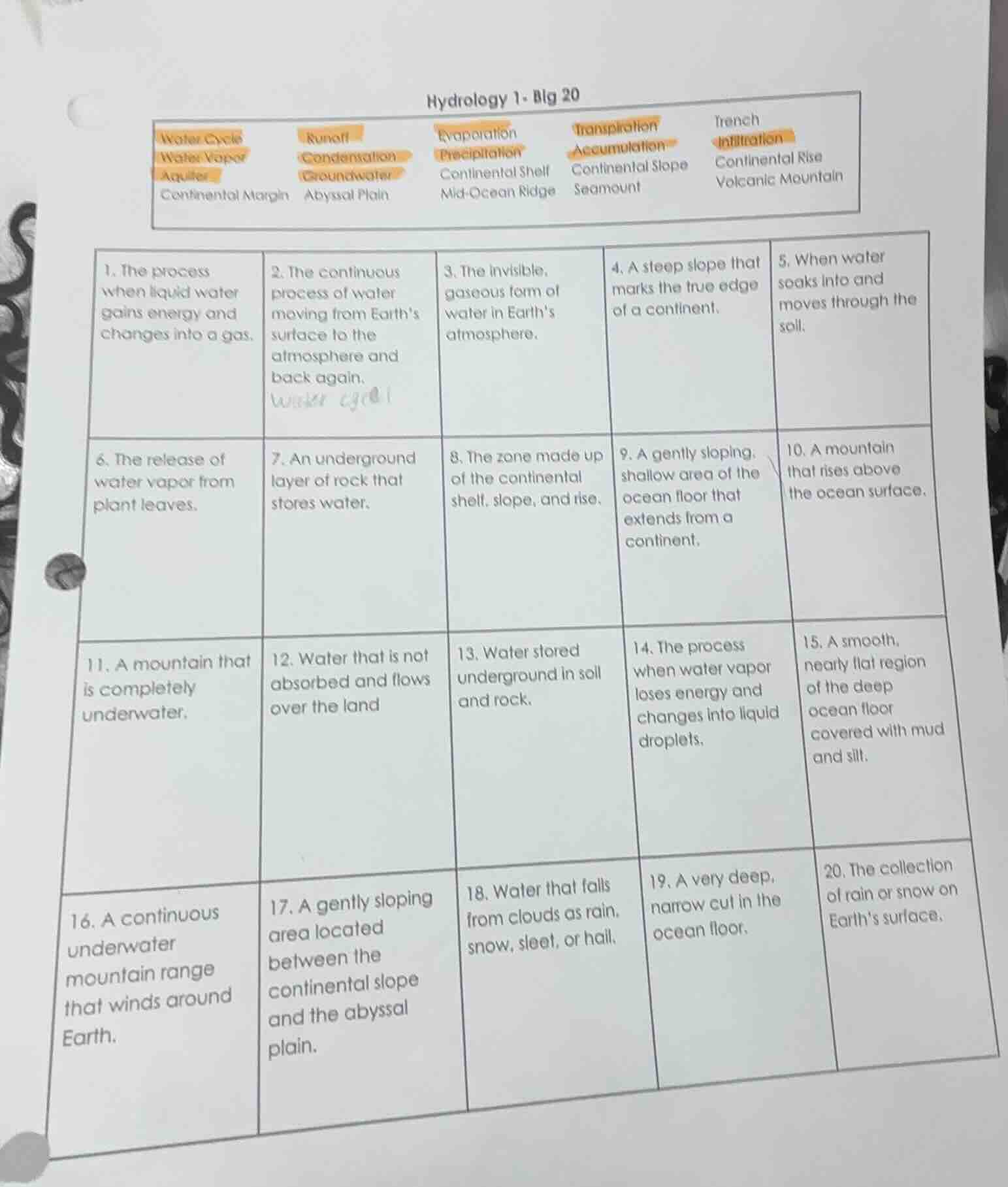
hydrology 1 - big 20
water cycle, runoff, evaporation, transpiration, trench
water vapor, condensation, precipitation, accumulation, infiltration
aquifer, groundwater, continental shelf, continental slope, continental rise
continental margin, abyssal plain, mid - ocean ridge, seamount, volcanic mountain
- the process when liquid water gains energy and changes into a gas.
- the continuous process of water moving from earth’s surface to the atmosphere and back again.
- the invisible, gaseous form of water in earth’s atmosphere.
- a steep slope that marks the true edge of a continent.
- when water soaks into and moves through the soil.
- the release of water vapor from plant leaves.
- an underground layer of rock that stores water.
- the zone made up of the continental shelf, slope, and rise.
- a gently sloping, shallow area of the ocean floor that extends from a continent.
- a mountain that rises above the ocean surface.
- a mountain that is completely underwater.
- water that is not absorbed and flows over the land
- water stored underground in soil and rock.
- the process when water vapor loses energy and changes into liquid droplets.
- a smooth, nearly flat region of the deep ocean floor covered with mud and silt.
- a continuous underwater mountain range that winds around earth.
- a gently sloping area located between the continental slope and the abyssal plain.
- water that falls from clouds as rain, snow, sleet, or hail.
- a very deep, narrow cut in the ocean floor.
- the collection of rain or snow on earth’s surface.
Response
To solve this, we match each definition to the correct term from the list:
1.
Liquid to gas (water gaining energy) is evaporation.
Continuous water movement (surface to atmosphere and back) is the water cycle.
Invisible gaseous water in the atmosphere is water vapor.

Snap & solve any problem in the app
Get step-by-step solutions on Sovi AI
Photo-based solutions with guided steps
Explore more problems and detailed explanations
Evaporation