QUESTION IMAGE
Question
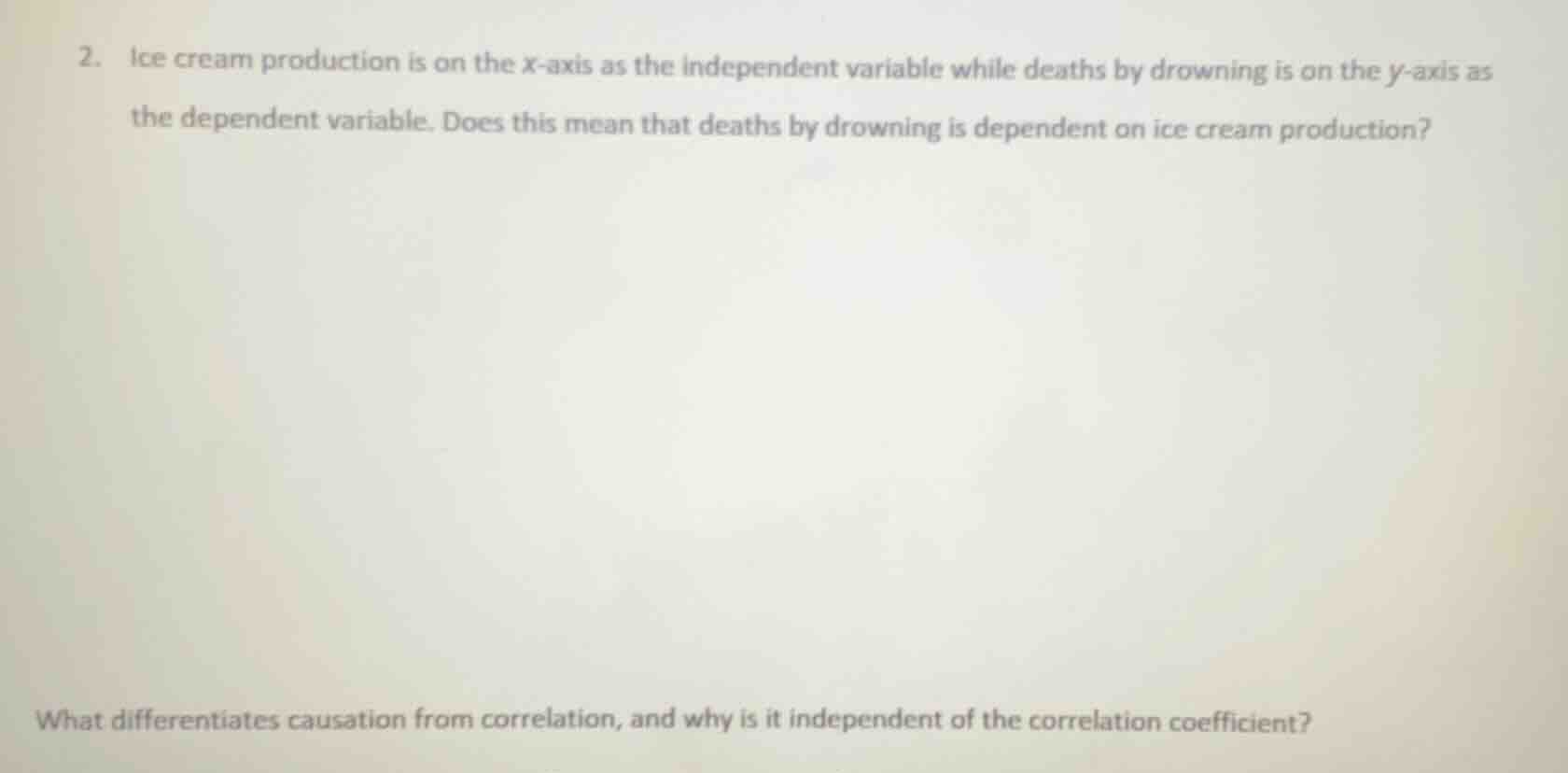
- ice cream production is on the x-axis as the independent variable while deaths by drowning is on the y-axis as the dependent variable. does this mean that deaths by drowning is dependent on ice cream production?
what differentiates causation from correlation, and why is it independent of the correlation coefficient?
Brief Explanations
- For the ice cream and drowning question: Plotting variables on axes only assigns measurement roles, not causal links. Both rise in warm months (a hidden third variable: temperature), so no direct dependence.
- For causation vs correlation: Correlation only measures linear association between two variables, while causation means one variable directly causes a change in the other. The correlation coefficient only quantifies the strength/ direction of association, not the existence of a causal mechanism, so it doesn't indicate if one variable causes the other.

Snap & solve any problem in the app
Get step-by-step solutions on Sovi AI
Photo-based solutions with guided steps
Explore more problems and detailed explanations
- No, plotting drowning deaths as the dependent variable (y-axis) and ice cream production as the independent variable (x-axis) does not mean drowning deaths depend on ice cream production. This is a correlation, likely driven by a third variable (higher temperatures in summer increase both ice cream consumption and drowning incidents).
- Correlation is a statistical measure of the strength and direction of a linear relationship between two variables, while causation means a change in one variable directly produces a change in another. The correlation coefficient only quantifies association, not causal relationships, so it is independent of causation—two variables can have a strong correlation coefficient with no causal link, or a causal link with a weak correlation coefficient.