QUESTION IMAGE
Question
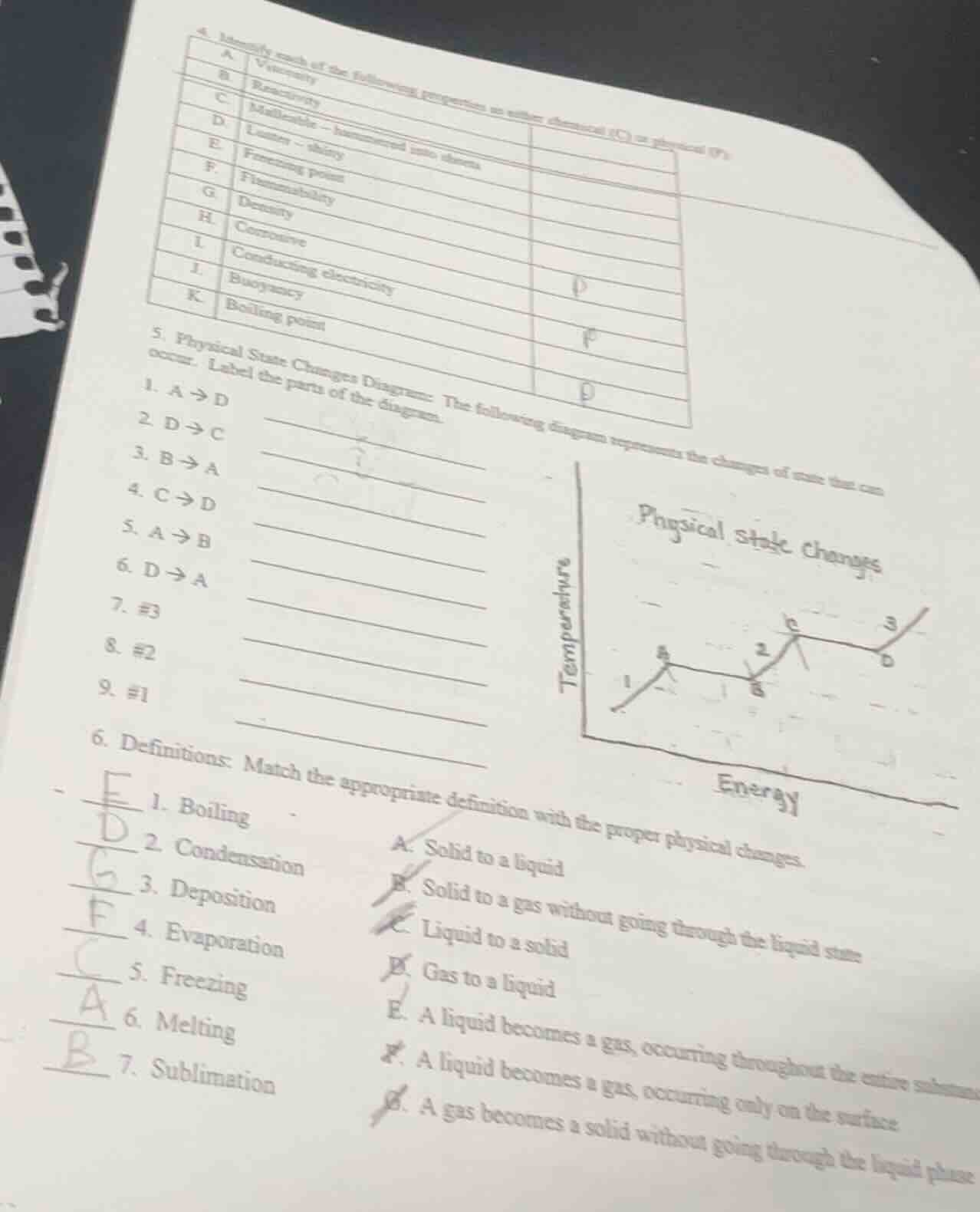
- identify each of the following properties as either chemical (c) or physical (p)
a viscosity
b reactivity
c malleable - hammered into sheets
d luster - shiny
e freezing point
f flammability
g density
h corrosive
i conducting electricity
j buoyancy
k boiling point
- physical state changes diagram: the following diagram represents the changes of state that can occur. label the parts of the diagram.
- a → d
- d → c
- b → a
- c → d
- a → b
- d → a
- #3
- #2
- #1
- definitions: match the appropriate definition with the proper physical changes.
- boiling a. solid to a liquid
- condensation b. solid to a gas without going through the liquid state
- deposition c. liquid to a solid
- evaporation d. gas to a liquid
- freezing e. a liquid becomes a gas, occurring throughout the entire substance
- melting f. a liquid becomes a gas, occurring only on the surface
- sublimation g. a gas becomes a solid without going through the liquid phase
Step1: Classify property types
Physical Properties (P):
A. Viscosity, C. Malleability, D. Luster, E. Freezing point, G. Density, I. Conducting electricity, J. Buoyancy, K. Boiling point
Chemical Properties (C):
B. Reactivity, F. Flammability, H. Corrosive
Step2: Label state change arrows
- $A \to D$: Vaporization (Boiling/Evaporation)
- $D \to C$: Condensation
- $B \to A$: Melting
- $C \to D$: Freezing
- $A \to B$: Fusion (Melting reverse: Freezing)
- $D \to A$: Condensation reverse: Vaporization
- #3: Sublimation (Solid to Gas)
- #2: Deposition (Gas to Solid)
- #1: Melting (Solid to Liquid)
Step3: Match definitions to changes
- Boiling: E. A liquid becomes a gas, occurring throughout the entire substance
- Condensation: D. Gas to a liquid
- Deposition: G. A gas becomes a solid without going through the liquid phase
- Evaporation: F. A liquid becomes a gas, occurring only on the surface
- Freezing: C. Liquid to a solid
- Melting: A. Solid to a liquid
- Sublimation: B. Solid to a gas without going through the liquid state

Snap & solve any problem in the app
Get step-by-step solutions on Sovi AI
Photo-based solutions with guided steps
Explore more problems and detailed explanations
Question 4 (Property Classification):
A. Viscosity: P
B. Reactivity: C
C. Malleability: P
D. Luster: P
E. Freezing point: P
F. Flammability: C
G. Density: P
H. Corrosive: C
I. Conducting electricity: P
J. Buoyancy: P
K. Boiling point: P
Question 5 (State Change Labels):
- $A \to D$: Vaporization
- $D \to C$: Condensation
- $B \to A$: Melting
- $C \to D$: Freezing
- $A \to B$: Freezing
- $D \to A$: Vaporization
- #3: Sublimation
- #2: Deposition
- #1: Melting
Question 6 (Definition Matching):
- Boiling: E. A liquid becomes a gas, occurring throughout the entire substance
- Condensation: D. Gas to a liquid
- Deposition: G. A gas becomes a solid without going through the liquid phase
- Evaporation: F. A liquid becomes a gas, occurring only on the surface
- Freezing: C. Liquid to a solid
- Melting: A. Solid to a liquid
- Sublimation: B. Solid to a gas without going through the liquid state