QUESTION IMAGE
Question
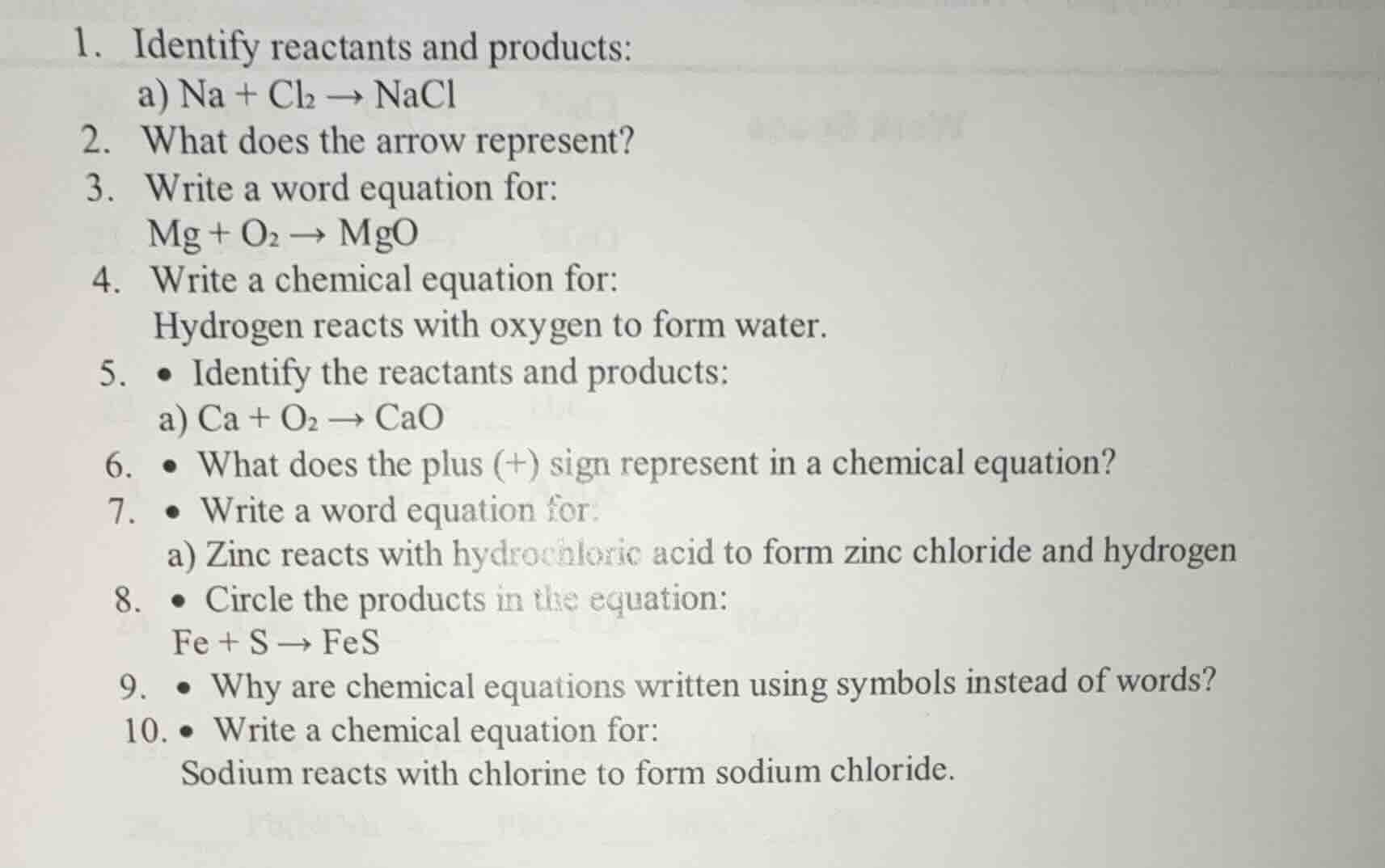
- identify reactants and products:
a) na + cl₂ → nacl
- what does the arrow represent?
- write a word equation for:
mg + o₂ → mgo
- write a chemical equation for:
hydrogen reacts with oxygen to form water.
- • identify the reactants and products:
a) ca + o₂ → cao
- • what does the plus (+) sign represent in a chemical equation?
- • write a word equation for:
a) zinc reacts with hydrochloric acid to form zinc chloride and hydrogen
- • circle the products in the equation:
fe + s → fes
- • why are chemical equations written using symbols instead of words?
- • write a chemical equation for:
sodium reacts with chlorine to form sodium chloride.
1. a)
Step1: Recall reactant/product definition
Reactants are on the left of the arrow, products on the right.
Step2: Identify for \( \text{Na} + \text{Cl}_2
ightarrow \text{NaCl} \)
Reactants: \( \text{Na} \) (sodium), \( \text{Cl}_2 \) (chlorine). Products: \( \text{NaCl} \) (sodium chloride).
Step1: Recall arrow meaning in chemical equations
The arrow represents "yields" or "reacts to form", showing the direction of the chemical reaction (reactants → products).
Step1: Identify reactants and products by formula
Reactants: \( \text{Mg} \) (magnesium), \( \text{O}_2 \) (oxygen). Product: \( \text{MgO} \) (magnesium oxide).
Step2: Translate to word equation
Magnesium + Oxygen → Magnesium Oxide

Snap & solve any problem in the app
Get step-by-step solutions on Sovi AI
Photo-based solutions with guided steps
Explore more problems and detailed explanations
Reactants: Sodium (\( \text{Na} \)), Chlorine (\( \text{Cl}_2 \)); Products: Sodium Chloride (\( \text{NaCl} \))