QUESTION IMAGE
Question
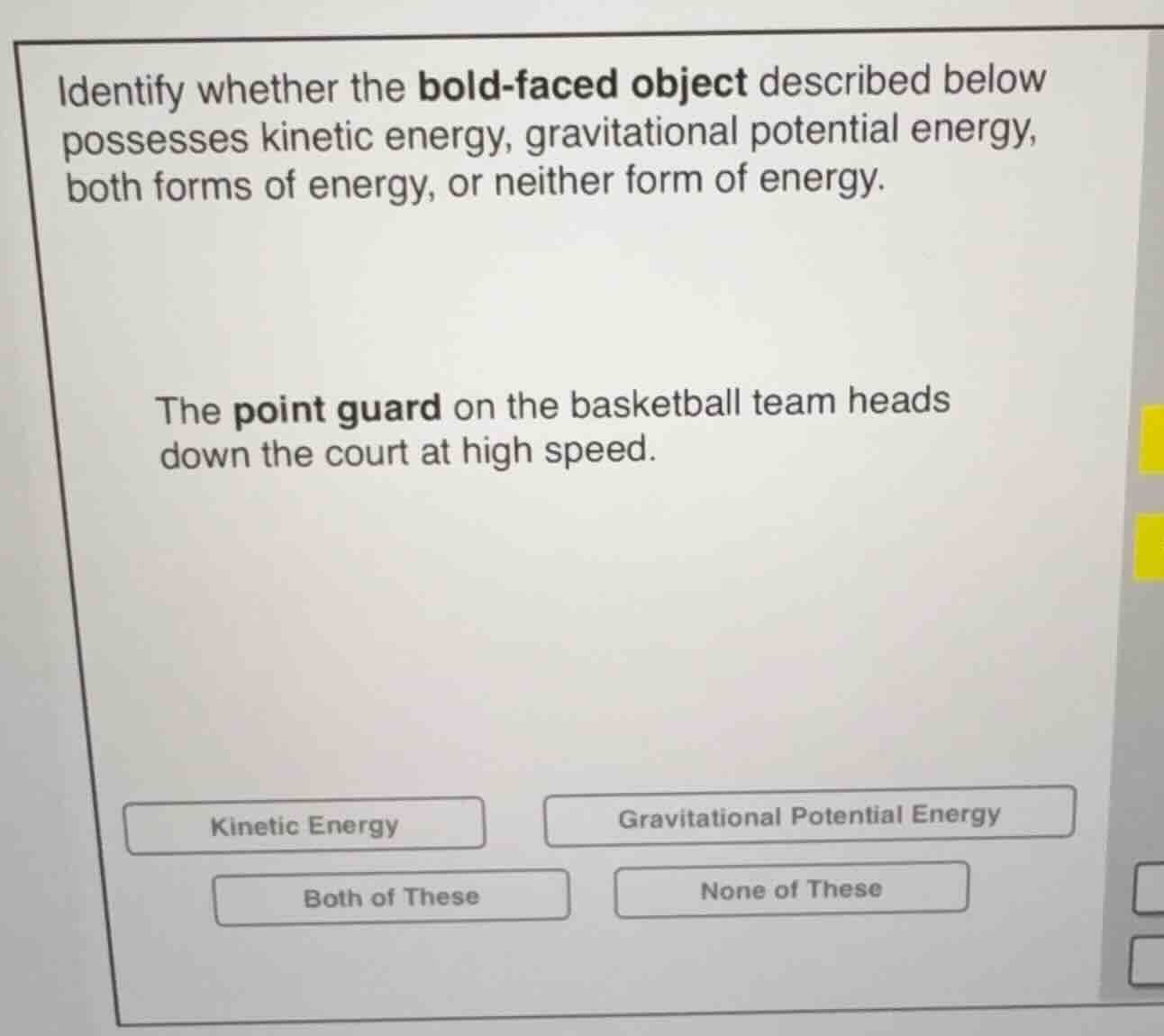
identify whether the bold - faced object described below possesses kinetic energy, gravitational potential energy, both forms of energy, or neither form of energy.
the point guard on the basketball team heads down the court at high speed.
kinetic energy gravitational potential energy
both of these none of these
Kinetic energy is the energy of motion. The point guard is moving at high speed, so they have kinetic energy. Gravitational potential energy depends on height above a reference point; since the point guard is on a basketball court (a relatively flat surface, and no significant height change is indicated), we can assume gravitational potential energy is negligible or not a major factor here. But since they are moving, they definitely have kinetic energy. Also, as a massive object (the point guard has mass) in motion, they have kinetic energy ($KE = \frac{1}{2}mv^2$, where $m$ is mass and $v$ is velocity). There's no indication of a height difference that would give significant gravitational potential energy, but even if we consider the normal gravitational potential energy at their height (which is constant here), the main energy from their motion is kinetic. Wait, actually, the question is about whether they possess kinetic, gravitational potential, both, or neither. Since they are moving (so kinetic energy) and are at a certain height (but gravitational potential energy is present for any object in a gravitational field, but the key is if it's a form relevant here. However, the main thing is that they are in motion, so kinetic energy. Also, do they have gravitational potential energy? Well, any object with mass at a height above the ground has gravitational potential energy, but in the context of the problem, maybe we consider that the height isn't changing and the focus is on the motion. Wait, but the point guard is on the court, so their height relative to the court is constant (assuming they are not jumping). But gravitational potential energy is $PE = mgh$, where $h$ is height above a reference (like the ground). So if $h$ is non - zero (which it is, since they are above the ground), they have gravitational potential energy. But the problem is about the bold - faced object (the point guard) as described: moving at high speed. So they have mass (so $m
eq0$), velocity ($v
eq0$) so kinetic energy, and height ($h
eq0$ relative to the ground) so gravitational potential energy? Wait, no, maybe the problem considers that the height is the same (like on the court, so $h$ is constant, so gravitational potential energy isn't changing, but does the object possess it? Yes, because gravitational potential energy depends on position in a gravitational field. But in the context of the problem, maybe the intended answer is both? Wait, no, let's re - think. The point guard is moving, so kinetic energy. Are they at a height where gravitational potential energy is a factor? Well, a person on the basketball court is at a certain height above the ground (say, a few feet), so they have gravitational potential energy. But maybe the problem is simplified: since they are moving, they have kinetic energy, and since they have mass and are at a height (even a small one), they have gravitational potential energy. Wait, but maybe the problem considers that the height is not changing and the main energy is kinetic. But according to the definitions: Kinetic energy: energy of motion (they have this because they are moving at high speed). Gravitational potential energy: energy due to position in a gravitational field (they have mass and are at a height above the ground, so they have this too). Wait, but maybe in the context of the problem, the height is considered to be the same (so no change in gravitational potential energy), but the question is about possessing the energy, not changing it. So an object at rest on a table has gravitational potential energy…

Snap & solve any problem in the app
Get step-by-step solutions on Sovi AI
Photo-based solutions with guided steps
Explore more problems and detailed explanations
Both of These