QUESTION IMAGE
Question
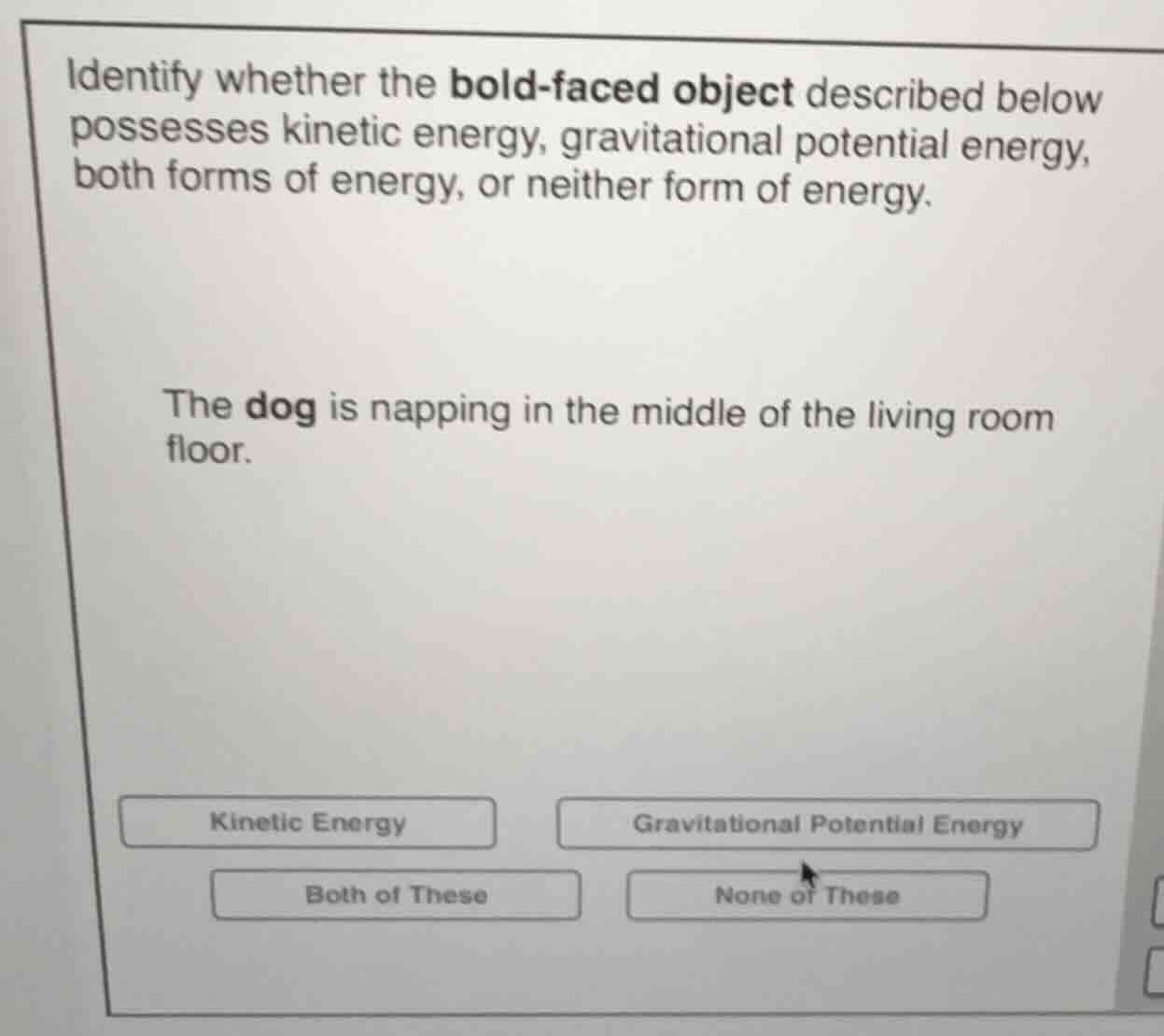
identify whether the bold-faced object described below possesses kinetic energy, gravitational potential energy, both forms of energy, or neither form of energy.
the dog is napping in the middle of the living room floor.
kinetic energy gravitational potential energy
both of these none of these
Brief Explanations
- Recall the definitions: Kinetic energy ($KE$) is energy of motion, so an object at rest (napping dog) has $KE = 0$. Gravitational potential energy ($GPE$) depends on height above a reference (e.g., ground). The dog is on the living room floor, which is at a height (even if low) relative to a lower reference (like basement), so it has $GPE$ (since $GPE = mgh$, $h>0$ here). Wait, correction: Wait, if the floor is the reference (h=0), but usually, gravitational potential energy is relative. However, the dog has mass and is in a gravitational field, so it has gravitational potential energy (as it could fall, but actually, any object with mass above zero height from a reference has GPE). But wait, the dog is at rest, so no KE. So it has gravitational potential energy. Wait, no—wait, the options: Let's re-express. Kinetic energy: energy due to motion. The dog is napping (not moving), so no KE. Gravitational potential energy: energy due to position in a gravitational field. The dog is above the center of the Earth (has height), so it has GPE. Wait, but maybe the floor is considered h=0, but even then, the dog has mass, and gravitational potential energy is relative. However, in typical problems, an object on a floor (not at ground level, but even at ground level, relative to center of Earth) has GPE. Wait, no—wait, maybe the problem considers that if the object is at rest and at a height (even small) it has GPE. Wait, but let's check again. The dog is napping (no motion: KE=0). Gravitational potential energy: yes, because it's in a gravitational field and has a height (even if the floor is the reference, but maybe the problem considers that any object with mass and in gravity has GPE, or maybe the floor is at a height. Wait, maybe I made a mistake. Wait, the options: "Gravitational Potential Energy" is an option. Wait, no—wait, the dog is on the floor. If we take the floor as the reference (h=0), then GPE=0. But that's not right. Wait, no, gravitational potential energy is $U = mgh$, where $h$ is the height above a reference point. If the reference is the ground outside, the living room floor is at some height (e.g., first floor, h>0), so the dog has GPE. But if the reference is the floor itself, h=0, GPE=0. But in physics, we usually take a reference (like ground level) where h is the height above that. So the dog, being at rest, has no KE, but has GPE. Wait, but maybe the problem considers that the dog is at rest (no KE) and has GPE. Wait, but the options: "Gravitational Potential Energy" is an option. Wait, no—wait, let's re-express. The dog is at rest: no KE. Does it have GPE? Yes, because it's in a gravitational field and has mass and height (even a small height) above a lower point. So the answer is Gravitational Potential Energy? Wait, no—wait, maybe the problem is simpler. Wait, the dog is on the floor. If the floor is the zero level, then GPE=0. But that's not correct. Wait, no, gravitational potential energy exists as long as there's a gravitational field and the object has mass and is not at infinite distance. So the dog has GPE (since it's in Earth's gravity) and no KE (at rest). So the correct option is "Gravitational Potential Energy". Wait, but let's check the options again. The options are: Kinetic Energy, Gravitational Potential Energy, Both, None. The dog is at rest: no KE. Has GPE: yes. So the answer is Gravitational Potential Energy. Wait, but maybe I messed up. Wait, no—if the dog is on the floor, and we take the floor as h=0, then GPE=0. But that's a reference choice. However, in most basic physics problems, an obje…

Snap & solve any problem in the app
Get step-by-step solutions on Sovi AI
Photo-based solutions with guided steps
Explore more problems and detailed explanations
Gravitational Potential Energy