QUESTION IMAGE
Question
impulse lab discussion
analysis
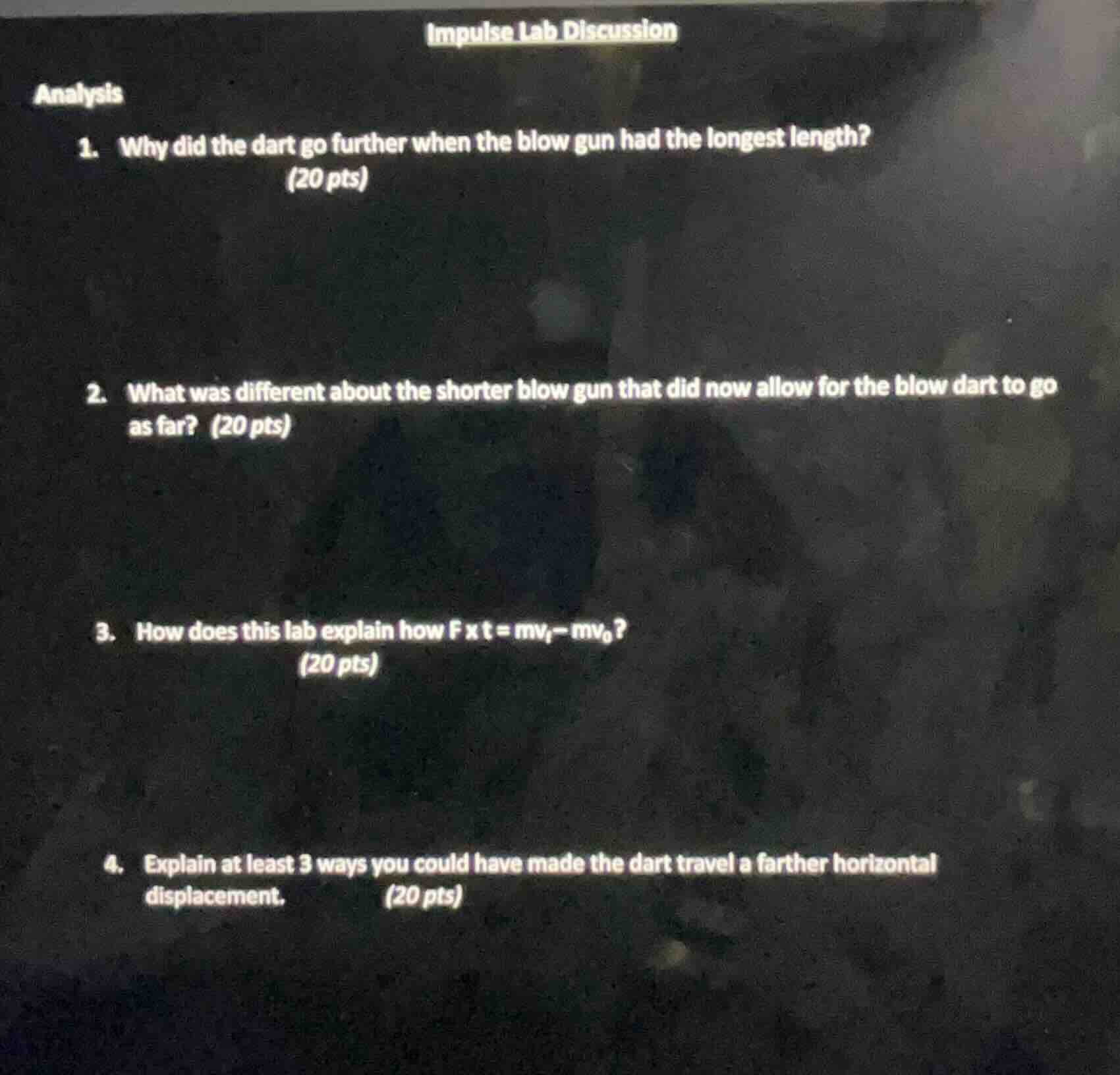
- why did the dart go further when the blow gun had the longest length?
(20 pts)
- what was different about the shorter blow gun that did now allow for the blow dart to go
as far? (20 pts)
- how does this lab explain how f x t = mvᵣ - mv₀?
(20 pts)
- explain at least 3 ways you could have made the dart travel a farther horizontal
displacement. (20 pts)
Brief Explanations
- For question 1: A longer blowgun lets the force from your breath act on the dart for more time. More time under force means greater impulse, which increases the dart's exit velocity. Higher exit velocity leads to a longer horizontal distance traveled.
- For question 2: The shorter blowgun reduces the time the propulsive force acts on the dart. This results in a smaller impulse, lower exit velocity, so the dart cannot travel as far.
- For question 3: The formula $F \times t = mv_f - mv_0$ is the impulse-momentum theorem, where $F \times t$ is impulse, and $mv_f - mv_0$ is the change in momentum. In the lab, the longer gun increases $t$ (time force acts) for the same applied force $F$, creating a larger impulse. This larger impulse leads to a bigger change in the dart's momentum (from $mv_0=0$ at rest to a higher $mv_f$), which matches the theorem.
- For question 4:
- Increase the force of the breath: A larger $F$ increases impulse, raising exit velocity.
- Lighten the dart's mass: A lower mass means the same impulse results in a higher exit velocity.
- Improve dart aerodynamics: Reducing air resistance lets the dart maintain velocity longer, increasing horizontal distance.

Snap & solve any problem in the app
Get step-by-step solutions on Sovi AI
Photo-based solutions with guided steps
Explore more problems and detailed explanations
- Longer time under force → higher exit velocity → farther distance.
- Shorter force application time → lower exit velocity → shorter distance.
- The lab demonstrates the impulse-momentum theorem: longer blowgun increases force application time, increasing impulse, which equals the dart's change in momentum (from rest to exit velocity).
4.
- Increase the propulsive force of the breath
- Use a less massive dart
- Modify the dart to reduce air resistance (e.g., add a streamlined tip)