QUESTION IMAGE
Question
6.1 independent practice
teks 7.6.i, 7.6.a, 7.6.d, 7.6.e
find the probability of each event. write each answer as a fraction in simplest form, as a decimal to the nearest hundredth, and as a percent to the nearest whole number.
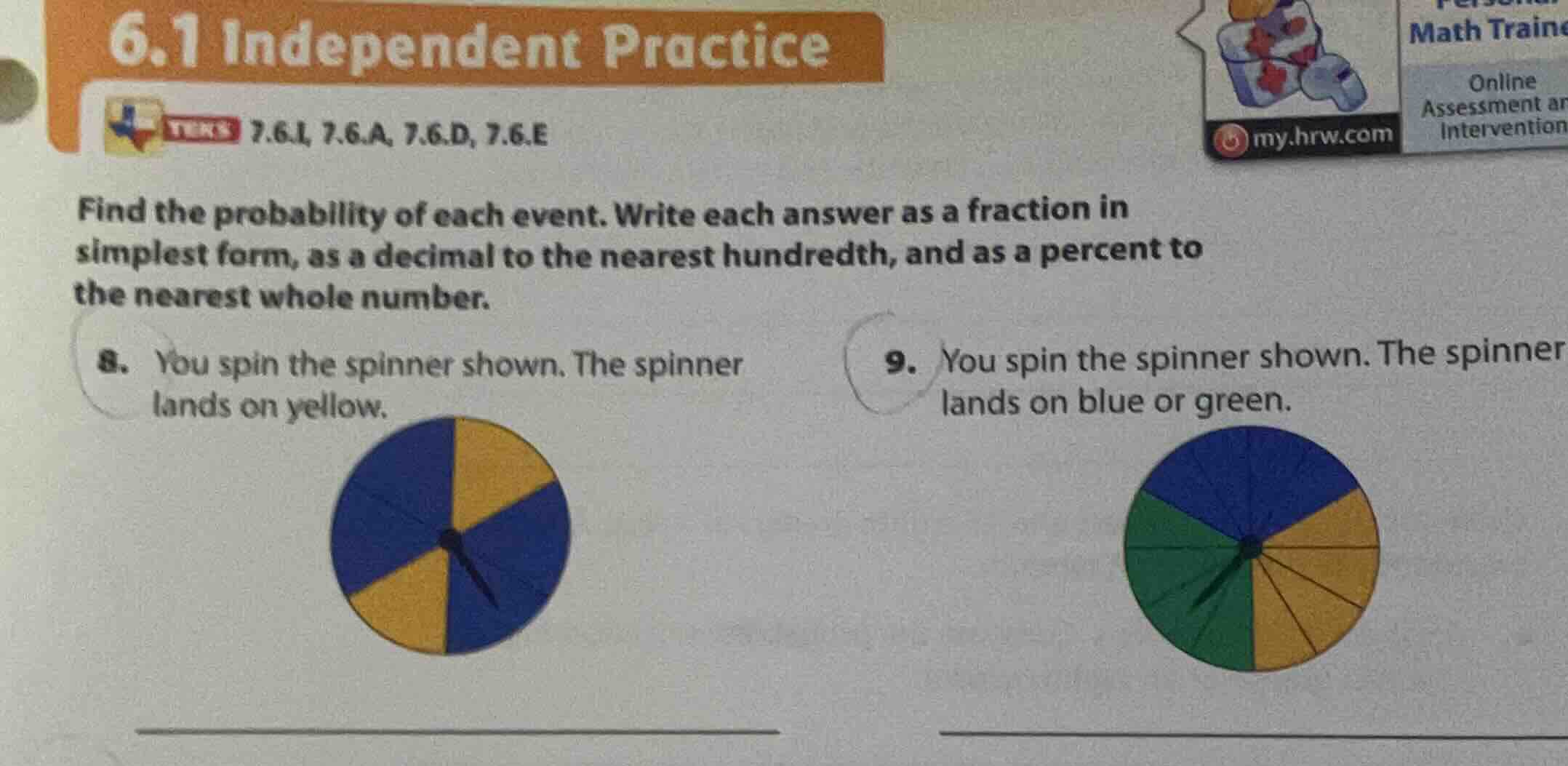
- you spin the spinner shown. the spinner lands on yellow.
- you spin the spinner shown. the spinner lands on blue or green.
Problem 8:
Step 1: Determine total sections
The spinner has 6 equal - sized sections (by looking at the spinner diagram: 2 yellow, 4 blue? Wait, no, looking at the first spinner: let's count the number of sections. The spinner is divided into 6 parts: 2 yellow and 4 blue? Wait, no, the first spinner (for problem 8) has 2 yellow and 4 blue? Wait, no, let's count again. The first spinner: the yellow parts are 2, and blue parts are 4? Wait, no, the diagram shows that the spinner is divided into 6 equal sectors. Let's see: the yellow regions are 2, and blue are 4? Wait, no, maybe I miscounted. Wait, the problem is about landing on yellow. Let's assume the spinner is divided into 6 equal - area sections, with 2 of them yellow.
The formula for probability is $P(event)=\frac{\text{Number of favorable outcomes}}{\text{Total number of possible outcomes}}$.
The number of favorable outcomes (landing on yellow) is 2. The total number of possible outcomes (total sections) is 6.
Step 2: Simplify the fraction
$P(\text{yellow})=\frac{2}{6}=\frac{1}{3}$.
Step 3: Convert to decimal
To convert $\frac{1}{3}$ to a decimal, we do $1\div3\approx0.33$ (to the nearest hundredth).
Step 4: Convert to percent
To convert the decimal to a percent, we multiply by 100. So $0.33\times100 = 33\%$ (to the nearest whole number).
Step 1: Determine total sections
Looking at the second spinner (for problem 9), let's count the total number of sections. Let's assume the spinner is divided into 12 equal - sized sections (by looking at the diagram: let's count the blue, green, and yellow sections. Let's say blue sections: 4, green sections: 4, yellow sections: 4? Wait, no, let's look again. The second spinner: blue, green, and yellow. Let's count the number of blue and green sections. Let's assume the total number of sections is 12. Let's say blue sections: 4, green sections: 4, yellow sections: 4? Wait, no, maybe the spinner is divided into 12 equal sectors. The number of blue sections: let's see, the blue part has 4 sections? Green has 4? Yellow has 4? Wait, the problem is landing on blue or green.
The number of favorable outcomes (blue or green) is the number of blue sections plus the number of green sections. Let's assume from the diagram: blue sections = 4, green sections = 4, so total favorable outcomes = 4 + 4=8. The total number of possible outcomes (total sections) is 12.
Step 2: Simplify the fraction
$P(\text{blue or green})=\frac{4 + 4}{12}=\frac{8}{12}=\frac{2}{3}$.
Step 3: Convert to decimal
To convert $\frac{2}{3}$ to a decimal, $2\div3\approx0.67$ (to the nearest hundredth).
Step 4: Convert to percent
Multiply the decimal by 100: $0.67\times100 = 67\%$ (to the nearest whole number).

Snap & solve any problem in the app
Get step-by-step solutions on Sovi AI
Photo-based solutions with guided steps
Explore more problems and detailed explanations
Fraction: $\frac{1}{3}$, Decimal: $0.33$, Percent: $33\%$