QUESTION IMAGE
Question
initial knowledge check
question 14
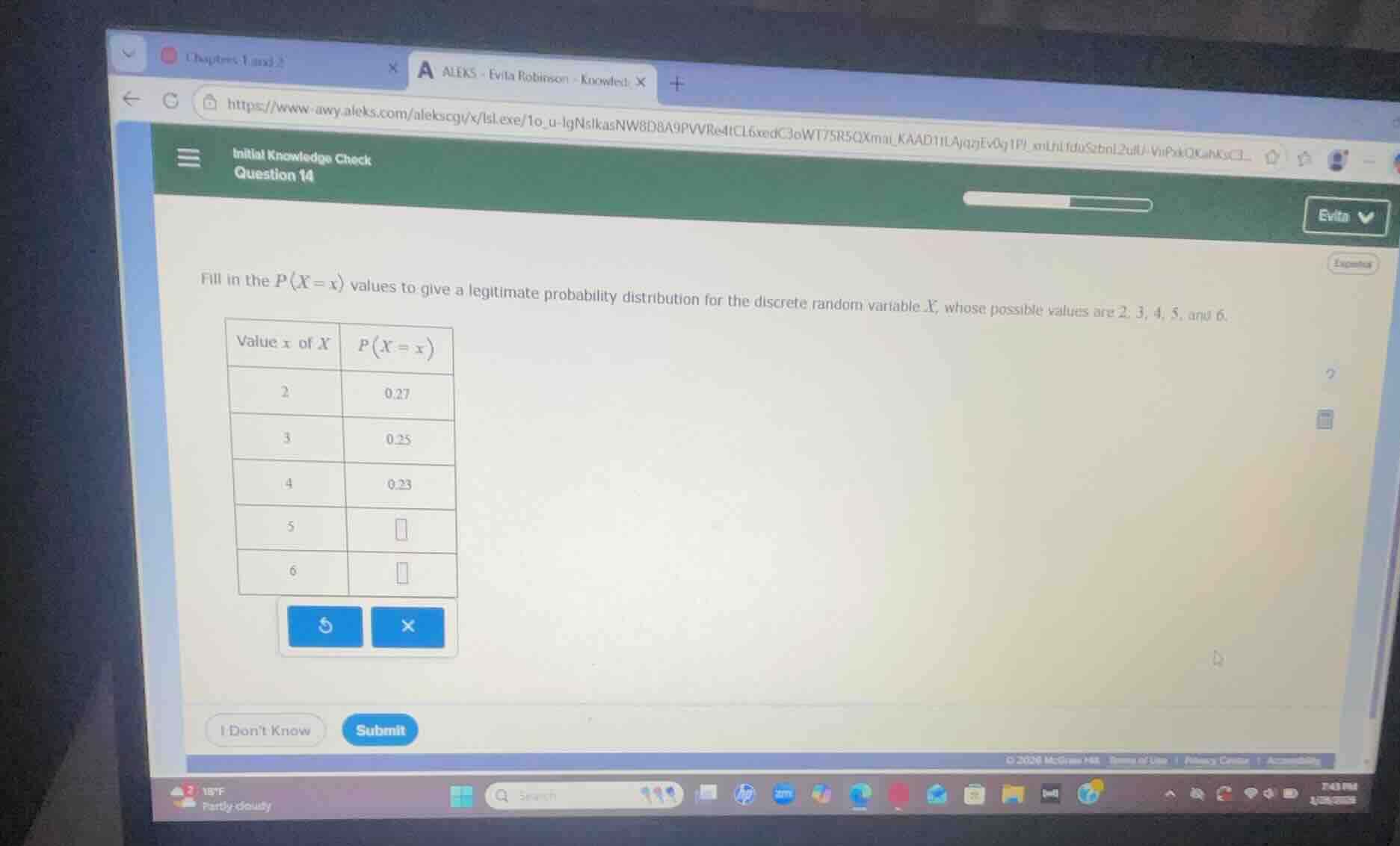
fill in the ( p(x = x) ) values to give a legitimate probability distribution for the discrete random variable ( x ), whose possible values are 2, 3, 4, 5, and 6.
| value ( x ) of ( x ) | ( p(x = x) ) |
|---|---|
| 3 | 0.25 |
| 4 | 0.23 |
| 5 | |
| 6 |
Step1: Sum known probabilities
$0.27 + 0.25 + 0.23 = 0.75$
Step2: Calculate remaining total probability
$1 - 0.75 = 0.25$
Step3: Assign equal values (valid split)
For a legitimate distribution, we can split the remaining probability equally between $x=5$ and $x=6$ (any non-negative values summing to 0.25 are valid; equal split is standard here):
$P(X=5) = \frac{0.25}{2} = 0.125$
$P(X=6) = \frac{0.25}{2} = 0.125$

Snap & solve any problem in the app
Get step-by-step solutions on Sovi AI
Photo-based solutions with guided steps
Explore more problems and detailed explanations
For $x=5$, $P(X=x)=0.125$; for $x=6$, $P(X=x)=0.125$
(Note: Any pair of non-negative numbers that add to 0.25 is also a valid solution, but equal division is a standard legitimate choice.)