QUESTION IMAGE
Question
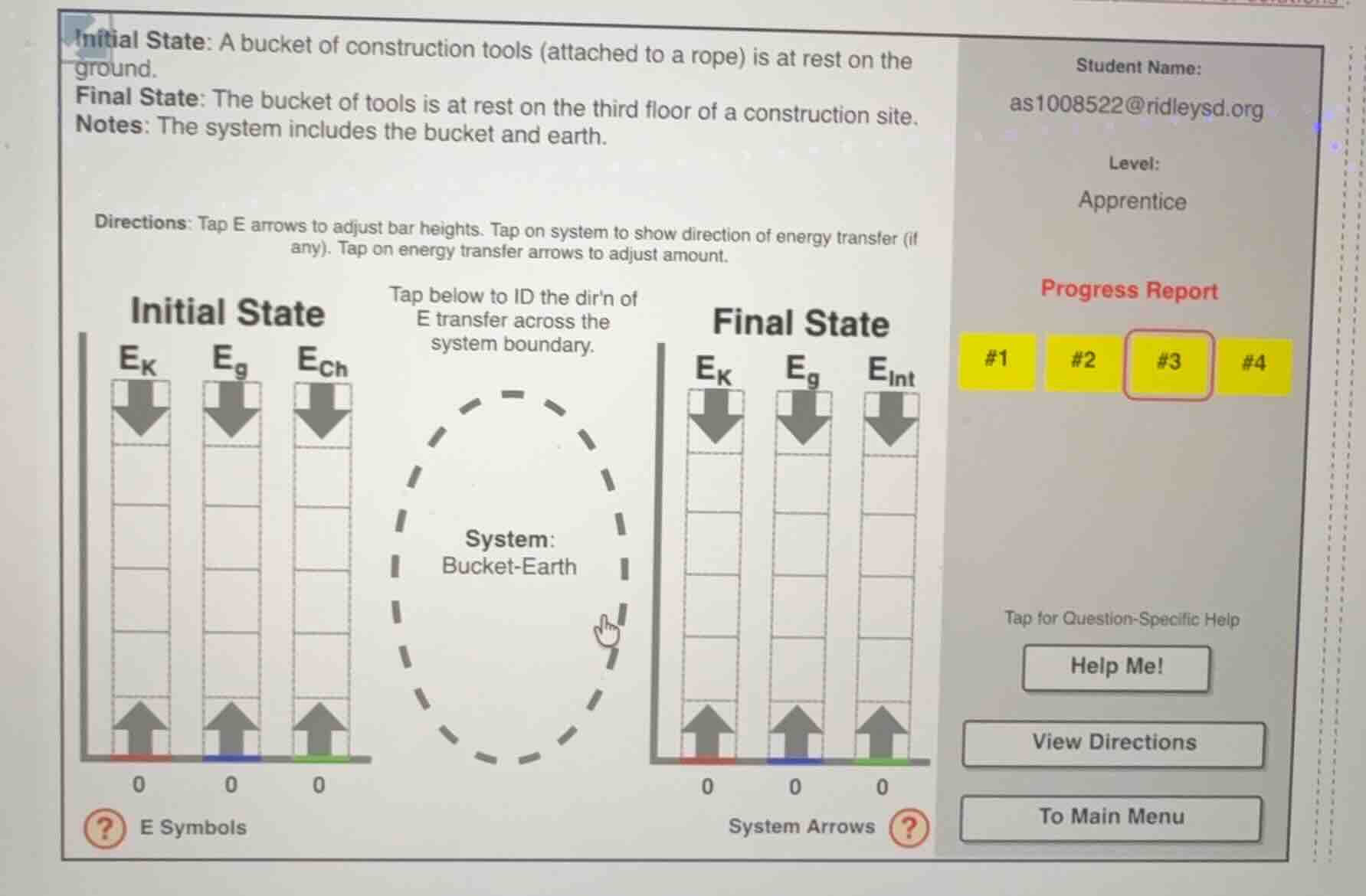
initial state: a bucket of construction tools (attached to a rope) is at rest on the ground.
final state: the bucket of tools is at rest on the third floor of a construction site.
notes: the system includes the bucket and earth.
directions: tap e arrows to adjust bar heights. tap on system to show direction of energy transfer (if any). tap on energy transfer arrows to adjust amount.
initial state
e_k, e_g, e_ch
tap below to id the dirn of e transfer across the system boundary.
final state
e_k, e_g, e_int
student name:
as1008522@ridleysd.org
level:
apprentice
progress report
#1 #2 #3 #4
? e symbols
system arrows ?
tap for question-specific help
help me!
view directions
to main menu
To solve this energy transfer problem, we analyze the initial and final states of the bucket - Earth system:
Step 1: Analyze Kinetic Energy ($E_K$)
In the initial state, the bucket is at rest on the ground, so its velocity $v = 0$. The formula for kinetic energy is $E_K=\frac{1}{2}mv^{2}$. Substituting $v = 0$ into the formula, we get $E_{K,initial}=0$. In the final state, the bucket is at rest on the third floor, so its velocity is also $0$. Using the same formula, $E_{K,final}=0$. So, there is no change in kinetic energy.
Step 2: Analyze Gravitational Potential Energy ($E_g$)
The formula for gravitational potential energy is $E_g = mgh$, where $h$ is the height relative to a reference point (here, the ground is the reference point with $h = 0$ initially). In the initial state, $h_{initial}=0$, so $E_{g,initial}=mg\times0 = 0$. In the final state, the bucket is on the third floor, so $h_{final}>0$. Then $E_{g,final}=mgh_{final}>0$. So, the gravitational potential energy of the system increases.
Step 3: Analyze Energy Transfer
For the system (bucket + Earth), to increase the gravitational potential energy, energy must be transferred into the system from an external source (like a person or a machine doing work on the bucket to lift it). Since the system's internal energy ($E_{Int}$) and chemical energy ($E_{Ch}$) in the initial state are $0$ (and there's no indication of a chemical reaction or internal energy change within the system itself), the energy transfer is into the system to increase the gravitational potential energy. So, the direction of energy transfer is into the system (from the surroundings to the bucket - Earth system) to increase $E_g$.
To represent the energy bars:
- For $E_K$: Both initial and final bars have a height corresponding to $0$ (since $E_K$ is $0$ in both states).
- For $E_g$: The initial bar has a height of $0$, and the final bar has a non - zero height (proportional to $mgh_{final}$).
- For the energy transfer: The arrow representing energy transfer should point into the system (the dashed - line circle representing the bucket - Earth system) to show that energy is being added to the system to increase the gravitational potential energy.
If we were to assign numerical values (assuming a mass $m$ and height $h$ of the third floor), say $m = 10\space kg$, $g = 9.8\space m/s^{2}$, and $h = 10\space m$ (approximate height of a third - floor building), then $E_g=mgh=10\times9.8\times10 = 980\space J$. So the final $E_g$ bar would have a height corresponding to $980\space J$, $E_K$ bars would have height $0$, and the energy transfer arrow would show energy entering the system.
The key points are: $E_K$ remains $0$, $E_g$ increases from $0$ to a positive value, and energy is transferred into the system.

Snap & solve any problem in the app
Get step-by-step solutions on Sovi AI
Photo-based solutions with guided steps
Explore more problems and detailed explanations
To solve this energy transfer problem, we analyze the initial and final states of the bucket - Earth system:
Step 1: Analyze Kinetic Energy ($E_K$)
In the initial state, the bucket is at rest on the ground, so its velocity $v = 0$. The formula for kinetic energy is $E_K=\frac{1}{2}mv^{2}$. Substituting $v = 0$ into the formula, we get $E_{K,initial}=0$. In the final state, the bucket is at rest on the third floor, so its velocity is also $0$. Using the same formula, $E_{K,final}=0$. So, there is no change in kinetic energy.
Step 2: Analyze Gravitational Potential Energy ($E_g$)
The formula for gravitational potential energy is $E_g = mgh$, where $h$ is the height relative to a reference point (here, the ground is the reference point with $h = 0$ initially). In the initial state, $h_{initial}=0$, so $E_{g,initial}=mg\times0 = 0$. In the final state, the bucket is on the third floor, so $h_{final}>0$. Then $E_{g,final}=mgh_{final}>0$. So, the gravitational potential energy of the system increases.
Step 3: Analyze Energy Transfer
For the system (bucket + Earth), to increase the gravitational potential energy, energy must be transferred into the system from an external source (like a person or a machine doing work on the bucket to lift it). Since the system's internal energy ($E_{Int}$) and chemical energy ($E_{Ch}$) in the initial state are $0$ (and there's no indication of a chemical reaction or internal energy change within the system itself), the energy transfer is into the system to increase the gravitational potential energy. So, the direction of energy transfer is into the system (from the surroundings to the bucket - Earth system) to increase $E_g$.
To represent the energy bars:
- For $E_K$: Both initial and final bars have a height corresponding to $0$ (since $E_K$ is $0$ in both states).
- For $E_g$: The initial bar has a height of $0$, and the final bar has a non - zero height (proportional to $mgh_{final}$).
- For the energy transfer: The arrow representing energy transfer should point into the system (the dashed - line circle representing the bucket - Earth system) to show that energy is being added to the system to increase the gravitational potential energy.
If we were to assign numerical values (assuming a mass $m$ and height $h$ of the third floor), say $m = 10\space kg$, $g = 9.8\space m/s^{2}$, and $h = 10\space m$ (approximate height of a third - floor building), then $E_g=mgh=10\times9.8\times10 = 980\space J$. So the final $E_g$ bar would have a height corresponding to $980\space J$, $E_K$ bars would have height $0$, and the energy transfer arrow would show energy entering the system.
The key points are: $E_K$ remains $0$, $E_g$ increases from $0$ to a positive value, and energy is transferred into the system.