QUESTION IMAGE
Question
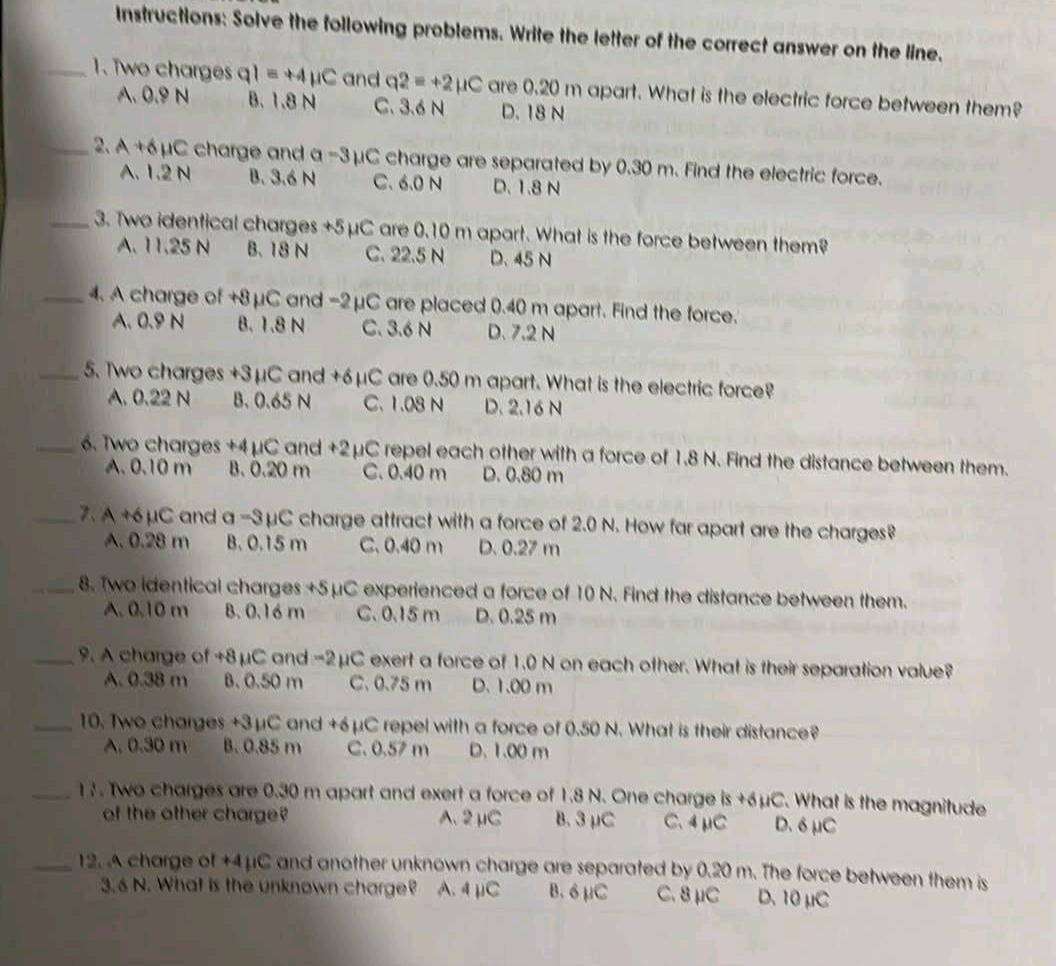
instructions: solve the following problems. write the letter of the correct answer on the line.
- two charges q1 = +4μc and q2 = +2μc are 0.20 m apart. what is the electric force between them?
a. 0.9 n b. 1.8 n c. 3.6 n d. 18 n
- a +6μc charge and a -3μc charge are separated by 0.30 m. find the electric force.
a. 1.2 n b. 3.6 n c. 6.0 n d. 1.8 n
- two identical charges +5μc are 0.10 m apart. what is the force between them?
a. 11.25 n b. 18 n c. 22.5 n d. 45 n
- a charge of +8μc and -2μc are placed 0.40 m apart. find the force.
a. 0.9 n b. 1.8 n c. 3.6 n d. 7.2 n
- two charges +3μc and +6μc are 0.50 m apart. what is the electric force?
a. 0.22 n b. 0.65 n c. 1.08 n d. 2.16 n
- two charges +4μc and +2μc repel each other with a force of 1.8 n. find the distance between them.
a. 0.10 m b. 0.20 m c. 0.40 m d. 0.80 m
- a +6μc and a -3μc charge attract with a force of 2.0 n. how far apart are the charges?
a. 0.28 m b. 0.15 m c. 0.40 m d. 0.27 m
- two identical charges +5μc experienced a force of 10 n. find the distance between them.
a. 0.10 m b. 0.16 m c. 0.15 m d. 0.25 m
- a charge of +8μc and -2μc exert a force of 1.0 n on each other. what is their separation value?
a. 0.38 m b. 0.50 m c. 0.75 m d. 1.00 m
- two charges +3μc and +6μc repel with a force of 0.50 n. what is their distance?
a. 0.30 m b. 0.85 m c. 0.57 m d. 1.00 m
- two charges are 0.30 m apart and exert a force of 1.8 n. one charge is +6μc. what is the magnitude of the other charge? a. 2 μc b. 3 μc c. 4 μc d. 6 μc
- a charge of +4μc and another unknown charge are separated by 0.20 m. the force between them is 3.6 n. what is the unknown charge? a. 4 μc b. 6 μc c. 8 μc d. 10 μc
: Substitute
\( r = \sqrt{\frac{9\times10^9 \times (4\times10^{-6})(2\times10^{-6})}{1.8}} \)
\( = \sqrt{\frac{9\times10^9 \times 8\times10^{-12}}{1.8}} \)
\( = \sqrt{\frac{72\times10^{-3}}{1.8}} \)
\( = \sqrt{40\times10^{-3}} \)
\( = \sqrt{0.04} \)
\( = 0.20 \, \text{m} \)
Step1: Rearrange Coulomb's Law for \( r \)
\( r = \sqrt{\frac{k|q_1q_2|}{F}} \)
\( q_1 = 6\times10^{-6} \, \text{C} \), \( q_2 = -3\times10^{-6} \, \text{C} \) (absolute value product \( 18\times10^{-12} \)), \( F = 2.0 \, \text{N} \), \( k = 9\times10^9 \).
Step2: Calculate
\( r = \sqrt{\frac{9\times10^9 \times 18\times10^{-12}}{2.0}} \)
\( = \sqrt{\frac{162\times10^{-3}}{2.0}} \)
\( = \sqrt{81\times10^{-3}} \)
\( = \sqrt{0.081} \approx 0.28 \, \text{m} \)
Step1: Rearrange for \( r \)
\( r = \sqrt{\frac{kq_1q_2}{F}} \), \( q_1 = q_2 = 5\times10^{-6} \, \text{C} \), \( F = 10 \, \text{N} \), \( k = 9\times10^9 \).
Step2: Substitute
\( r = \sqrt{\frac{9\times10^9 \times (5\times10^{-6})^2}{10}} \)
\( = \sqrt{\frac{9\times10^9 \times 25\times10^{-12}}{10}} \)
\( = \sqrt{\frac{225\times10^{-3}}{10}} \)
\( = \sqrt{22.5\times10^{-3}} \)
\( = \sqrt{0.0225} = 0.15 \, \text{m} \)
Step1: Rearrange Coulomb's Law
\( r = \sqrt{\frac{k|q_1q_2|}{F}} \)
\( q_1 = 8\times10^{-6} \, \text{C} \), \( q_2 = -2\times10^{-6} \, \text{C} \) (absolute value product \( 16\times10^{-12} \)), \( F = 1.0 \, \text{N} \), \( k = 9\times10^9 \).
Step2: Calculate
\( r = \sqrt{\frac{9\times10^9 \times 16\times10^{-12}}{1.0}} \)
\( = \sqrt{\frac{144\times10^{-3}}{1.0}} \)
\( = \sqrt{0.144} \approx 0.38 \, \text{m} \)

Snap & solve any problem in the app
Get step-by-step solutions on Sovi AI
Photo-based solutions with guided steps
Explore more problems and detailed explanations
B. 0.20 m