QUESTION IMAGE
Question
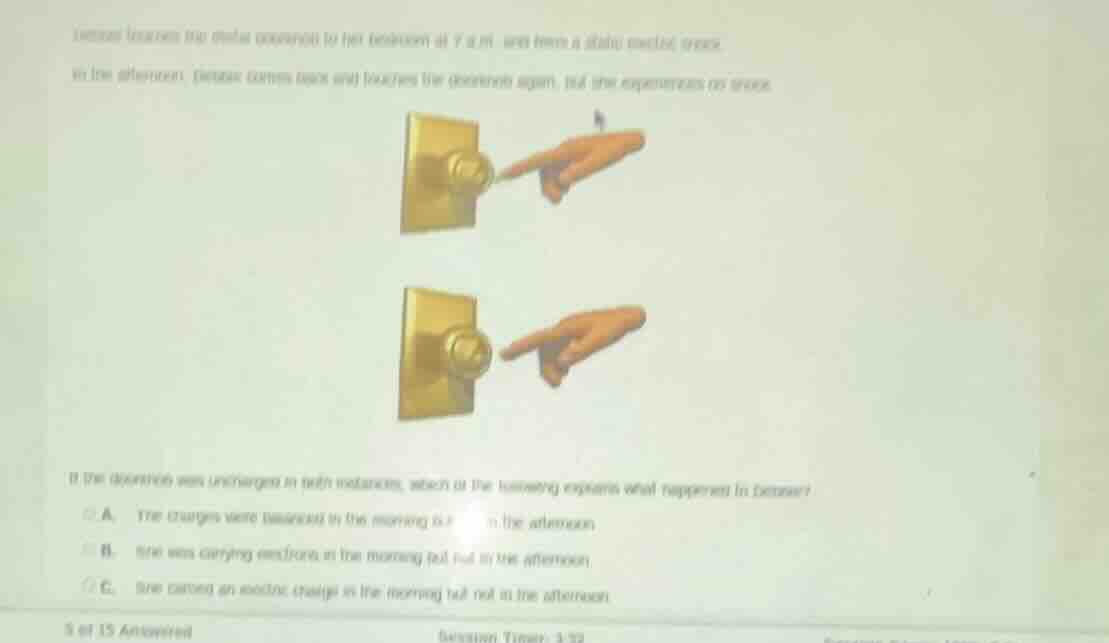
jenna touches the doorknob connected to her bedroom at 7 a.m. and feels a static electric shock. in the afternoon, jenna comes back and touches the doorknob again, but she experiences no shock. if the doorknob was uncharged in both instances, which of the following explains what happened to jenna? a. the charges were transferred to the doorknob in the afternoon. b. she was carrying electrons in the morning but not in the afternoon. c. she carried an electric charge in the morning but not in the afternoon.
To solve this, we analyze the electrostatic discharge (shock) scenario:
Key Concept:
Electrostatic shock occurs when there's a transfer of static electric charge between a person and an object. If the doorknob is uncharged, the shock depends on the person having static charge (to transfer to the doorknob) or not.
Analyzing Each Option:
- Option A: If charges were "balanced" (no net charge transfer) in both, there would be no shock in either. Eliminate A.
- Option B: "Carrying electrons" (having static charge) in the morning but not the afternoon. If she had static charge in the morning, touching the doorknob would transfer charge (causing a shock). If no charge in the afternoon, no shock. This matches the scenario (shock in morning, none in afternoon).
- Option C: "Got an electric charge" implies the doorknob charged her, but the doorknob is uncharged. Charge transfer is from the person (with static charge) to the doorknob, not the reverse. Eliminate C.
The shock occurs when a person with static electric charge (e.g., excess electrons) touches an uncharged object (doorknob), transferring charge. If Tessa had static charge (carried electrons) in the morning, she got a shock; if not in the afternoon, no shock. Option B explains this. Options A (balanced charges → no shock) and C (uncharged doorknob charging her → illogical) are incorrect.

Snap & solve any problem in the app
Get step-by-step solutions on Sovi AI
Photo-based solutions with guided steps
Explore more problems and detailed explanations
B. She was carrying electrons in the morning, but not in the afternoon.