QUESTION IMAGE
Question
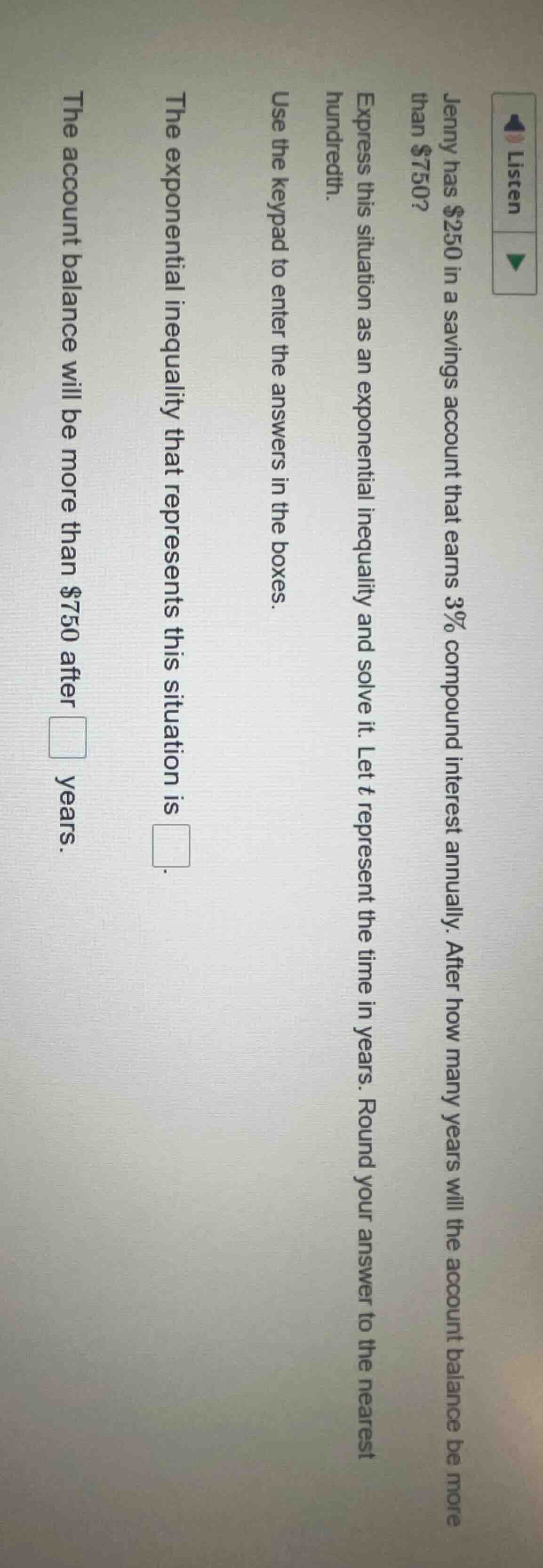
jenny has $250 in a savings account that earns 3% compound interest annually. after how many years will the account balance be more than $750? express this situation as an exponential inequality and solve it. let t represent the time in years. round your answer to the nearest hundredth. use the keypad to enter the answers in the boxes. the exponential inequality that represents this situation is. the account balance will be more than $750 after years.
Step1: Recall compound interest formula
The formula for annual compound interest is $A = P(1+r)^t$, where $P=\$250$, $r=0.03$, and $A>\$750$.
Step2: Write the exponential inequality
Substitute values into the formula:
$250(1+0.03)^t > 750$
Step3: Simplify the inequality
Divide both sides by 250:
$(1.03)^t > 3$
Step4: Solve for t using logarithms
Take natural log of both sides:
$\ln(1.03^t) > \ln(3)$
Use log power rule $\ln(a^b)=b\ln(a)$:
$t\ln(1.03) > \ln(3)$
Isolate t:
$t > \frac{\ln(3)}{\ln(1.03)}$
Step5: Calculate the value
Compute the right-hand side:
$t > \frac{1.098612}{0.029559} \approx 37.17$

Snap & solve any problem in the app
Get step-by-step solutions on Sovi AI
Photo-based solutions with guided steps
Explore more problems and detailed explanations
The exponential inequality that represents this situation is $250(1.03)^t > 750$.
The account balance will be more than $\$750$ after $37.17$ years.