QUESTION IMAGE
Question
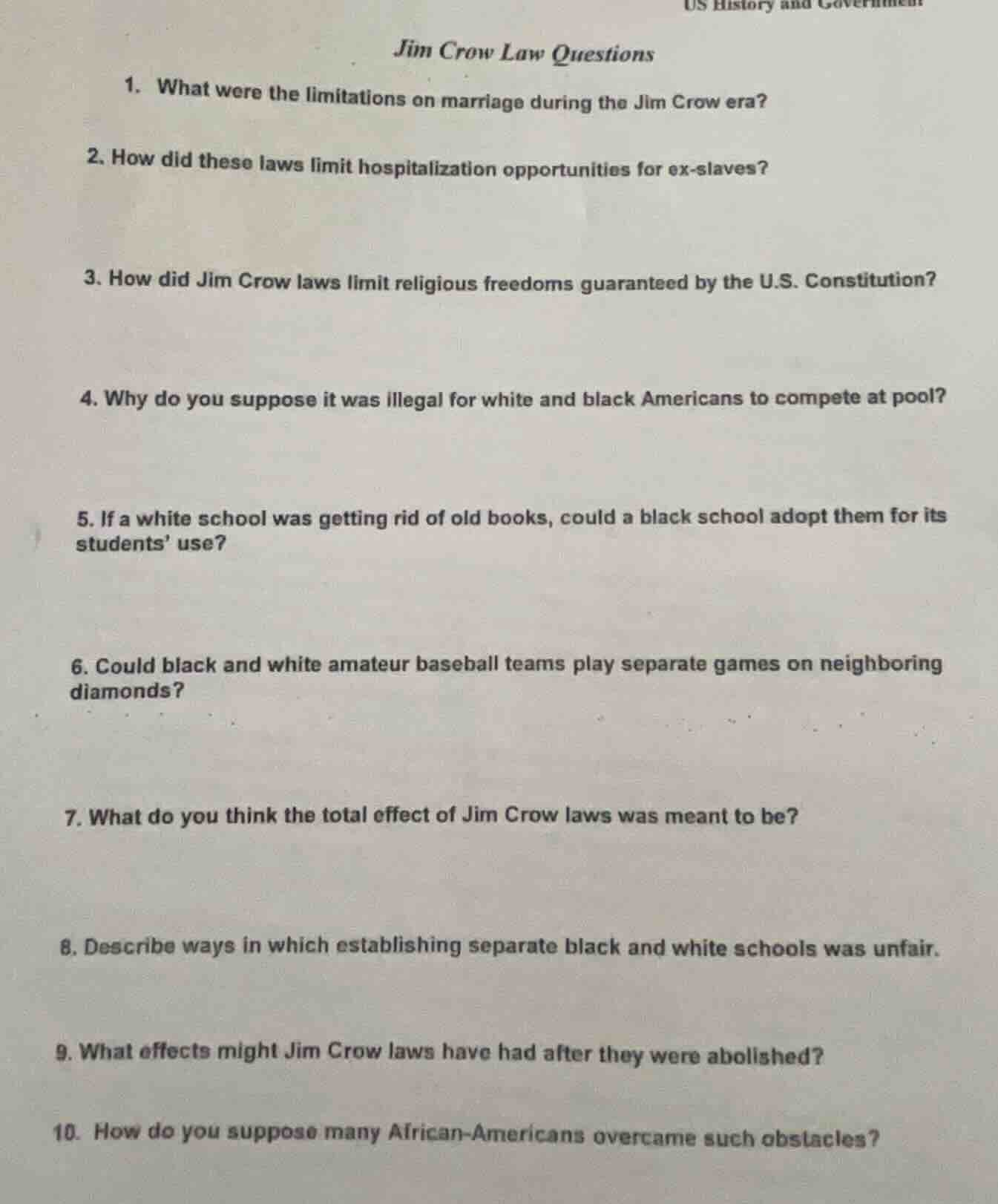
jim crow law questions
- what were the limitations on marriage during the jim crow era?
- how did these laws limit hospitalization opportunities for ex-slaves?
- how did jim crow laws limit religious freedoms guaranteed by the u.s. constitution?
- why do you suppose it was illegal for white and black americans to compete at pool?
- if a white school was getting rid of old books, could a black school adopt them for its students use?
- could black and white amateur baseball teams play separate games on neighboring diamonds?
- what do you think the total effect of jim crow laws was meant to be?
- describe ways in which establishing separate black and white schools was unfair.
- what effects might jim crow laws have had after they were abolished?
- how do you suppose many african-americans overcame such obstacles?
Brief Explanations
- Jim Crow-era anti-miscegenation laws banned interracial marriage, enforcing racial segregation in marital unions.
- Jim Crow laws enforced segregated hospital facilities, with Black patients relegated to underfunded, overcrowded, and lower-quality wards or separate hospitals, denying them equal access to care.
- These laws enforced segregated religious spaces, barred Black worshipers from white congregations' full participation, and restricted Black religious leaders' ability to operate across racial lines, violating the First Amendment's free exercise and establishment clauses.
- This was part of enforcing strict racial hierarchy; integrated leisure activities like pool competition challenged the idea of white racial superiority by implying social equality.
- No, Jim Crow segregation rules prohibited sharing school resources between white and Black institutions, as it would violate the "separate but equal" doctrine's strict racial separation.
- No, even separate games on neighboring fields were often banned under Jim Crow, as any proximity in leisure activities was seen as undermining racial segregation and hierarchy.
- The total effect was to enforce and maintain white racial supremacy, codify racial segregation in all public and private life, and suppress Black social, economic, and political advancement.
- Separate schools were unfair because white schools received far more funding, had newer facilities, better-qualified teachers, and more comprehensive curricula, while Black schools were underresourced, perpetuating educational inequality.
- After abolition, Jim Crow left enduring systemic racism: wealth gaps from limited economic opportunities, intergenerational educational inequities, racial bias in institutions, and cultural attitudes that sustained discrimination.
- African-Americans overcame obstacles through forming mutual aid societies, civil rights activism (including legal challenges and grassroots protests), building independent Black institutions (schools, businesses, churches), and community organizing to advocate for equality.

Snap & solve any problem in the app
Get step-by-step solutions on Sovi AI
Photo-based solutions with guided steps
Explore more problems and detailed explanations
- Anti-miscegenation laws banned interracial marriage.
- Enforced segregated, underfunded Black-only hospital facilities.
- Segregated religious spaces, restricted cross-racial religious participation, violating First Amendment rights.
- To uphold white racial superiority by preventing equal social interaction.
- No, strict segregation rules prohibited resource sharing.
- No, proximity in leisure activities was banned to preserve racial hierarchy.
- Enforce white supremacy, codify racial segregation, suppress Black advancement.
- White schools had far more funding, better facilities, teachers, and curricula.
- Enduring systemic racism, wealth/education gaps, institutional bias, and discriminatory cultural attitudes.
- Mutual aid societies, civil rights activism, independent Black institutions, and community organizing.