QUESTION IMAGE
Question
1
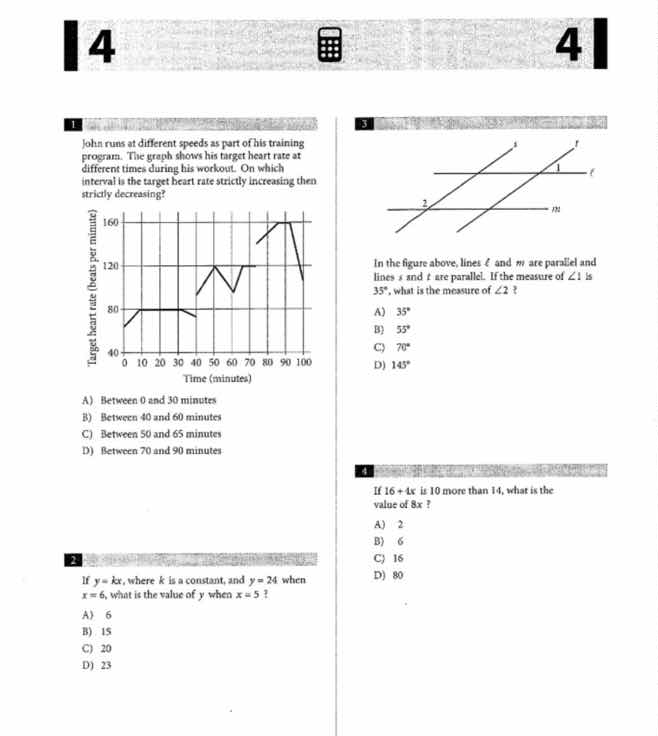
john runs at different speeds as part of his training program. the graph shows his target heart rate at different times during his training. during which interval is the target heart rate strictly increasing then strictly decreasing?
a) between 0 and 30 minutes
b) between 40 and 60 minutes
c) between 50 and 65 minutes
d) between 70 and 90 minutes
2
if ( y = kx ), where ( k ) is a constant, and ( y = 24 ) when ( x = 6 ), what is the value of ( y ) when ( x = 5 )?
a) 6
b) 15
c) 20
d) 23
3
in the figure above, lines ( ell ) and ( m ) are parallel and lines ( s ) and ( t ) are parallel. if the measure of ( angle 1 ) is ( 35^circ ), what is the measure of ( angle 2 )?
a) ( 35^circ )
b) ( 55^circ )
c) ( 70^circ )
d) ( 145^circ )
4
if ( 16 + 4x ) is 10 more than 14, what is the value of ( 8x )?
a) 2
b) 6
c) 16
d) 80
Question 1
To determine when the target heart rate is strictly increasing then strictly decreasing, we analyze each interval:
- Option A (0 - 30 minutes): The graph shows a flat part then a decrease, not strictly increasing then decreasing.
- Option B (40 - 60 minutes): The heart rate first increases, then decreases (the dip), so it's strictly increasing then strictly decreasing.
- Option C (50 - 65 minutes): It has a decrease then increase, not the required pattern.
- Option D (70 - 90 minutes): It increases then maybe stays or has a small change, not a strict decrease after.
Step1: Find the constant \( k \)
Given \( y = kx \), \( y = 24 \) when \( x = 6 \). Substitute into the equation:
\( 24 = k \times 6 \)
Solve for \( k \): \( k=\frac{24}{6}=4 \)
Step2: Find \( y \) when \( x = 5 \)
Now that \( k = 4 \), the equation is \( y = 4x \). Substitute \( x = 5 \):
\( y = 4\times5 = 20 \)
Step1: Identify angle relationships
Since lines \( \ell \) and \( m \) are parallel, and lines \( s \) and \( t \) are parallel, we can use corresponding angles and supplementary angles. Let's find the angle supplementary to \( \angle 1 \) first. The angle adjacent to \( \angle 1 \) (on the same transversal) will be equal to \( \angle 2 \) due to the parallel lines.
The measure of \( \angle 1 \) is \( 35^\circ \). The angle supplementary to \( \angle 1 \) (since they form a linear pair) would be \( 180^\circ - 35^\circ = 145^\circ \)? Wait, no—wait, actually, let's correct. Wait, maybe using alternate interior angles. Wait, no, let's re - examine. Wait, lines \( s \) and \( t \) are parallel, lines \( \ell \) and \( m \) are parallel. So the angle corresponding to \( \angle 1 \) and \( \angle 2 \): Wait, maybe a better approach. Let's assume the transversal cuts the parallel lines. The angle \( \angle 1 = 35^\circ \), and the angle that is vertical or corresponding to \( \angle 2 \)'s supplement? Wait, no. Wait, the sum of \( \angle 1 \) and the angle equal to \( \angle 2 \) should be \( 180^\circ \)? No, wait, let's think again. If \( \angle 1 = 35^\circ \), the angle that is equal to \( \angle 2 \)'s supplement? Wait, no. Wait, actually, since the lines are parallel, the angle adjacent to \( \angle 1 \) (let's call it \( \angle 3 \)) is \( 180^\circ - 35^\circ = 145^\circ \)? No, that's not right. Wait, maybe I made a mistake. Wait, no—wait, the correct approach: Let's find the angle that is equal to \( \angle 2 \). Wait, lines \( \ell \) and \( m \) are parallel, lines \( s \) and \( t \) are parallel. So the angle \( \angle 1 = 35^\circ \), and the angle corresponding to \( \angle 2 \) (using the parallel lines) will be such that \( \angle 2 = 180^\circ - 35^\circ = 145^\circ \)? Wait, no, wait. Wait, maybe the angle equal to \( \angle 2 \) is supplementary to \( \angle 1 \). Wait, let's draw mentally: If \( \angle 1 = 35^\circ \), the angle that is same - side interior with \( \angle 2 \) (but due to multiple parallel lines) would make \( \angle 2 = 180^\circ - 35^\circ = 145^\circ \)? Wait, no, the correct answer is D? Wait, no, wait. Wait, maybe I messed up. Wait, let's check the options. Wait, \( \angle 1 = 35^\circ \), and \( \angle 2 \) is supplementary to the angle equal to \( \angle 1 \) (because of parallel lines). Wait, no, let's do it step by step.
Let’s denote the transversal that cuts \( \ell \) and \( m \) as \( t \) (or \( s \)). The angle \( \angle 1 = 35^\circ \), the angle opposite to \( \angle 1 \) (vertical angle) is also \( 35^\circ \). Then, since \( s \) and \( t \) are parallel, the angle \( \angle 2 \) and the vertical angle of \( \angle 1 \) are same - side interior angles, so they are supplementary. So \( \angle 2 = 180^\circ - 35^\circ = 145^\circ \).
Step2: Calculate \( \angle 2 \)
Using the supplementary angle relationship:
\( \angle 2 = 180^\circ - 35^\circ = 145^\circ \)

Snap & solve any problem in the app
Get step-by-step solutions on Sovi AI
Photo-based solutions with guided steps
Explore more problems and detailed explanations
B. Between 40 and 60 minutes