QUESTION IMAGE
Question
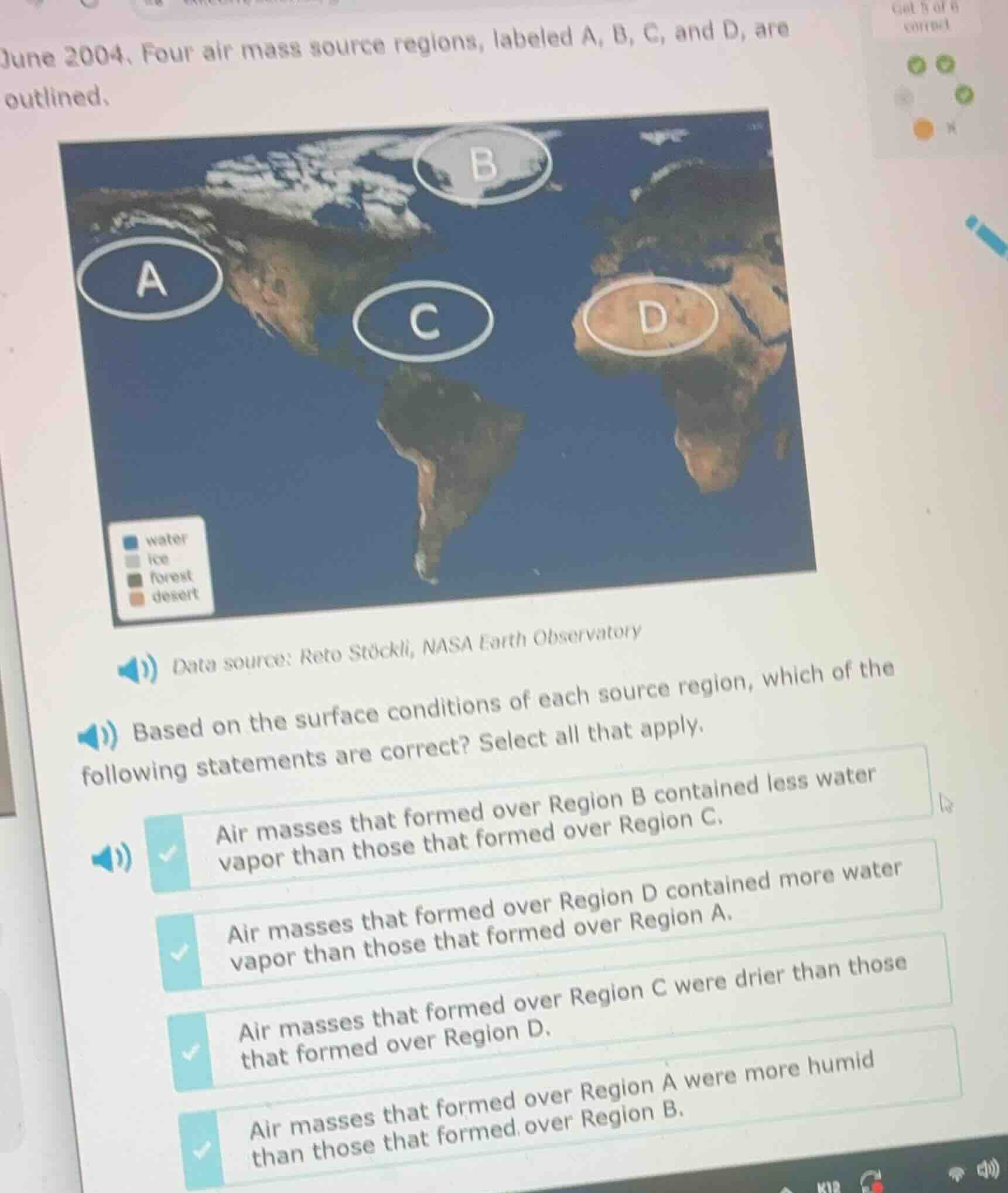
june 2004. four air mass source regions, labeled a, b, c, and d, are outlined.
data source: reto stöckli, nasa earth observatory
based on the surface conditions of each source region, which of the following statements are correct? select all that apply.
air masses that formed over region b contained less water vapor than those that formed over region c.
air masses that formed over region d contained more water vapor than those that formed over region a.
air masses that formed over region c were drier than those that formed over region d.
air masses that formed over region a were more humid than those that formed over region b.
- Region B is an ice-covered polar area, which has very low evaporation, so its air masses hold less water vapor than Region C (open ocean, high evaporation).
- Region D is a desert with low moisture, so its air masses have less water vapor than Region A (open ocean, high evaporation), making this statement incorrect.
- Region C is open ocean (high moisture), so its air masses are more humid (not drier) than Region D (desert, low moisture), making this statement incorrect.
- Region A is warm open ocean with high evaporation, so its air masses are more humid than cold, ice-covered Region B with minimal evaporation.

Snap & solve any problem in the app
Get step-by-step solutions on Sovi AI
Photo-based solutions with guided steps
Explore more problems and detailed explanations
- Correct: Air masses that formed over Region B contained less water vapor than those that formed over Region C.
- Correct: Air masses that formed over Region A were more humid than those that formed over Region B.
- Incorrect: Air masses that formed over Region D contained more water vapor than those that formed over Region A.
- Incorrect: Air masses that formed over Region C were drier than those that formed over Region D.