QUESTION IMAGE
Question
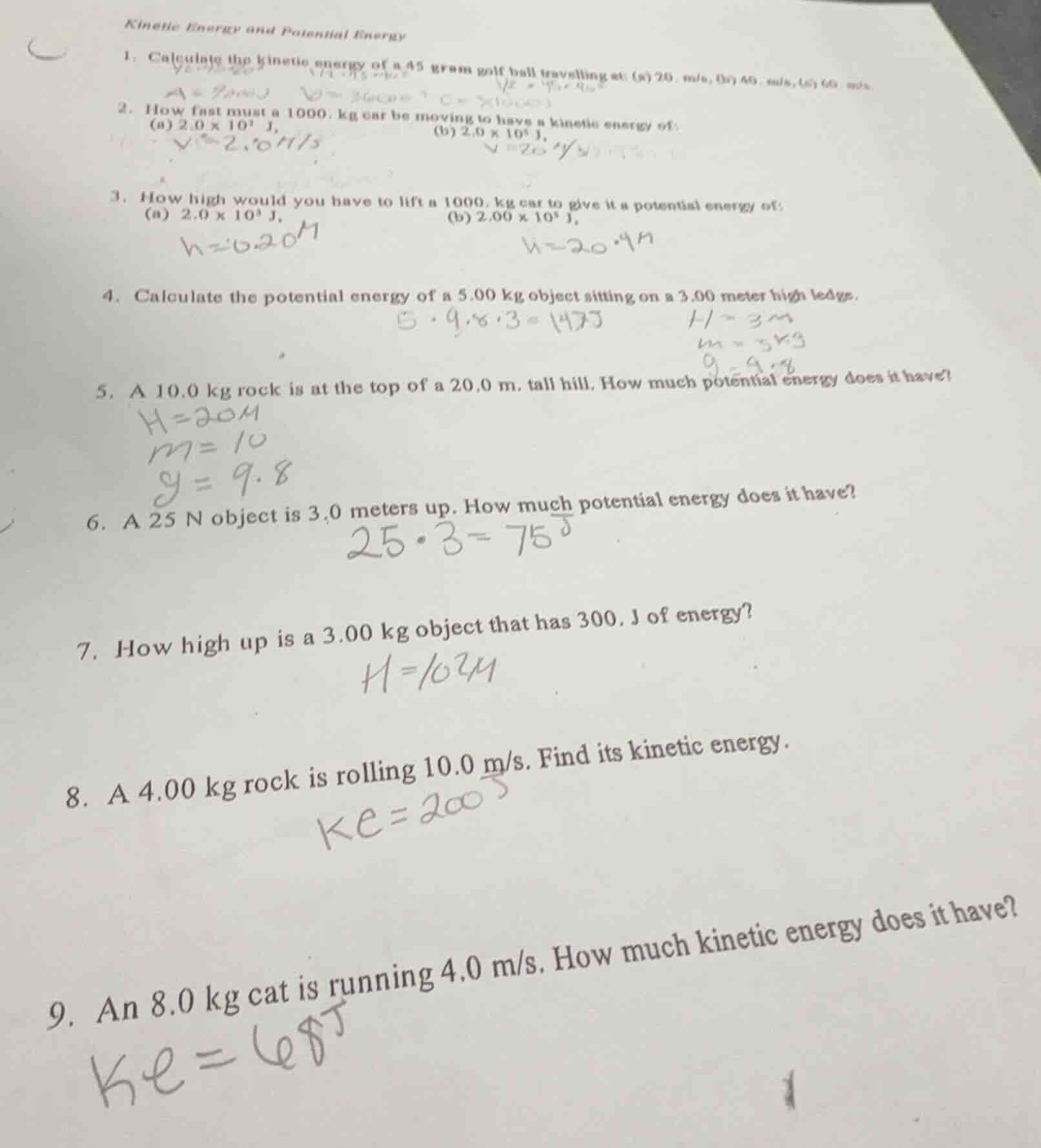
kinetic energy and potential energy
- calculate the kinetic energy of a 45 gram golf ball travelling at: (a) 20. m/s, (b) 40. m/s, (c) 60. m/s
- how fast must a 1000. kg car be moving to have a kinetic energy of:
(a) $2.0 \times 10^{3}$ j,
(b) $2.0 \times 10^{5}$ j,
- how high would you have to lift a 1000. kg car to give it a potential energy of:
(a) $2.0 \times 10^{3}$ j,
(b) $2.00 \times 10^{5}$ j,
- calculate the potential energy of a 5.00 kg object sitting on a 3.00 meter high ledge.
- a 10.0 kg rock is at the top of a 20.0 m. tall hill. how much potential energy does it have?
- a 25 n object is 3.0 meters up. how much potential energy does it have?
- how high up is a 3.00 kg object that has 300. j of energy?
- a 4.00 kg rock is rolling 10.0 m/s. find its kinetic energy.
- an 8.0 kg cat is running 4.0 m/s. how much kinetic energy does it have?
Problem 1
Step1: Convert mass to kg
$m = 45\ \text{g} = 0.045\ \text{kg}$
Step2: Kinetic energy formula
$KE = \frac{1}{2}mv^2$
Step3: Calculate for 20 m/s
$KE = \frac{1}{2} \times 0.045 \times 20^2 = 9\ \text{J}$
Step4: Calculate for 40 m/s
$KE = \frac{1}{2} \times 0.045 \times 40^2 = 36\ \text{J}$
Step5: Calculate for 60 m/s
$KE = \frac{1}{2} \times 0.045 \times 60^2 = 81\ \text{J}$
---
Problem 2
Step1: Rearrange KE for velocity
$v = \sqrt{\frac{2KE}{m}}$
Step2: Calculate for $2.0 \times 10^3\ \text{J}$
$v = \sqrt{\frac{2 \times 2.0 \times 10^3}{1000}} = 2.0\ \text{m/s}$
Step3: Calculate for $2.0 \times 10^5\ \text{J}$
$v = \sqrt{\frac{2 \times 2.0 \times 10^5}{1000}} = 20\ \text{m/s}$
---
Problem 3
Step1: Rearrange PE for height
$h = \frac{PE}{mg}$, use $g=9.8\ \text{m/s}^2$
Step2: Calculate for $2.0 \times 10^3\ \text{J}$
$h = \frac{2.0 \times 10^3}{1000 \times 9.8} \approx 0.20\ \text{m}$
Step3: Calculate for $2.00 \times 10^5\ \text{J}$
$h = \frac{2.00 \times 10^5}{1000 \times 9.8} \approx 20.4\ \text{m}$
---
Problem 4
Step1: Gravitational PE formula
$PE = mgh$
Step2: Substitute values
$PE = 5.00 \times 9.8 \times 3.00 = 147\ \text{J}$
---
Problem 5
Step1: Apply PE formula
$PE = mgh$
Step2: Substitute values
$PE = 10.0 \times 9.8 \times 20.0 = 1960\ \text{J}$
---
Problem 6
Step1: PE formula for weight (W=mg)
$PE = Wh$
Step2: Substitute values
$PE = 25 \times 3.0 = 75\ \text{J}$
---
Problem 7
Step1: Rearrange PE for height
$h = \frac{PE}{mg}$
Step2: Substitute values
$h = \frac{300}{3.00 \times 9.8} \approx 10.2\ \text{m}$
---
Problem 8
Step1: Apply KE formula
$KE = \frac{1}{2}mv^2$
Step2: Substitute values
$KE = \frac{1}{2} \times 4.00 \times 10.0^2 = 200\ \text{J}$
---
Problem 9
Step1: Apply KE formula
$KE = \frac{1}{2}mv^2$
Step2: Substitute values
$KE = \frac{1}{2} \times 8.0 \times 4.0^2 = 64\ \text{J}$

Snap & solve any problem in the app
Get step-by-step solutions on Sovi AI
Photo-based solutions with guided steps
Explore more problems and detailed explanations
- (a) $9\ \text{J}$, (b) $36\ \text{J}$, (c) $81\ \text{J}$
- (a) $2.0\ \text{m/s}$, (b) $20\ \text{m/s}$
- (a) $0.20\ \text{m}$, (b) $20.4\ \text{m}$
- $147\ \text{J}$
- $1960\ \text{J}$
- $75\ \text{J}$
- $10.2\ \text{m}$
- $200\ \text{J}$
- $64\ \text{J}$