QUESTION IMAGE
Question
kinetic energy and potential energy formulas
learning target: i can calculate potential and kinetic energy.
potential energy and kinetic energy are both measured in joules (j), but they have
different formulas with respect to their different attributes.
potential energy depends on the force acting on the two objects, so its formula is:
potential energy = mgh
- m is the mass measured in kilograms
- g is the acceleration due to gravity (9.8 m/s²)
- h is the height in meters
kinetic energy is directly proportional to an object’s mass and the square of its velocity:
kinetic energy = ½ mv²
- m is the mass measured in kilograms
- v is the velocity of meters per second
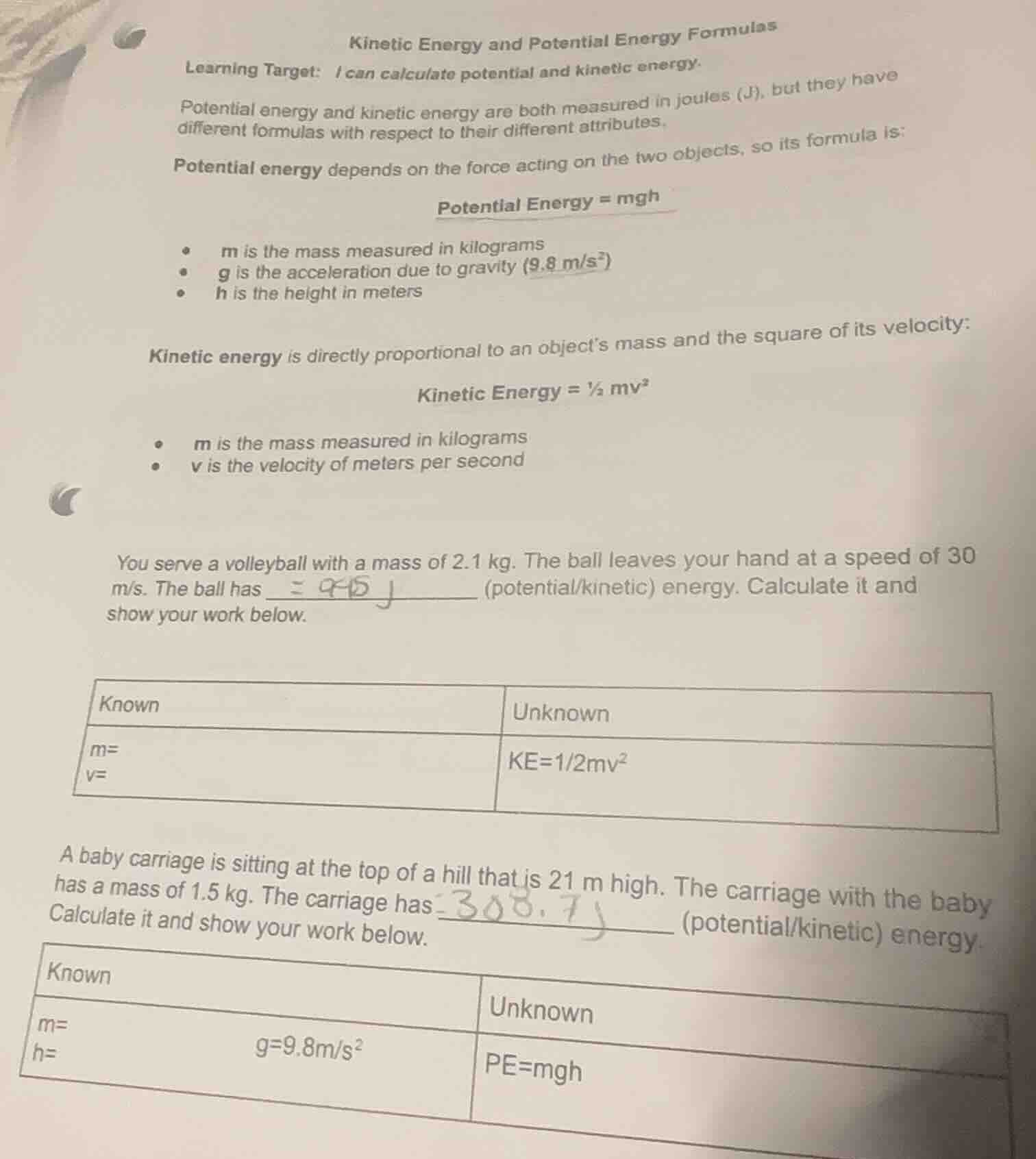
you serve a volleyball with a mass of 2.1 kg. the ball leaves your hand at a speed of 30
m/s. the ball has ______ (potential/kinetic) energy. calculate it and
show your work below.
| known | unknown |
|---|---|
| v= |
a baby carriage is sitting at the top of a hill that is 21 m high. the carriage with the baby
has a mass of 1.5 kg. the carriage has ______ (potential/kinetic) energy.
calculate it and show your work below.
| known | unknown |
|---|---|
| h= | |
| g=9.8m/s² |
First Problem (Volleyball Kinetic Energy)
Step1: Identify known values
$m = 2.1\ \text{kg}$, $v = 30\ \text{m/s}$
Step2: Use kinetic energy formula
$KE=\frac{1}{2}mv^{2}$
Substitute values: $KE=\frac{1}{2}\times2.1\times(30)^{2}$
Step3: Calculate
First, $(30)^{2}=900$
Then, $\frac{1}{2}\times2.1\times900 = 1.05\times900 = 945$
Step1: Identify known values
$m = 1.5\ \text{kg}$, $g = 9.8\ \text{m/s}^2$, $h = 21\ \text{m}$
Step2: Use potential energy formula
$PE=mgh$
Substitute values: $PE = 1.5\times9.8\times21$
Step3: Calculate
First, $1.5\times9.8 = 14.7$
Then, $14.7\times21 = 308.7$

Snap & solve any problem in the app
Get step-by-step solutions on Sovi AI
Photo-based solutions with guided steps
Explore more problems and detailed explanations
The ball has kinetic energy. The kinetic energy is $945\ \text{J}$.