QUESTION IMAGE
Question
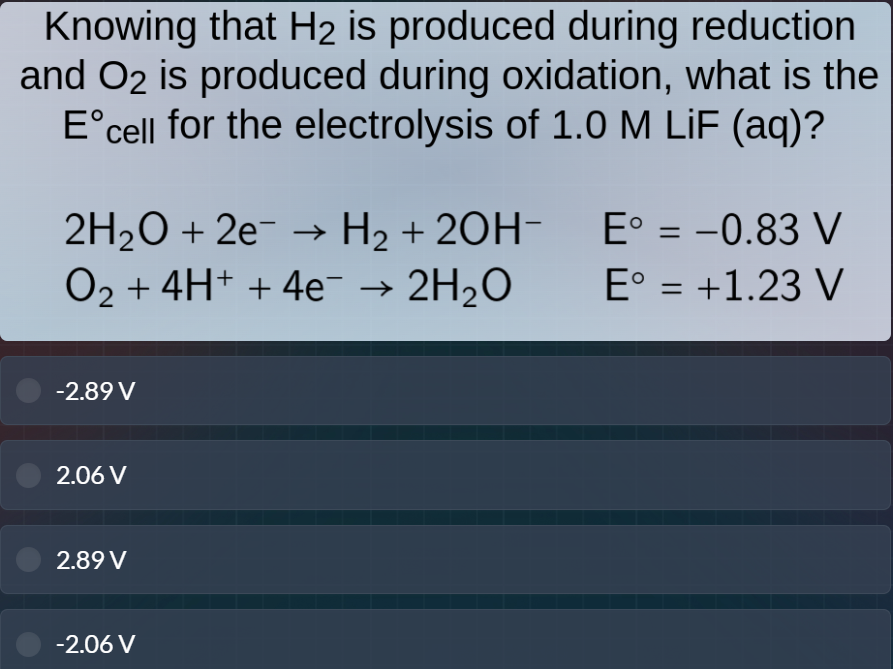
knowing that h₂ is produced during reduction and o₂ is produced during oxidation, what is the e°cell for the electrolysis of 1.0 m lif (aq)?
2h₂o + 2e⁻ → h₂ + 2oh⁻ e° = −0.83 v
o₂ + 4h⁺ + 4e⁻ → 2h₂o e° = +1.23 v
-2.89 v
2.06 v
2.89 v
-2.06 v
Step1: Identify Oxidation and Reduction Half - Reactions
For the electrolysis of aqueous LiF, we have to consider the possible half - reactions. The reduction reaction (where \(H_2\) is produced) is \(2H_2O + 2e^-\to H_2+2OH^-\) with \(E^{\circ}_{red}=- 0.83\ V\). The oxidation reaction (where \(O_2\) is produced) is the reverse of \(O_2 + 4H^++4e^-\to2H_2O\). When we reverse an oxidation - reduction half - reaction, the sign of \(E^{\circ}\) changes. So the oxidation half - reaction is \(2H_2O\to O_2 + 4H^++4e^-\) with \(E^{\circ}_{ox}=- 1.23\ V\) (since we reversed the given reduction half - reaction for oxidation).
Step2: Balance the Electrons and Calculate \(E^{\circ}_{cell}\)
First, we need to balance the number of electrons in the two half - reactions. The reduction half - reaction: \(2H_2O + 2e^-\to H_2+2OH^-\) (2 electrons transferred). The oxidation half - reaction: \(2H_2O\to O_2 + 4H^++4e^-\) (4 electrons transferred). To balance the electrons, we multiply the reduction half - reaction by 2: \(4H_2O + 4e^-\to2H_2 + 4OH^-\) with \(E^{\circ}_{red}\) (for the multiplied reaction) still \(-0.83\ V\) (because the standard reduction potential is an intensive property and does not change with the stoichiometric coefficient). The oxidation half - reaction remains \(2H_2O\to O_2 + 4H^++4e^-\) with \(E^{\circ}_{ox}=-1.23\ V\).
Now, the formula for \(E^{\circ}_{cell}\) is \(E^{\circ}_{cell}=E^{\circ}_{cathode}(reduction)-E^{\circ}_{anode}(reduction)\) or \(E^{\circ}_{cell}=E^{\circ}_{red}(cathode)+E^{\circ}_{ox}(anode)\).
Using the second formula: \(E^{\circ}_{cell}=E^{\circ}_{red}(reduction\ half - reaction)+E^{\circ}_{ox}(oxidation\ half - reaction)\).
The reduction half - reaction (after multiplying by 2) has \(E^{\circ}_{red}=-0.83\ V\) and the oxidation half - reaction has \(E^{\circ}_{ox}=-1.23\ V\)? Wait, no. Wait, the correct formula is \(E^{\circ}_{cell}=E^{\circ}_{cathode}(reduction)+E^{\circ}_{anode}(oxidation)\). The cathode is where reduction occurs, and the anode is where oxidation occurs.
The reduction half - reaction (cathode): \(2H_2O + 2e^-\to H_2+2OH^-\), \(E^{\circ}_{cathode}=-0.83\ V\)
The oxidation half - reaction (anode): reverse of \(O_2 + 4H^++4e^-\to2H_2O\) is \(2H_2O\to O_2 + 4H^++4e^-\), \(E^{\circ}_{anode\ (oxidation)}=- 1.23\ V\) (since the original \(E^{\circ}\) for the reduction of \(O_2\) is \(+1.23\ V\), so for oxidation, it is \(-1.23\ V\))
But we need to balance the electrons. Let's multiply the reduction half - reaction by 2 to get 4 electrons: \(4H_2O + 4e^-\to2H_2+4OH^-\), \(E^{\circ}_{cathode}=-0.83\ V\) (intensive property, so no change with multiplication)
The oxidation half - reaction: \(2H_2O\to O_2 + 4H^++4e^-\), \(E^{\circ}_{anode\ (oxidation)}=-1.23\ V\)
Now, \(E^{\circ}_{cell}=E^{\circ}_{cathode}+E^{\circ}_{anode\ (oxidation)}\)
\(E^{\circ}_{cell}=(-0.83\ V)\times2+(- 1.23\ V)\)? No, that's wrong. Wait, the correct way is:
For a cell reaction, \(E^{\circ}_{cell}=E^{\circ}_{cathode}(reduction)-E^{\circ}_{anode}(reduction)\)
The cathode reaction (reduction): \(2H_2O + 2e^-\to H_2+2OH^-\), \(E^{\circ}_{cathode}=-0.83\ V\)
The anode reaction (oxidation) is the reverse of \(O_2 + 4H^++4e^-\to2H_2O\), so the anode reaction (reduction) would be \(O_2 + 4H^++4e^-\to2H_2O\) with \(E^{\circ}_{anode}(reduction)=+1.23\ V\)
Then \(E^{\circ}_{cell}=E^{\circ}_{cathode}(reduction)-E^{\circ}_{anode}(reduction)\)
\(E^{\circ}_{cell}=-0.83\ V-( + 1.23\ V)=-2.06\ V\)
Wait, let's re - do it. The reduction half - reaction (cathode): \(2H_2O + 2e^-\to H_2+2OH^-\), \(E^{\circ}_{red,cathode…

Snap & solve any problem in the app
Get step-by-step solutions on Sovi AI
Photo-based solutions with guided steps
Explore more problems and detailed explanations
\(-2.06\ V\) (corresponding to the option - 2.06 V)