QUESTION IMAGE
Question
knowledge check
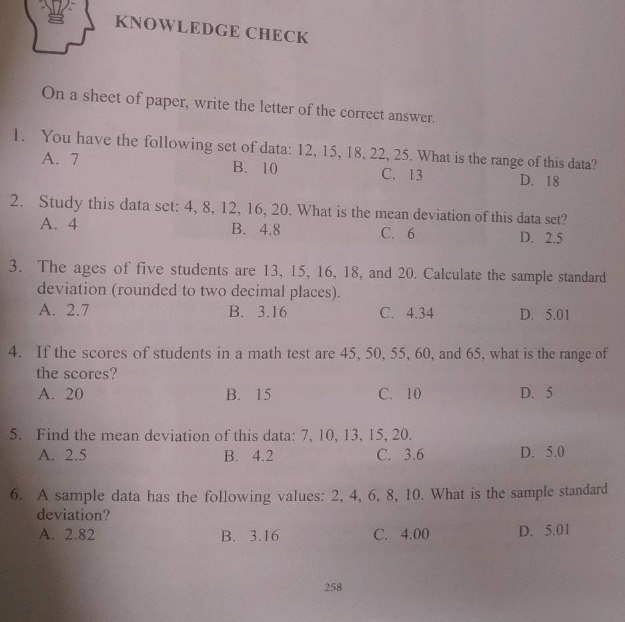
on a sheet of paper, write the letter of the correct answer.
- you have the following set of data: 12, 15, 18, 22, 25. what is the range of this data?
a. 7
b. 10
c. 13
d. 18
- study this data set: 4, 8, 12, 16, 20. what is the mean deviation of this data set?
a. 4
b. 4.8
c. 6
d. 2.5
- the ages of five students are 13, 15, 16, 18, and 20. calculate the sample standard deviation (rounded to two decimal places).
a. 2.7
b. 3.16
c. 4.34
d. 5.01
- if the scores of students in a math test are 45, 50, 55, 60, and 65, what is the range of the scores?
a. 20
b. 15
c. 10
d. 5
- find the mean deviation of this data: 7, 10, 13, 15, 20.
a. 2.5
b. 4.2
c. 3.6
d. 5.0
- a sample data has the following values: 2, 4, 6, 8, 10. what is the sample standard deviation?
a. 2.82
b. 3.16
c. 4.00
d. 5.01
Question 1
Step1: Recall range formula
Range is calculated as the difference between the maximum and minimum values in a data set. The formula is \( \text{Range} = \text{Maximum value} - \text{Minimum value} \).
Step2: Identify max and min
For the data set \( 12, 15, 18, 22, 25 \), the maximum value is \( 25 \) and the minimum value is \( 12 \).
Step3: Calculate range
Substitute the values into the formula: \( 25 - 12 = 13 \).
Step1: Find the mean
First, calculate the mean (\( \bar{x} \)) of the data set \( 4, 8, 12, 16, 20 \). The formula for the mean is \( \bar{x} = \frac{\sum_{i = 1}^{n} x_{i}}{n} \), where \( n \) is the number of data points.
\( \sum_{i = 1}^{5} x_{i}=4 + 8+12 + 16+20=60 \), and \( n = 5 \). So, \( \bar{x}=\frac{60}{5}=12 \).
Step2: Calculate absolute deviations
Find the absolute deviation of each data point from the mean:
\( |4 - 12| = 8 \), \( |8 - 12| = 4 \), \( |12 - 12| = 0 \), \( |16 - 12| = 4 \), \( |20 - 12| = 8 \).
Step3: Find the mean of absolute deviations
The mean deviation is the mean of these absolute deviations. The formula is \( \text{Mean Deviation}=\frac{\sum_{i = 1}^{n}|x_{i}-\bar{x}|}{n} \).
\( \sum_{i = 1}^{5}|x_{i}-\bar{x}|=8 + 4+0 + 4+8 = 24 \). Then, \( \text{Mean Deviation}=\frac{24}{5}=4.8 \).
Step1: Find the mean
For the data set \( 13, 15, 16, 18, 20 \), \( n = 5 \).
\( \sum_{i = 1}^{5}x_{i}=13 + 15+16 + 18+20 = 82 \). The mean \( \bar{x}=\frac{82}{5}=16.4 \).
Step2: Calculate squared deviations
Find \( (x_{i}-\bar{x})^{2} \) for each data point:
- \( (13 - 16.4)^{2}=(- 3.4)^{2}=11.56 \)
- \( (15 - 16.4)^{2}=(-1.4)^{2}=1.96 \)
- \( (16 - 16.4)^{2}=(-0.4)^{2}=0.16 \)
- \( (18 - 16.4)^{2}=(1.6)^{2}=2.56 \)
- \( (20 - 16.4)^{2}=(3.6)^{2}=12.96 \)
Step3: Find the sample variance
The sample variance (\( s^{2} \)) is given by \( s^{2}=\frac{\sum_{i = 1}^{n}(x_{i}-\bar{x})^{2}}{n - 1} \).
\( \sum_{i = 1}^{5}(x_{i}-\bar{x})^{2}=11.56+1.96 + 0.16+2.56+12.96 = 29.2 \).
\( n-1 = 4 \), so \( s^{2}=\frac{29.2}{4}=7.3 \).
Step4: Find the sample standard deviation
The sample standard deviation (\( s \)) is the square root of the sample variance: \( s=\sqrt{7.3}\approx2.7 \) (rounded to two decimal places).

Snap & solve any problem in the app
Get step-by-step solutions on Sovi AI
Photo-based solutions with guided steps
Explore more problems and detailed explanations
C