QUESTION IMAGE
Question
landmark library
gibbons v. ogden (1824)
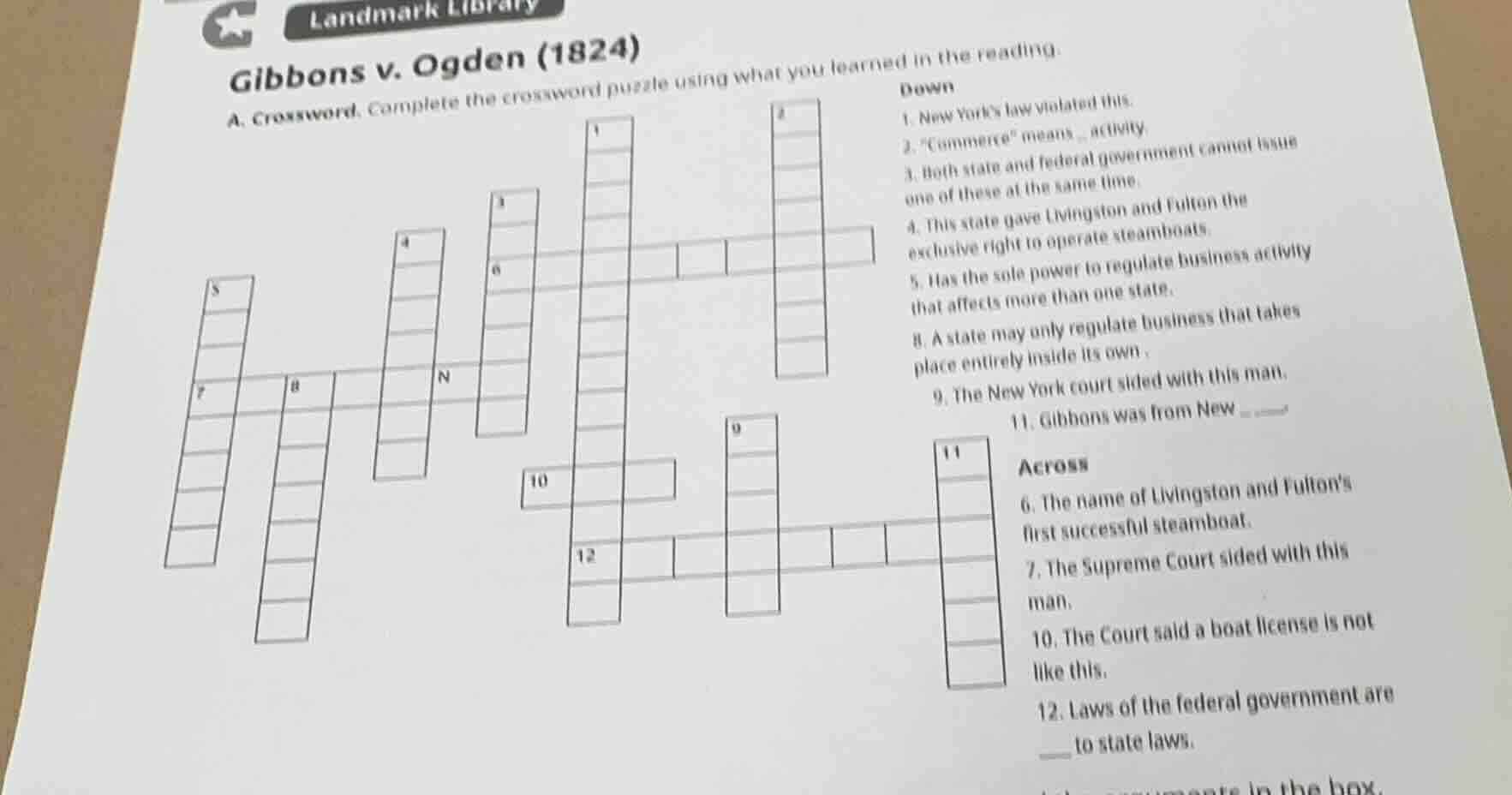
a. crossword. complete the crossword puzzle using what you learned in the reading.
down
- new yorks law violated this.
- \commerce\ means __ activity
- both state and federal government cannot issue one of these at the same time.
- this state gave livingston and fulton the exclusive right to operate steamboats
- has the sole power to regulate business activity that affects more than one state.
- a state may only regulate business that takes place entirely inside its own __.
- the new york court sided with this man.
- gibbons was from new ____
across
- the name of livingston and fultons first successful steamboat.
- the supreme court sided with this man.
- the court said a boat license is not like this.
- laws of the federal government are ____ to state laws.
Brief Explanations
All answers are based on the details of the Gibbons v. Ogden (1824) Supreme Court case, a landmark ruling on federal commerce power.

Snap & solve any problem in the app
Get step-by-step solutions on Sovi AI
Photo-based solutions with guided steps
Explore more problems and detailed explanations
Down:
- CONSTITUTION (New York's law violated the U.S. Constitution's Commerce Clause)
- BUSINESS ("Commerce" refers to business/trade activity)
- LICENSE (States and federal government cannot issue conflicting steamboat licenses)
- NEW YORK (New York granted Livingston & Fulton exclusive steamboat rights)
- CONGRESS (Congress has sole power over interstate commerce)
- BORDERS (States only regulate intrastate, in-state business)
- OGDEN (New York courts initially ruled in Ogden's favor)
- JERSEY (Gibbons was a steamboat operator from New Jersey)
Across:
- CLERMONT (Livingston and Fulton's first successful steamboat)
- GIBBONS (The Supreme Court ruled in Gibbons' favor)
- TAX (The court held a boat license is not a tax)
- SUPREME (Federal laws are supreme over state laws per the Supremacy Clause)