QUESTION IMAGE
Question
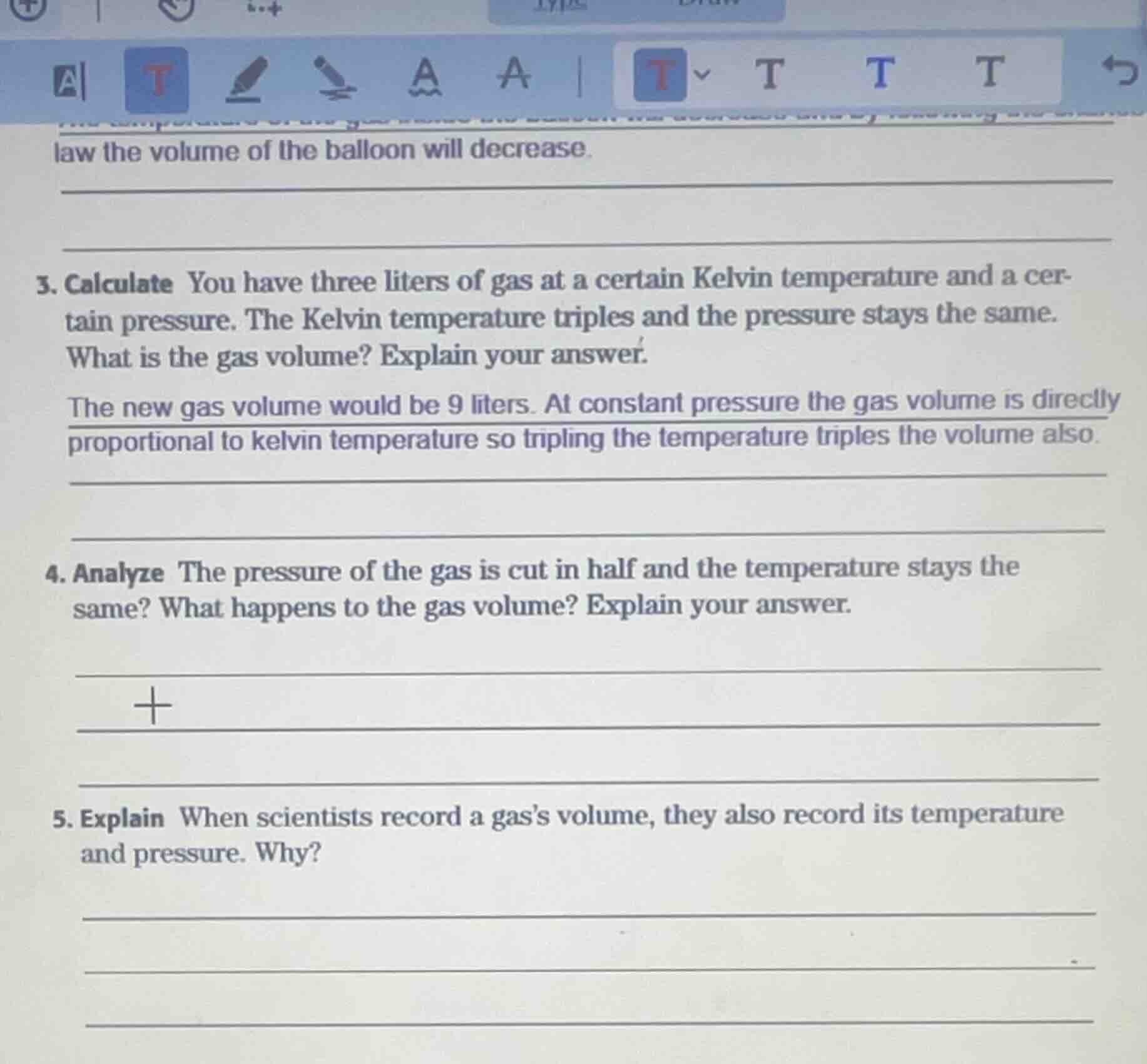
law the volume of the balloon will decrease.
- calculate you have three liters of gas at a certain kelvin temperature and a certain pressure. the kelvin temperature triples and the pressure stays the same. what is the gas volume? explain your answer.
the new gas volume would be 9 liters. at constant pressure the gas volume is directly proportional to kelvin temperature so tripling the temperature triples the volume also.
- analyze the pressure of the gas is cut in half and the temperature stays the same? what happens to the gas volume? explain your answer.
- explain when scientists record a gas’s volume, they also record its temperature and pressure. why?
Step1: Apply Charles's Law (Q3)
Charles's Law: $\frac{V_1}{T_1} = \frac{V_2}{T_2}$ (constant $P$)
Given $V_1=3\ \text{L}$, $T_2=3T_1$
Step2: Solve for new volume (Q3)
$V_2 = V_1 \times \frac{T_2}{T_1} = 3\ \text{L} \times 3 = 9\ \text{L}$
Step3: Apply Boyle's Law (Q4)
Boyle's Law: $P_1V_1 = P_2V_2$ (constant $T$)
Given $P_2=\frac{1}{2}P_1$
Step4: Solve for new volume (Q4)
$V_2 = V_1 \times \frac{P_1}{P_2} = V_1 \times 2$
Step5: Relate gas properties (Q5)
Gas volume depends on $P$ and $T$ via gas laws.

Snap & solve any problem in the app
Get step-by-step solutions on Sovi AI
Photo-based solutions with guided steps
Explore more problems and detailed explanations
- The new gas volume is 9 liters. At constant pressure, gas volume is directly proportional to Kelvin temperature (Charles's Law), so tripling the temperature triples the volume.
- The gas volume doubles. At constant temperature, gas volume is inversely proportional to pressure (Boyle's Law), so halving the pressure doubles the volume.
- Gas volume is not an independent property; it changes with changes in temperature and pressure (per gas laws like Boyle's, Charles's, and the Ideal Gas Law). Recording all three ensures an accurate, reproducible measurement of the gas's state.