QUESTION IMAGE
Question
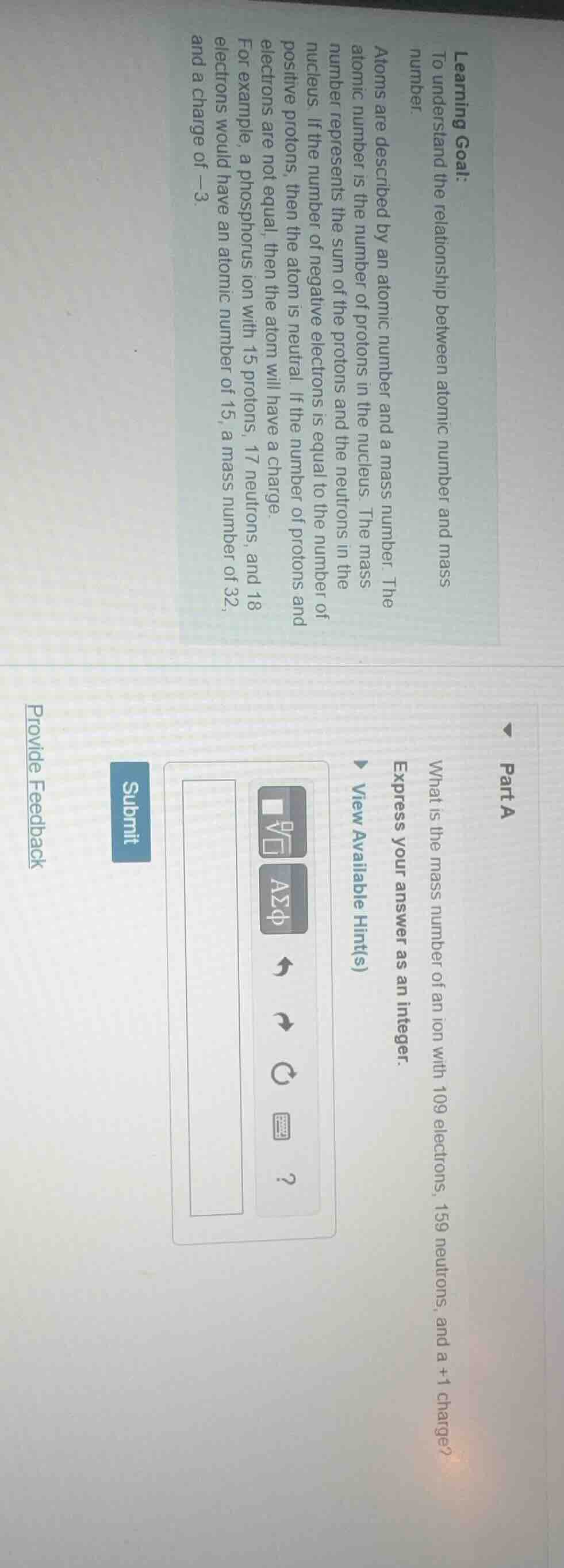
learning goal: to understand the relationship between atomic number and mass number. atoms are described by an atomic number and a mass number. the atomic number is the number of protons in the nucleus. the mass number represents the sum of the protons and the neutrons in the nucleus. if the number of negative electrons is equal to the number of positive protons, then the atom is neutral. if the number of protons and electrons are not equal, then the atom will have a charge. for example, a phosphorus ion with 15 protons, 17 neutrons, and 18 electrons would have an atomic number of 15, a mass number of 32, and a charge of -3. part a what is the mass number of an ion with 109 electrons, 159 neutrons, and a +1 charge? express your answer as an integer. view available hint(s) submit provide feedback
Step1: Find number of protons
The ion has a +1 charge, so protons = electrons + 1.
$\text{Protons} = 109 + 1 = 110$
Step2: Calculate mass number
Mass number = protons + neutrons.
$\text{Mass number} = 110 + 159 = 269$

Snap & solve any problem in the app
Get step-by-step solutions on Sovi AI
Photo-based solutions with guided steps
Explore more problems and detailed explanations
269