QUESTION IMAGE
Question
lecture 13 quiz 2
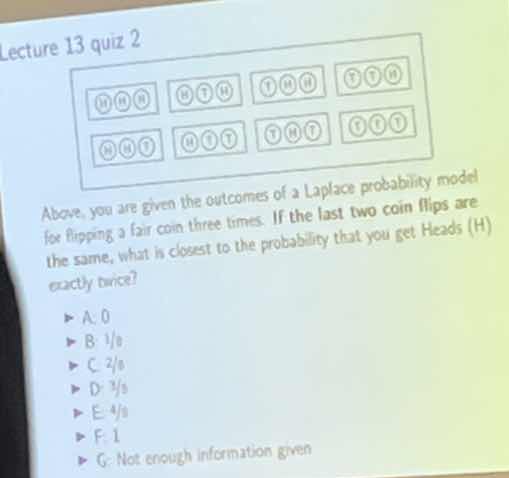
above, you are given the outcomes of a laplace probability model for flipping a fair coin three times. if the last two coin flips are the same, what is closest to the probability that you get heads (h) exactly twice?
▶ a. 0
▶ b. 1/6
▶ c. 2/6
▶ d. 3/6
▶ e. 4/6
▶ f. 1
▶ g. not enough information given
Step1: Identify relevant outcomes
We first filter all 3-flip outcomes where the last two flips are the same. The valid outcomes are: HHH, HTT, THH, TTT, HHT, TTH (wait, correction: from the given set, the outcomes with last two same are HHH, HTT, THH, TTT, HHT, TTH? No, let's list the 8 total outcomes and select those where 2nd and 3rd are equal:
- HHH (last two H,H: same)
- HHT (last two H,T: no)
- HTH (last two T,H: no)
- HTT (last two T,T: same)
- THH (last two H,H: same)
- THT (last two H,T: no)
- TTH (last two T,H: no)
- TTT (last two T,T: same)
Wait, the given box has: HHH, HTH, THH, TTH, HHT, HTT, THT, TTT. So the outcomes where last two flips are same are: $\text{HHH, HTT, THH, TTT, HHT? No, HHT last two are H,T: no. Correct valid set: } S = \{\text{HHH, HTT, THH, TTT}\}$? No, wait: last two flips same means flip2=flip3.
- HHH: flip2=H, flip3=H: yes
- HTH: flip2=T, flip3=H: no
- THH: flip2=H, flip3=H: yes
- TTH: flip2=T, flip3=H: no
- HHT: flip2=H, flip3=T: no
- HTT: flip2=T, flip3=T: yes
- THT: flip2=H, flip3=T: no
- TTT: flip2=T, flip3=T: yes
So total valid outcomes: $n(S) = 4$ (HHH, HTT, THH, TTT)
Step2: Identify favorable outcomes
Now find outcomes in $S$ with exactly 2 Heads.
- HHH: 3 Heads: no
- HTT: 1 Head: no
- THH: 2 Heads: yes
- TTT: 0 Heads: no
Wait, correction: wait THH has two Heads, is there another? No, let's recheck: the only outcome in the valid set with exactly 2 H is THH? Wait no, wait HHT is not in the valid set (last two flips H and T, not same). Wait no, wait the condition is "last two coin flips are the same"—so flip 2 and 3 are same. An outcome with exactly 2 H would need two H and one T, with flip2=flip3.
If flip2=flip3=H: then flip1 must be T to get exactly 2 H (THH)
If flip2=flip3=T: then flip1 would need to be H to get 1 H (HTT), which is not 2 H.
So favorable outcomes: $n(F) = 1$? No, wait wait HHH has 3 H, THH has 2 H. Wait wait, no: wait "exactly two Heads"—so count of H is 2. THH has two H, is there another? Let's see: is there an outcome with flip2=flip3, and exactly two H?
Suppose flip1=H, flip2=H, flip3=H: 3 H (not exactly 2)
flip1=T, flip2=H, flip3=H: 2 H (yes)
flip1=H, flip2=T, flip3=T: 1 H (no)
flip1=T, flip2=T, flip3=T: 0 H (no)
Wait, but wait the problem says "the outcomes of a Laplace probability model for flipping a fair coin three times"—so all 8 outcomes are equally likely, and we are conditioning on last two flips same.
Wait, wait I made a mistake: HHT: last two flips are H and T, not same, so excluded. HTH: last two T and H, excluded. THT: last two H and T, excluded. TTH: last two T and H, excluded. So valid conditional space is 4 outcomes, as above.
Step3: Calculate conditional probability
Conditional probability formula: $P(F|S) = \frac{n(F)}{n(S)}$
Substitute values: $\frac{1}{4}$? No, wait wait—wait THH is one, is there another? Wait no: wait what about HHT? No, HHT last two flips are H and T, which are not same, so it's not in the conditional set. Wait wait, no: "last two coin flips are the same"—flip 2 and flip 3, right? Yes, "last two" means the second and third flip in three flips.
Wait wait, wait another way: list all 8 outcomes, mark those with last two same:
- HHH: yes (last two H,H)
- HHT: no (last two H,T)
- HTH: no (last two T,H)
- HTT: yes (last two T,T)
- THH: yes (last two H,H)
- THT: no (last two H,T)
- TTH: no (last two T,H)
- TTT: yes (last two T,T)
So 4 outcomes in conditional space. Now how many have exactly 2 H? Only THH (T, H, H) has exactly two H. HHH has three H, which is not exactly two. HTT has one H, TTT has zero. So $n(F)=1$, $n(S)=4$…

Snap & solve any problem in the app
Get step-by-step solutions on Sovi AI
Photo-based solutions with guided steps
Explore more problems and detailed explanations
C. 2/8