QUESTION IMAGE
Question
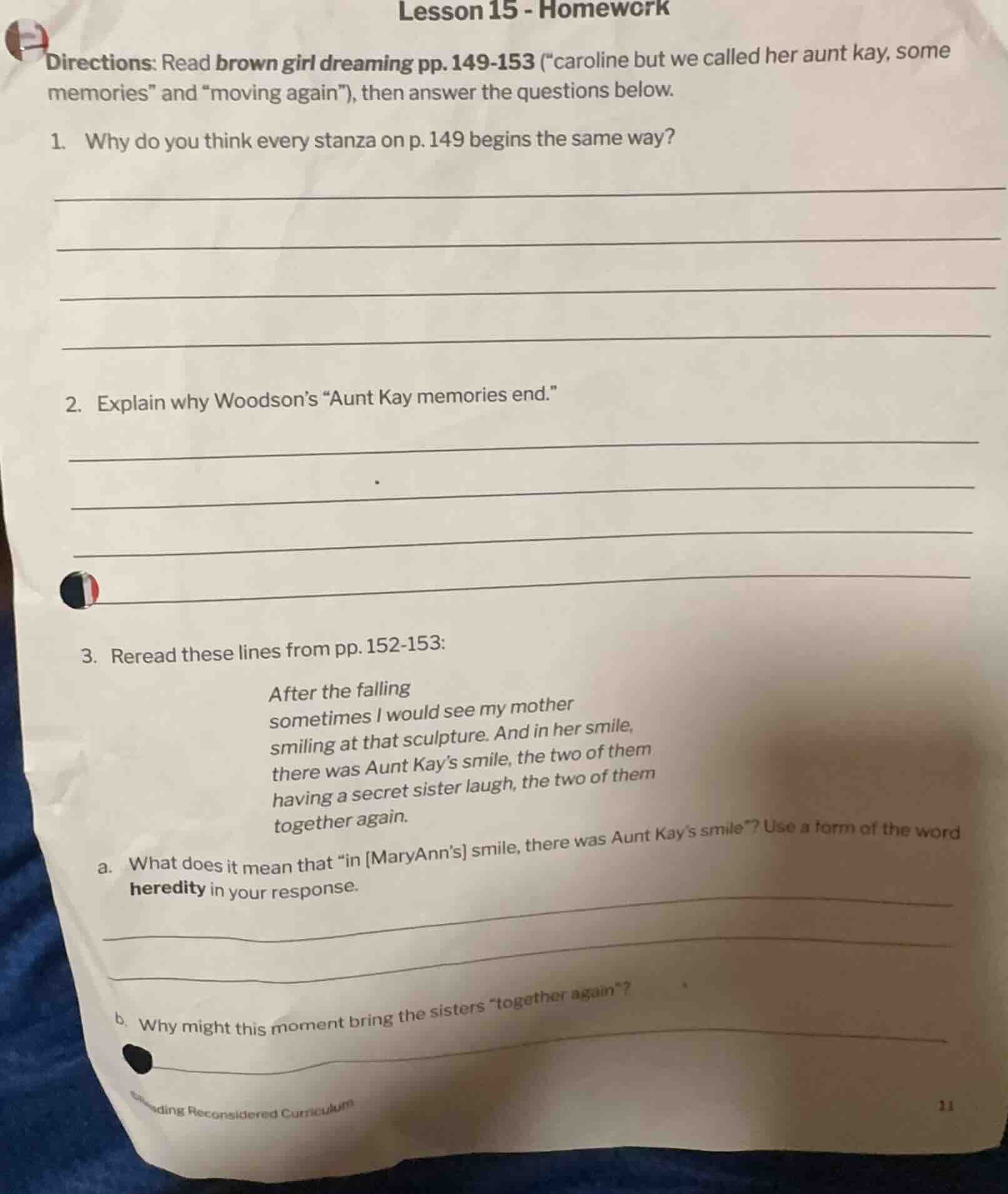
lesson 15 - homework
directions: read brown girl dreaming pp. 149 - 153 (\caroline but we called her aunt kay, some memories\ and \moving again\), then answer the questions below.
- why do you think every stanza on p. 149 begins the same way?
- explain why woodson’s \aunt kay memories end.\
- reread these lines from pp. 152 - 153:
after the falling
sometimes i would see my mother
smiling at that sculpture. and in her smile,
there was aunt kay’s smile, the two of them
having a secret sister laugh, the two of them
together again.
a. what does it mean that \in maryann’s smile, there was aunt kay’s smile\? use a form of the word heredity in your response.
b. why might this moment bring the sisters \together again\?
To answer these questions, we analyze the text "Brown Girl Dreaming" and use literary analysis concepts:
Question 1
Repeating the same opening in each stanza is a literary device (anaphora). It emphasizes a central idea, creates rhythm, and unifies the stanzas. It might highlight a recurring memory or emotion, drawing attention to the theme of Aunt Kay or shared experiences.
Woodson’s “Aunt Kay memories end” likely because the family moves (per the “moving again” section). Relocation often disrupts relationships and daily life, so the end of proximity to Aunt Kay (or a change in circumstances) ends the memories’ continuity. The text’s “moving again” context supports this: moving severs the daily interactions that fueled those memories.
“In [MaryAnn’s] smile, there was Aunt Kay’s smile” reflects heredity (biological/behavioral traits passed between relatives). MaryAnn (Woodson’s mother) and Aunt Kay are sisters, so heredity explains shared facial expressions (smile) as a trait passed through family. The smile is a hereditary trait, linking them even when apart.

Snap & solve any problem in the app
Get step-by-step solutions on Sovi AI
Photo-based solutions with guided steps
Explore more problems and detailed explanations
Every stanza on p. 149 begins the same way (anaphora) to emphasize a core theme (e.g., Aunt Kay, shared memories), create rhythmic consistency, and unify the text. This repetition draws attention to the subject, reinforces emotions, and makes the stanzas feel connected.