QUESTION IMAGE
Question
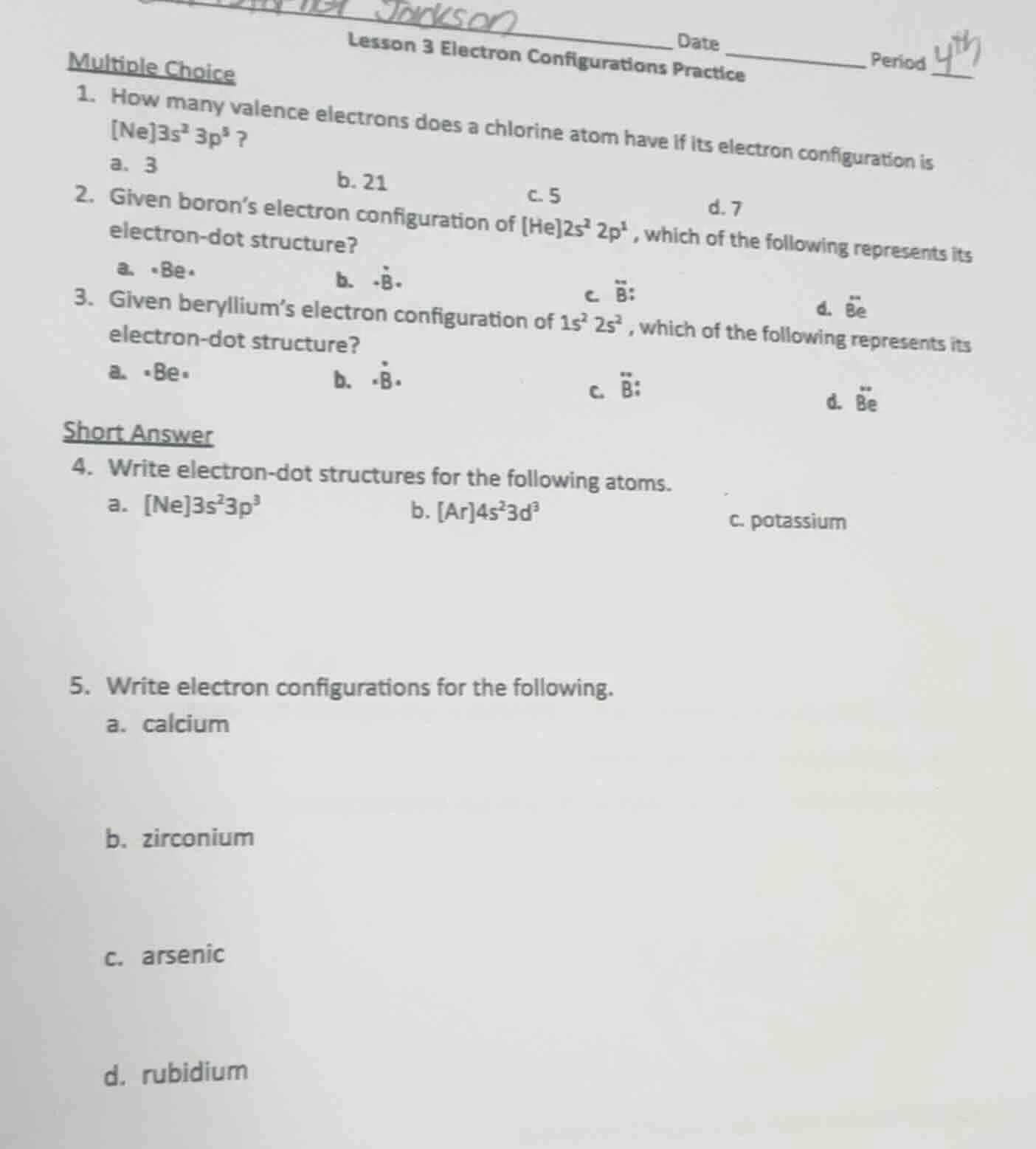
lesson 3 electron configurations practice
date
period
multiple choice
- how many valence electrons does a chlorine atom have if its electron configuration is ne3s²3p⁵?
a. 3 b. 21 c. 5 d. 7
- given boron’s electron configuration of he2s²2p¹, which of the following represents its electron - dot structure?
a. ·be· b. ·b· c. b: d. be
- given beryllium’s electron configuration of 1s²2s², which of the following represents its electron - dot structure?
a. ·be· b. ·b· c. b: d. be
short answer
- write electron - dot structures for the following atoms.
a. ne3s²3p³ b. ar4s²3d³ c. potassium
- write electron configurations for the following.
a. calcium
b. zirconium
c. arsenic
d. rubidium
Question 1
Step1: Identify valence electrons
Valence electrons are in the outermost shell. The electron configuration is $[\text{Ne}]3s^2 3p^5$. The outermost shell is $n = 3$, with $3s^2$ and $3p^5$.
Step2: Sum valence electrons
Add the electrons in the outermost shell: $2 + 5 = 7$.
Step1: Determine valence electrons
Boron's electron configuration is $[\text{He}]2s^2 2p^1$. Valence electrons are $2 + 1 = 3$.
Step2: Match electron - dot structure
Electron - dot structure shows valence electrons. Boron (B) should have 3 valence electrons represented as $\cdot \dot{\text{B}}\cdot$. Option b has the correct representation.
Step1: Find valence electrons
Beryllium's electron configuration is $1s^2 2s^2$. Valence electrons are in the $2s$ subshell, so there are 2 valence electrons.
Step2: Identify electron - dot structure
The electron - dot structure for beryllium (Be) with 2 valence electrons is $\cdot \text{Be}\cdot$. Option a matches.

Snap & solve any problem in the app
Get step-by-step solutions on Sovi AI
Photo-based solutions with guided steps
Explore more problems and detailed explanations
d. 7