QUESTION IMAGE
Question
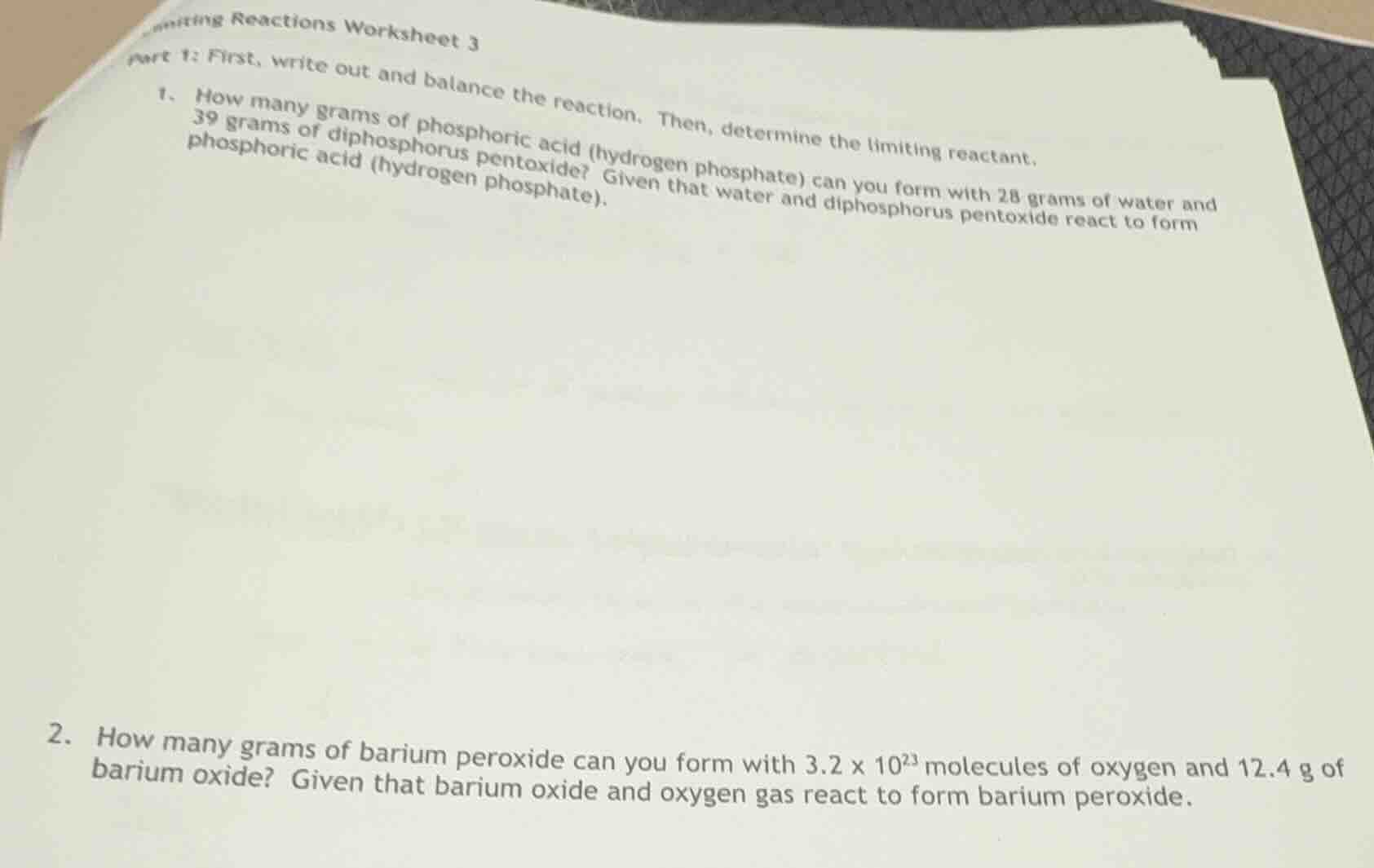
limiting reactions worksheet 3
part 1: first, write out and balance the reaction. then, determine the limiting reactant.
- how many grams of phosphoric acid (hydrogen phosphate) can you form with 28 grams of water and 39 grams of diphosphorus pentoxide? given that water and diphosphorus pentoxide react to form phosphoric acid (hydrogen phosphate).
- how many grams of barium peroxide can you form with $3.2 \times 10^{23}$ molecules of oxygen and 12.4 g of barium oxide? given that barium oxide and oxygen gas react to form barium peroxide.
Problem 1
Step1: Write & balance the reaction
Unbalanced: $\text{P}_2\text{O}_5 + \text{H}_2\text{O}
ightarrow \text{H}_3\text{PO}_4$
Balanced: $\text{P}_2\text{O}_5 + 3\text{H}_2\text{O}
ightarrow 2\text{H}_3\text{PO}_4$
Step2: Calculate molar masses
Molar mass of $\text{H}_2\text{O}$: $2(1.008) + 16.00 = 18.016\ \text{g/mol}$
Molar mass of $\text{P}_2\text{O}_5$: $2(30.97) + 5(16.00) = 141.94\ \text{g/mol}$
Molar mass of $\text{H}_3\text{PO}_4$: $3(1.008) + 30.97 + 4(16.00) = 97.994\ \text{g/mol}$
Step3: Convert reactants to moles
Moles of $\text{H}_2\text{O}$: $\frac{28\ \text{g}}{18.016\ \text{g/mol}} \approx 1.554\ \text{mol}$
Moles of $\text{P}_2\text{O}_5$: $\frac{39\ \text{g}}{141.94\ \text{g/mol}} \approx 0.2748\ \text{mol}$
Step4: Find limiting reactant
From balanced equation, 1 mol $\text{P}_2\text{O}_5$ needs 3 mol $\text{H}_2\text{O}$.
Required $\text{H}_2\text{O}$ for $\text{P}_2\text{O}_5$: $0.2748\ \text{mol} \times 3 = 0.8244\ \text{mol}$
Available $\text{H}_2\text{O}$ (1.554 mol) > required, so $\text{P}_2\text{O}_5$ is limiting.
Step5: Calculate product mass
From reaction, 1 mol $\text{P}_2\text{O}_5$ makes 2 mol $\text{H}_3\text{PO}_4$.
Moles of $\text{H}_3\text{PO}_4$: $0.2748\ \text{mol} \times 2 = 0.5496\ \text{mol}$
Mass of $\text{H}_3\text{PO}_4$: $0.5496\ \text{mol} \times 97.994\ \text{g/mol} \approx 53.96\ \text{g}$
Step1: Write & balance the reaction
Unbalanced: $\text{BaO} + \text{O}_2
ightarrow \text{BaO}_2$
Balanced: $4\text{BaO} + \text{O}_2
ightarrow 4\text{BaO}_2$
Step2: Calculate molar masses
Molar mass of $\text{BaO}$: $137.33 + 16.00 = 153.33\ \text{g/mol}$
Molar mass of $\text{BaO}_2$: $137.33 + 2(16.00) = 169.33\ \text{g/mol}$
Step3: Convert reactants to moles
Moles of $\text{BaO}$: $\frac{12.4\ \text{g}}{153.33\ \text{g/mol}} \approx 0.0809\ \text{mol}$
Moles of $\text{O}_2$: $\frac{3.2 \times 10^{23}\ \text{molecules}}{6.022 \times 10^{23}\ \text{molecules/mol}} \approx 0.531\ \text{mol}$
Step4: Find limiting reactant
From balanced equation, 4 mol $\text{BaO}$ needs 1 mol $\text{O}_2$.
Required $\text{O}_2$ for $\text{BaO}$: $\frac{0.0809\ \text{mol}}{4} = 0.0202\ \text{mol}$
Available $\text{O}_2$ (0.531 mol) > required, so $\text{BaO}$ is limiting.
Step5: Calculate product mass
From reaction, 4 mol $\text{BaO}$ makes 4 mol $\text{BaO}_2$ (1:1 ratio).
Moles of $\text{BaO}_2$ = 0.0809 mol
Mass of $\text{BaO}_2$: $0.0809\ \text{mol} \times 169.33\ \text{g/mol} \approx 13.7\ \text{g}$

Snap & solve any problem in the app
Get step-by-step solutions on Sovi AI
Photo-based solutions with guided steps
Explore more problems and detailed explanations
Limiting reactant: $\text{P}_2\text{O}_5$; Mass of phosphoric acid: ~54 g
---