QUESTION IMAGE
Question
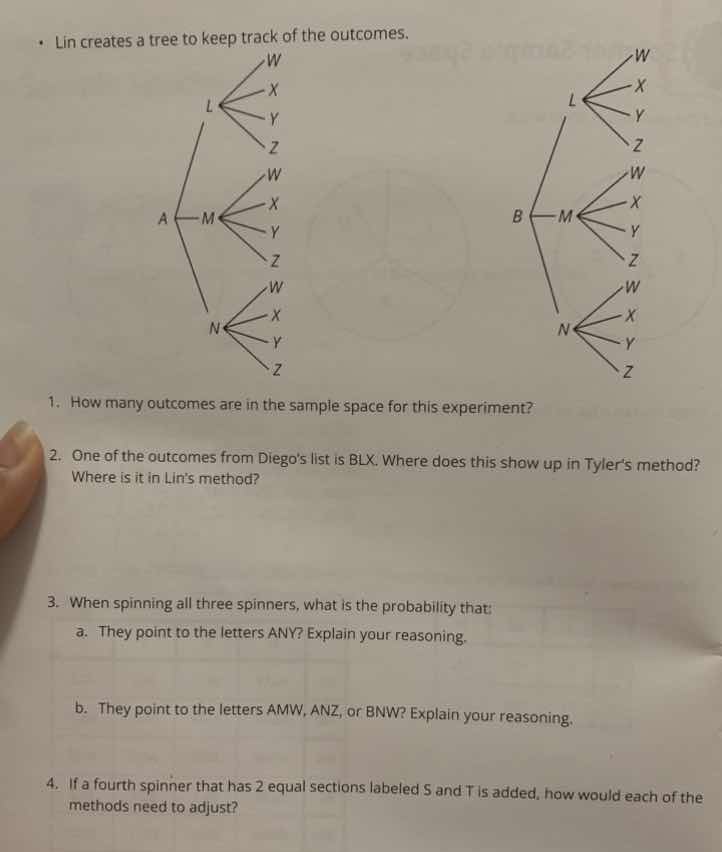
- lin creates a tree to keep track of the outcomes.
- how many outcomes are in the sample space for this experiment?
- one of the outcomes from diegos list is blx. where does this show up in tylers method? where is it in lins method?
- when spinning all three spinners, what is the probability that:
a. they point to the letters any? explain your reasoning.
b. they point to the letters amw, anz, or bnw? explain your reasoning.
- if a fourth spinner that has 2 equal sections labeled s and t is added, how would each of the methods need to adjust?
Step1: Count outcomes per branch
First level: 3 nodes (A/B, L/M/N). Second level: 4 nodes each.
Total outcomes: $3 \times 4 = 12$ per tree, but combined sample space is $3 \times 4 = 12$? No, wait: Each first node (A/B) has 3 second nodes, each with 4 outcomes. So total: $2 \times 3 \times 4 = 24$
Step2: Verify total outcomes
Each main branch (A, B) has 3 sub-branches (L/M/N), each with 4 final outcomes. $2 \times 3 \times 4 = 24$
Diego's list (BLX) would be a combined label of the three spinners: first spinner lands on B, second on L, third on X. In Lin's tree method, this is the path starting at B, then moving to the L branch, and finally to the X endpoint on that L branch.
Part a:
Step1: Calculate total outcomes
Total sample space size: $2 \times 3 \times 4 = 24$
Step2: Count favorable outcomes
ANY is one specific combination. Number of favorable outcomes = 1
Step3: Compute probability
Probability = $\frac{\text{Favorable Outcomes}}{\text{Total Outcomes}} = \frac{1}{24}$
Part b:
Step1: Count favorable outcomes
AMW, ANZ, BNW are 3 distinct specific combinations. Favorable outcomes = 3
Step2: Compute probability
Probability = $\frac{3}{24} = \frac{1}{8}$
For Tyler's list method: Every existing outcome label would be extended by adding either S or T at the end, doubling the total number of listed outcomes. For Lin's tree method: Each final endpoint (W/X/Y/Z) on the existing tree would have two new branches extending from it, labeled S and T, which doubles the total number of endpoints in the tree.

Snap & solve any problem in the app
Get step-by-step solutions on Sovi AI
Photo-based solutions with guided steps
Explore more problems and detailed explanations
24
---