QUESTION IMAGE
Question
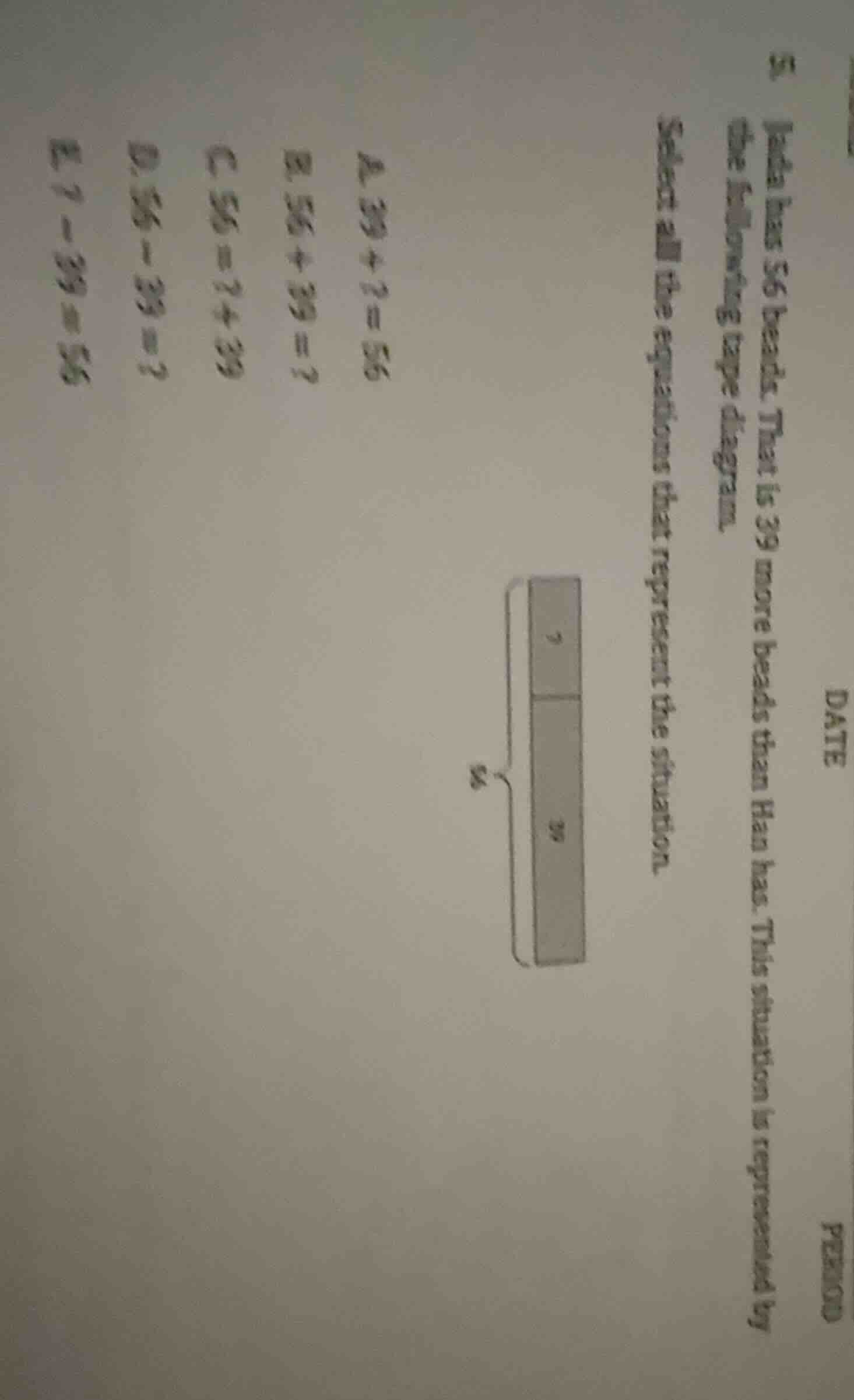
linda has 56 beads. that is 39 more beads than han has. this situation is represented by the following tape diagram. select all the equations that represent the situation. a. 39 +? = 56 b. 56 + 39 =? c. 56 =? + 39 d. 56 - 39 =? e. 7 - 39 = 56
Let's assume Han has \( x \) beads. Then Julia has \( x + 39 \) beads, and we know Julia has 56 beads. So the relationship is \( x + 39 = 56 \), which can be rearranged to other equivalent forms.
Step 1: Analyze Option A
Option A: \( 39 +? = 56 \). Here, \(? \) represents the number of beads Han has. If we let Han's beads be \(? \), then Julia's beads (56) are Han's beads plus 39, so \( 39 +? = 56 \) is correct.
Step 2: Analyze Option B
Option B: \( 56 + 39 =? \). This would imply Julia's beads plus 39, which doesn't match the situation (Julia has more than Han, not less), so this is incorrect.
Step 3: Analyze Option C
Option C: \( 56 =? + 39 \). This is the same as Option A, just rearranged (commutative property of addition), so it's correct.
Step 4: Analyze Option D
Option D: \( 56 - 39 =? \). Subtracting 39 from Julia's beads (56) gives Han's beads, which is correct because \( 56 - 39 =? \) is equivalent to \(? + 39 = 56 \).
Step 5: Analyze Option E
Option E: \(? - 39 = 56 \). This would imply Han's beads minus 39 equals Julia's beads, but Julia has more beads than Han, so this is incorrect.

Snap & solve any problem in the app
Get step-by-step solutions on Sovi AI
Photo-based solutions with guided steps
Explore more problems and detailed explanations
A. \( 39 +? = 56 \), C. \( 56 =? + 39 \), D. \( 56 - 39 =? \)