QUESTION IMAGE
Question
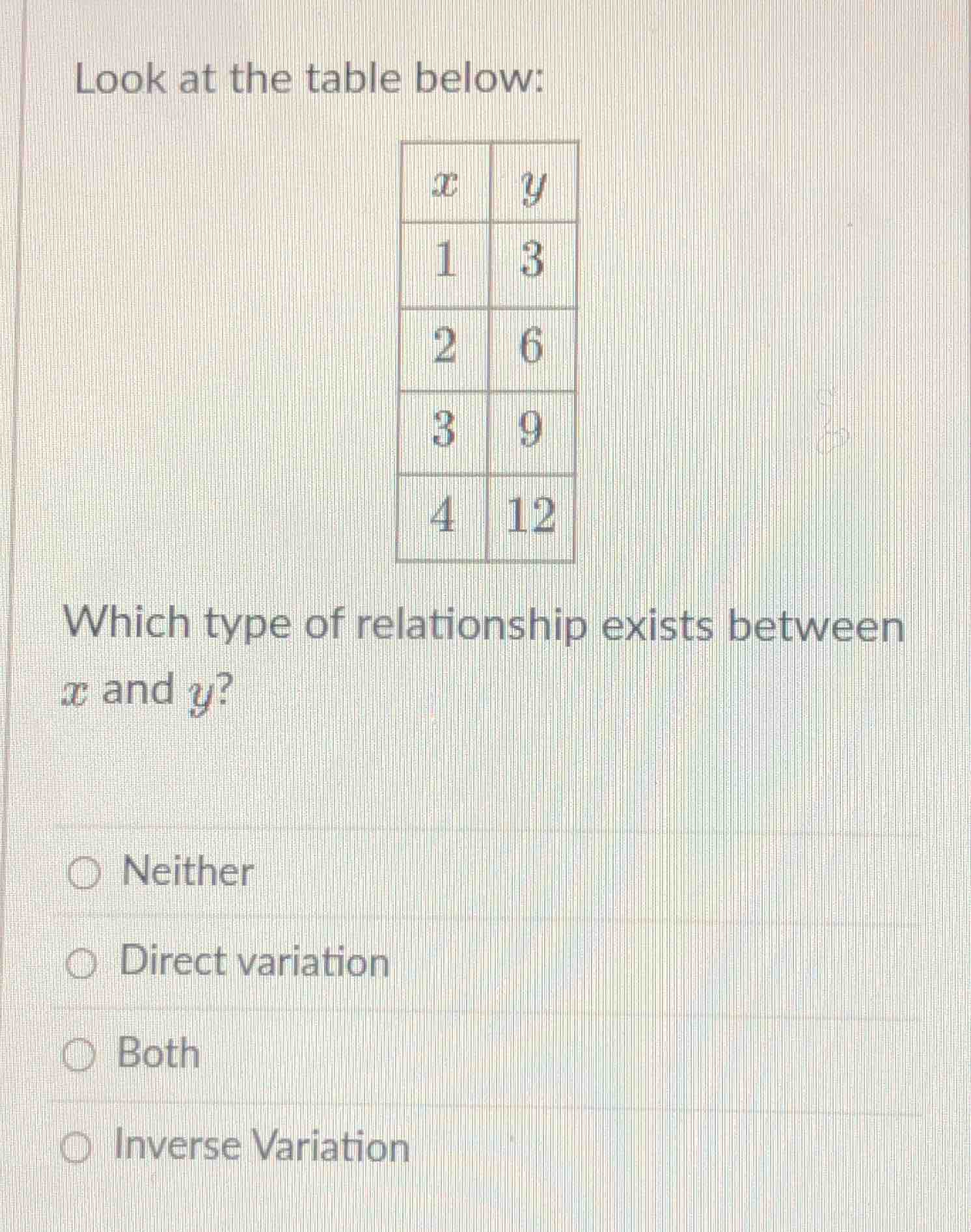
look at the table below:
which type of relationship exists between x and y?
○ neither
○ direct variation
○ both
○ inverse variation
Step1: Recall direct variation formula
Direct variation is \( y = kx \), where \( k \) is constant. Inverse variation is \( y=\frac{k}{x} \), \( k = xy \) constant.
Step2: Check direct variation (ratio \( \frac{y}{x} \))
For \( x = 1, y = 3 \): \( \frac{y}{x}=\frac{3}{1}=3 \)
For \( x = 2, y = 6 \): \( \frac{y}{x}=\frac{6}{2}=3 \)
For \( x = 3, y = 9 \): \( \frac{y}{x}=\frac{9}{3}=3 \)
For \( x = 4, y = 12 \): \( \frac{y}{x}=\frac{12}{4}=3 \)
Ratio \( \frac{y}{x} \) is constant (\( k = 3 \)), so it's direct variation.
Step3: Check inverse variation (product \( xy \))
\( 1\times3 = 3 \), \( 2\times6 = 12 \), products not constant. So not inverse.

Snap & solve any problem in the app
Get step-by-step solutions on Sovi AI
Photo-based solutions with guided steps
Explore more problems and detailed explanations
Direct variation