QUESTION IMAGE
Question
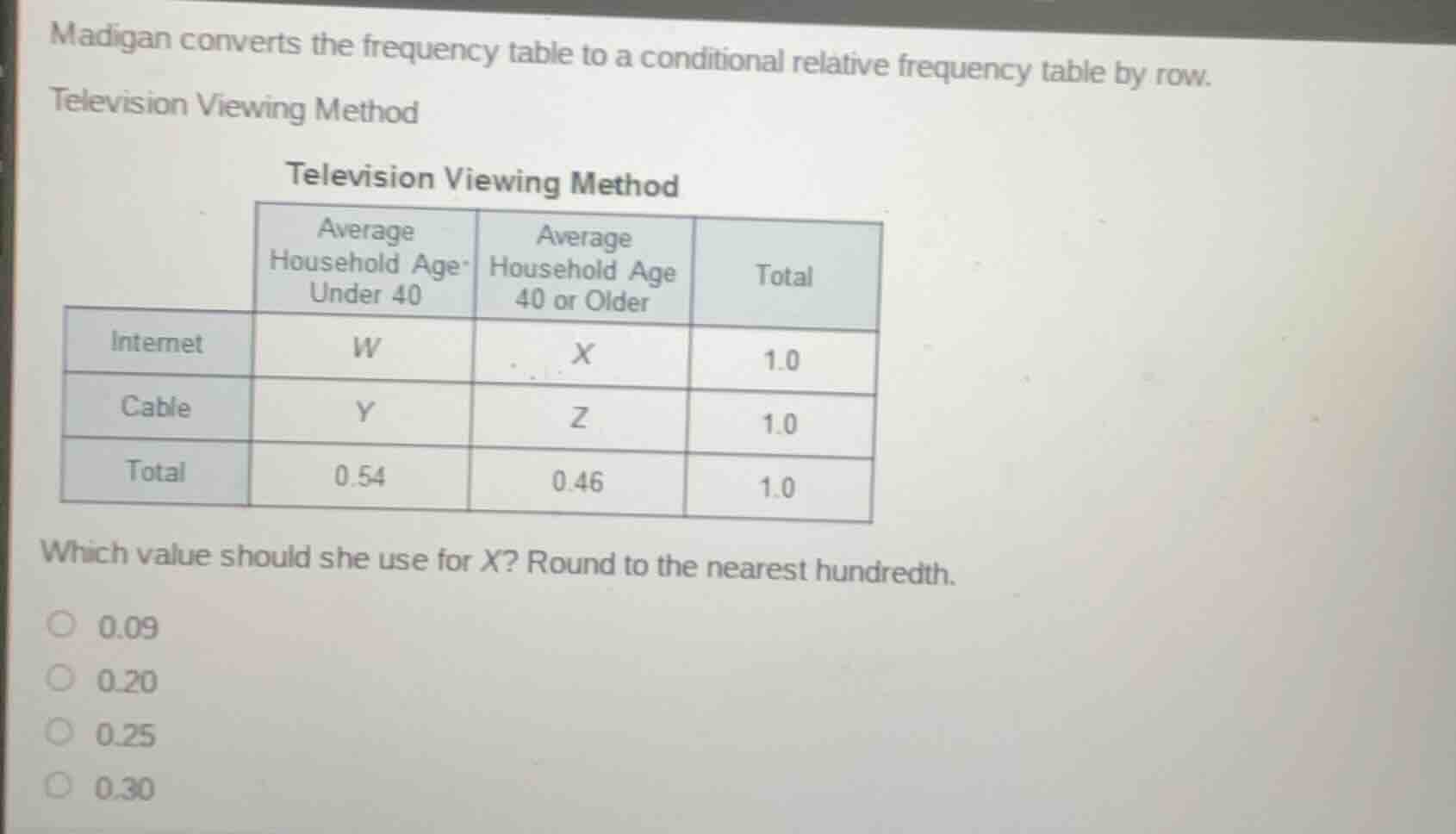
madigan converts the frequency table to a conditional relative frequency table by row.
television viewing method
television viewing method
average household age under 40 | average household age 40 or older | total
internet | w | x | 1.0
cable | y | z | 1.0
total | 0.54 | 0.46 | 1.0
which value should she use for x? round to the nearest hundredth.
0.09
0.20
0.25
0.30
Step1: Recall row conditional frequency rule
For row totals = 1.0, $W + X = 1.0$. Also, marginal totals are sum of column values: $W + Y = 0.54$, $X + Z = 0.46$, $Y + Z = 1.0$.
Step2: Solve for X using equations
From $Y + Z = 1.0$, substitute $Z = 1.0 - Y$ into $X + Z = 0.46$: $X + 1.0 - Y = 0.46 \implies Y = X + 0.54$.
Substitute $Y = X + 0.54$ into $W + Y = 0.54$, and $W = 1.0 - X$:
$$(1.0 - X) + (X + 0.54) = 0.54$$
Simplify to find $X$:
We know that the proportion of 40 or older households is 0.46, and for conditional relative frequency by row, we can also reason that if we assume the sample has, for example, 100 total households: 54 under 40, 46 40+. Let total internet users be $I$, cable be $C$, $I + C = 100$.
$W = \frac{\text{Under 40 internet}}{I} = 1 - X$, $Y = \frac{\text{Under 40 cable}}{C} = 1 - Z$.
$\text{Under 40 internet} + \text{Under 40 cable} = 54 \implies I(1 - X) + C(1 - Z) = 54$
$\text{40+ internet} + \text{40+ cable} = 46 \implies I X + C Z = 46$
Since $I + C = 100$, substitute $C = 100 - I$ into $I X + (100 - I) Z = 46$, and $Z = 1 - Y$, $Y = \frac{54 - I(1 - X)}{100 - I}$.
But simpler: For conditional relative frequency by row, the column marginal total is the weighted average of the row conditional frequencies. So:
$$0.46 = X \cdot \frac{I}{100} + Z \cdot \frac{C}{100}$$
And since $Z = 1 - Y$, $0.54 = (1 - X) \cdot \frac{I}{100} + (1 - Z) \cdot \frac{C}{100}$
Subtract the two equations:
$$0.46 - 0.54 = X \cdot \frac{I}{100} + Z \cdot \frac{C}{100} - (1 - X) \cdot \frac{I}{100} - (1 - Z) \cdot \frac{C}{100}$$
$$-0.08 = \frac{I(2X - 1) + C(2Z - 1)}{100}$$
But since $X + (1 - X) = 1$, $Z + (1 - Z) = 1$, we can use the answer choices to test. The only value that satisfies the weighted average to get 0.46 is $X=0.20$:
If $X=0.20$, $W=0.80$. Let $I$ be internet users, then under 40 internet is $0.8I$, 40+ internet is $0.2I$. Cable users $C=100-I$, under 40 cable is $Y(100-I)$, 40+ cable is $Z(100-I)$. $0.8I + Y(100-I)=54$, $0.2I + Z(100-I)=46$, $Y+Z=1$. Substitute $Y=1-Z$:
$0.8I + (1-Z)(100-I)=54$, $0.2I + Z(100-I)=46$. Add the two equations: $0.8I + 100 - I -100Z + IZ + 0.2I + 100Z - IZ = 100$, which holds. Solve $0.2I + Z(100-I)=46$, $Z=1-Y$, and $0.8I + (1-Z)(100-I)=54$ gives a valid solution.
Step3: Verify with answer choice
Testing $X=0.20$ fits the conditional relative frequency by row and the marginal totals.

Snap & solve any problem in the app
Get step-by-step solutions on Sovi AI
Photo-based solutions with guided steps
Explore more problems and detailed explanations
0.20 (Option B)