QUESTION IMAGE
Question
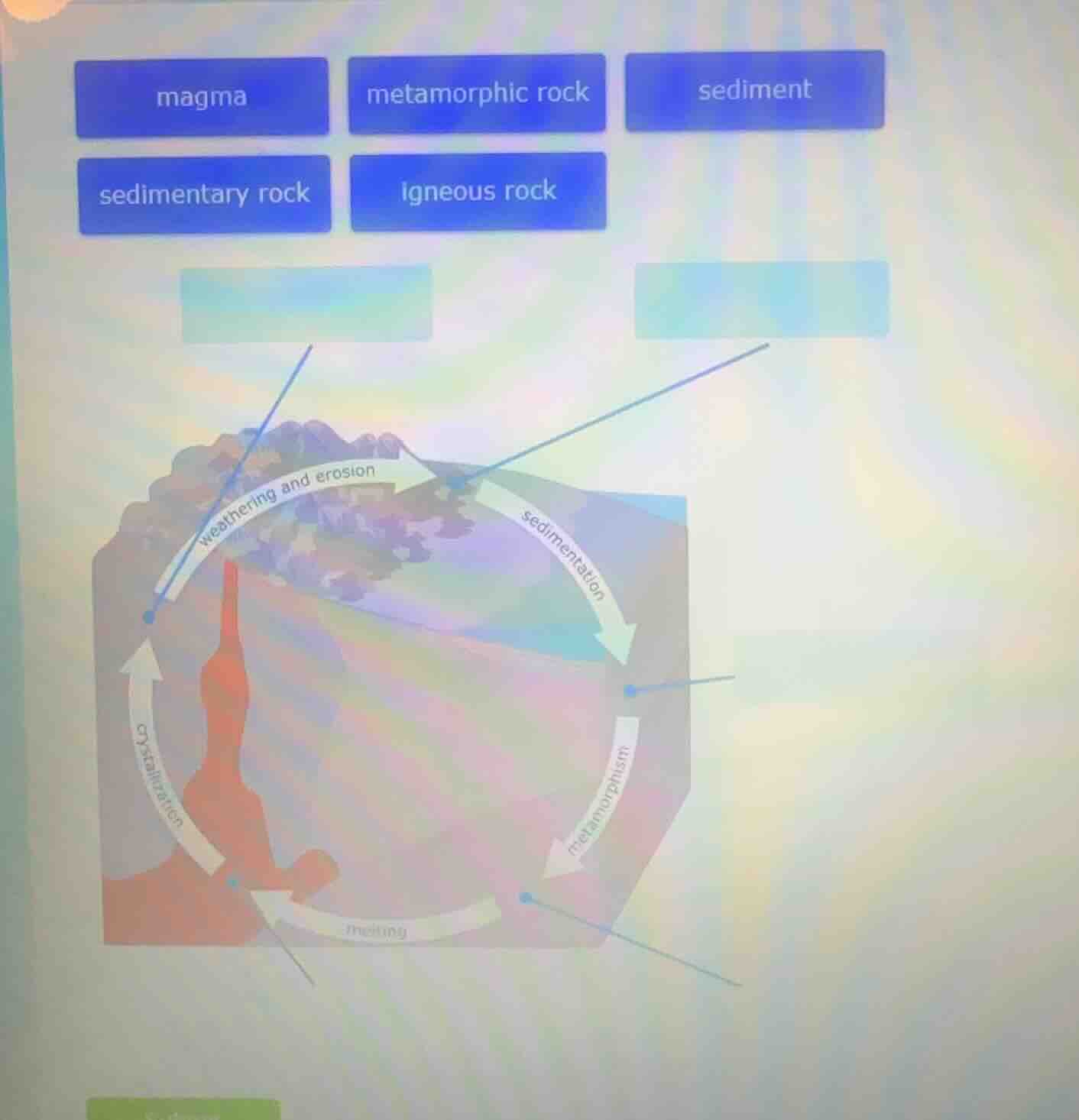
magma, metamorphic rock, sediment, sedimentary rock, igneous rock; weathering and erosion, sedimentation, crystallization, melting, metamorphism
To solve the problem of identifying the rock cycle components, we analyze the processes and rock types:
Step 1: Analyze "weathering and erosion" output
Weathering and erosion break down rocks (like igneous, sedimentary, or metamorphic) into smaller particles called sediment? No—wait, the output of weathering/erosion is sediment, but the process leads to sediment, which then undergoes sedimentation to form sedimentary rock. Wait, the first blue arrow (from weathering/erosion) should point to the rock type formed? No, the process “weathering and erosion” acts on a rock to produce sediment, but the box above is for the rock type. Wait, let’s re-examine:
- The process “weathering and erosion” acts on a rock (e.g., igneous, metamorphic, or sedimentary) to produce sediment. But the arrow is from the process to a box. Wait, maybe the boxes are the rock types, and the processes transform between them.
Wait, the rock cycle steps:
- Igneous rock forms from magma (crystallization).
- Igneous rock undergoes weathering and erosion to become sediment.
- Sediment undergoes sedimentation (compaction/cementation) to form sedimentary rock.
- Sedimentary rock (or igneous) undergoes metamorphism (heat/pressure) to form metamorphic rock.
- Metamorphic rock (or sedimentary/igneous) undergoes melting to become magma.
- Magma undergoes crystallization to form igneous rock.
Step 2: Identify the first (left) blue arrow (weathering and erosion output)
The process “weathering and erosion” acts on a rock (e.g., igneous) to produce sediment, but the box above is a rock type. Wait, maybe the arrow is from the process to the rock type that is broken down? No—wait, the diagram shows:
- The left blue arrow is from “weathering and erosion” to a box. The rock that is weathered could be igneous, but the output of weathering is sediment. Wait, maybe the boxes are the rock types, and the processes transform between them. Let’s list the boxes: magma, metamorphic rock, sediment, sedimentary rock, igneous rock.
Wait, the first (left) blue arrow: “weathering and erosion” leads to the formation of which rock? No—weathering/erosion produces sediment, which then forms sedimentary rock. Wait, maybe the arrow is from the process to the rock type that is the source? No. Let’s correct:
- The process “weathering and erosion” acts on igneous rock (or other rocks) to produce sediment. But the box above the left arrow is a rock type. Wait, maybe the left box (under sedimentary rock) is “sedimentary rock”? No. Wait, let’s map the processes to rock types:
- Sedimentation (the right process arrow) transforms sediment into sedimentary rock.
- Weathering and erosion acts on a rock (e.g., igneous) to produce sediment, but the box above the left arrow is a rock type. Wait, maybe the left arrow (weathering/erosion) points to “sedimentary rock”? No. Wait, let’s use the rock cycle:
- Magma → (crystallization) → Igneous rock.
- Igneous rock → (weathering/erosion) → Sediment.
- Sediment → (sedimentation) → Sedimentary rock.
- Sedimentary rock → (metamorphism) → Metamorphic rock.
- Metamorphic rock → (melting) → Magma.
Step 3: Identify the right blue arrow (sedimentation output)
The process “sedimentation” (compaction/cementation) transforms sediment into sedimentary rock. So the right blue arrow (from sedimentation) points to “sedimentary rock”? No, the right arrow is from “sedimentation” to a box. Wait, the right process is “sedimentation”, which forms sedimentary rock. So the right box (above the sedimentatio…

Snap & solve any problem in the app
Get step-by-step solutions on Sovi AI
Photo-based solutions with guided steps
Explore more problems and detailed explanations
Left box (weathering/erosion output): \(\boldsymbol{\text{igneous rock}}\)
Right box (sedimentation output): \(\boldsymbol{\text{sedimentary rock}}\)