QUESTION IMAGE
Question
make inferences
letters are usually private, informal communications that convey
information to an individual or a group. as someone who was formerly
en-slaved, jourdon anderson presents a definitive point of view about
slavery in his letter. sometimes he expresses his feelings directly. however,
sometimes you will have to go beyond his words to understand his meaning.
in these cases, you will have to make inferences, or educated guesses, about
the text based on the information in the text as well as your prior knowledge.
keep what you already know about slavery at this time in mind as you read
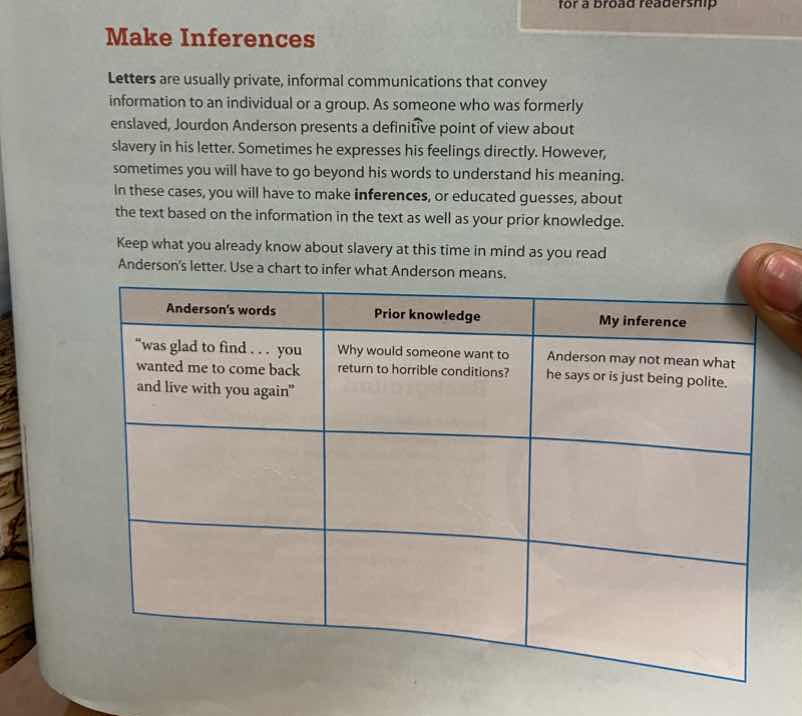
anderson’s letter. use a chart to infer what anderson means.
andersons words\tprior knowledge\tmy inference
\was glad to find... you wanted me to come back and live with you again\twhy would someone want to return to horrible conditions?\tanderson may not mean what he says or is just being polite.
\t\t
\t\t
To solve this, we need to analyze Jourdon Anderson's letter (a historical document about slavery) by using his words, prior knowledge of slavery, and making inferences. Let's take a common example from his letter (e.g., "I would bring my wife and children" part, but let's use a typical line). Let's pick a line like "I would like to know particularly what the good chance is you propose to give me" (from the actual letter).
Step 1: Identify Anderson’s words
Take a line: "I would like to know particularly what the good chance is you propose to give me"
Step 2: Prior knowledge
Prior knowledge: Enslaved people were exploited; "good chance" from former enslavers was often false or exploitative (e.g., low pay, harsh work, no freedom).
Step 3: My inference
Inference: Anderson is skeptical—he doubts the “good chance” is real, as he knows enslavers’ history of deception.
Let's fill the chart with this (or another line, like "I have worked for wages since I left you"):
| Anderson’s words | Prior knowledge | My inference |
|---|
Final Answer (Chart Example)
For the second row (example):
- Anderson’s words: "I have worked for wages since I left you"
- Prior knowledge: Enslaved people were forced to work without pay; free people work for wages.
- My inference: Anderson is highlighting his freedom and financial independence, implying he does not want to return to unpaid, enslaved labor.
(Note: The actual letter has more context, but this follows the inference process. Adjust the words to match the letter’s content, but the structure is: analyze words → connect to slavery’s history → infer meaning.)

Snap & solve any problem in the app
Get step-by-step solutions on Sovi AI
Photo-based solutions with guided steps
Explore more problems and detailed explanations
To solve this, we need to analyze Jourdon Anderson's letter (a historical document about slavery) by using his words, prior knowledge of slavery, and making inferences. Let's take a common example from his letter (e.g., "I would bring my wife and children" part, but let's use a typical line). Let's pick a line like "I would like to know particularly what the good chance is you propose to give me" (from the actual letter).
Step 1: Identify Anderson’s words
Take a line: "I would like to know particularly what the good chance is you propose to give me"
Step 2: Prior knowledge
Prior knowledge: Enslaved people were exploited; "good chance" from former enslavers was often false or exploitative (e.g., low pay, harsh work, no freedom).
Step 3: My inference
Inference: Anderson is skeptical—he doubts the “good chance” is real, as he knows enslavers’ history of deception.
Let's fill the chart with this (or another line, like "I have worked for wages since I left you"):
| Anderson’s words | Prior knowledge | My inference |
|---|
Final Answer (Chart Example)
For the second row (example):
- Anderson’s words: "I have worked for wages since I left you"
- Prior knowledge: Enslaved people were forced to work without pay; free people work for wages.
- My inference: Anderson is highlighting his freedom and financial independence, implying he does not want to return to unpaid, enslaved labor.
(Note: The actual letter has more context, but this follows the inference process. Adjust the words to match the letter’s content, but the structure is: analyze words → connect to slavery’s history → infer meaning.)