QUESTION IMAGE
Question
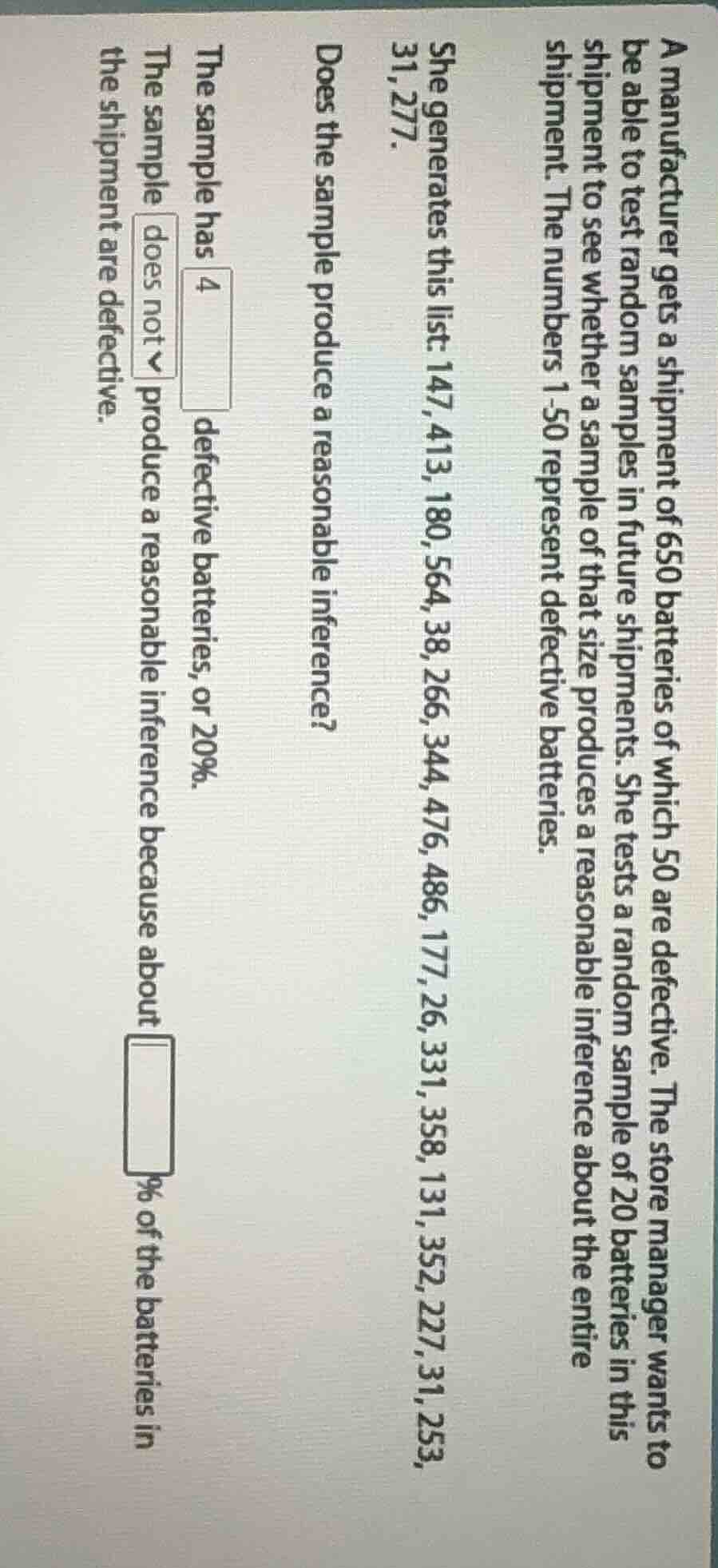
a manufacturer gets a shipment of 650 batteries of which 50 are defective. the store manager wants to be able to test random samples in future shipments. she tests a random sample of 20 batteries in this shipment to see whether a sample of that size produces a reasonable inference about the entire shipment. the numbers 1 - 50 represent defective batteries. she generates this list: 147, 413, 180, 564, 38, 266, 344, 476, 486, 177, 26, 331, 358, 131, 352, 227, 31, 253, 31, 277. does the sample produce a reasonable inference? the sample has 4 defective batteries, or 20%. the sample does not produce a reasonable inference because about % of the batteries in the shipment are defective.
Step1: Identify defective numbers
Numbers 1 - 50 represent defective. Check which sample numbers are in 1 - 50: 38, 26, 31, 31. Count them: 4.
Step2: Calculate percentage
Sample size = 20. Percentage = $\frac{\text{Defective in sample}}{\text{Sample size}} \times 100 = \frac{4}{20} \times 100 = 20\%$. But total defective is 50 out of 650, $\frac{50}{650} \approx 7.69\%$. So sample (20%) doesn't match total (~7.69%), so it does not produce a reasonable inference. The percentage from sample is 20%, but actual is ~7.69%, but the question's box for percentage: we calculated sample's defective % as $\frac{4}{20} \times 100 = 20\%$, but wait, no—wait, the total shipment has 650 batteries, 50 defective. The sample is 20 batteries. We found 4 defective in sample. So sample's defective % is $\frac{4}{20} \times 100 = 20\%$, but actual is $\frac{50}{650} \approx 7.69\%$. So the sample's percentage is 20%, but it's not reasonable because it's different from actual. Wait, the question's second box: "because about [ ]% of the batteries in the shipment are defective." Wait, no—wait, the actual defective percentage is $\frac{50}{650} \approx 7.7\%$, but the sample's is 20%. But maybe I misread. Wait, the problem says: "The sample [has 4 defective batteries, or 20%]. The sample [does not] produce a reasonable inference because about [ ]% of the batteries in the shipment are defective." Wait, no—wait, the shipment has 650 batteries, 50 defective. So actual defective percentage is $\frac{50}{650} \times 100 \approx 7.7\%$ (or 8% approx). But the sample has 4 out of 20, which is 20%. So the sample's percentage is 20%, but the actual is ~7.7%, so the sample does not produce a reasonable inference because about 7.7% (or 8%) of the shipment is defective, but sample says 20%. Wait, maybe the question's box is for the sample's defective percentage? Wait, the first box: "The sample has 4 defective batteries, or 20%." Then "does not" produce reasonable inference because about [ ]% of the shipment are defective. Wait, no—wait, the shipment's actual defective percentage is $\frac{50}{650} \times 100 \approx 7.7\%$ (or 8%). But maybe I made a mistake. Wait, let's recalculate:
Total batteries: 650, defective: 50. So actual defective %: $\frac{50}{650} \times 100 = \frac{5000}{650} \approx 7.69\% \approx 8\%$ (or 7.7%).
Sample: 20 batteries, 4 defective. Sample defective %: $\frac{4}{20} \times 100 = 20\%$.
So the sample's percentage is 20%, but the actual is ~7.7%, so the sample does not produce a reasonable inference because about 7.7% (or 8%) of the shipment are defective, but the sample says 20%. Wait, but the question's box for the percentage: maybe it's the sample's defective percentage? No, the sentence is "because about [ ]% of the batteries in the shipment are defective." Wait, no—wait, the shipment's actual defective percentage is ~7.7%, so the sample (20%) is not reasonable because it's different from the actual (~7.7%). But the box is to fill the percentage. Wait, maybe I messed up. Wait, the sample has 4 defective out of 20, so sample's defective % is 20%, but the shipment's is 50/650 ≈7.7%. So the sample does not produce a reasonable inference because about 7.7% (or 8%) of the shipment are defective, but the sample's percentage is 20%, which is different. But the question's box: let's check the numbers. Wait, the sample size is 20, defective in sample: 4. So 4/20 = 0.2 = 20%. But the shipment's defective is 50/650 ≈0.0769 = 7.69% ≈8%. So the sample's percentage is 20%, but the actual is ~8%, so the sample does not produce a reasonable infere…

Snap & solve any problem in the app
Get step-by-step solutions on Sovi AI
Photo-based solutions with guided steps
Explore more problems and detailed explanations
The sample does not produce a reasonable inference. The percentage is 20.